Last updated: July 2, 2026
In May 2026, the SEC charged 21 individuals in a scheme spanning eight years. According to the SEC’s May 2026 complaint, an M&A attorney misappropriated nonpublic information from more than twelve pending corporate transactions. He passed it through a network of traders who shared profits back.
In fact, the case illustrates something that trips up most beginners: illegal insider trades and legal insider trades coexist in U.S. markets.
The legal version fills an SEC database every day. The illegal version fills a federal docket. Most guides treat insider trading as purely criminal. In reality, the term covers two distinct activities that share a name but almost nothing else. Therefore, this article covers the legal boundary, what makes a trade illegal, and how the SEC detects violations.
What Insider Trades Actually Are
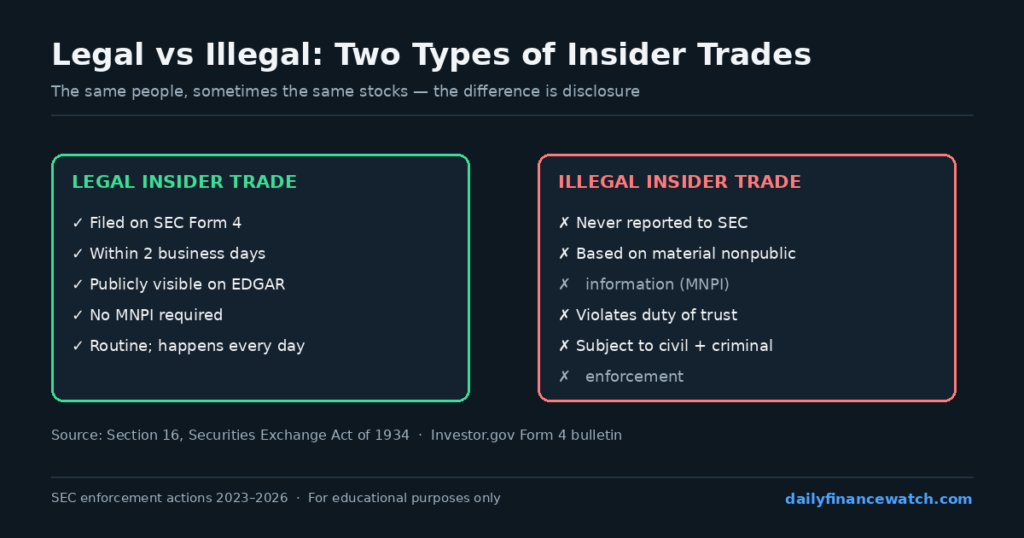
Disclosure is what separates legal insider trades from illegal ones.
An insider, under Section 16 of the Securities Exchange Act, includes corporate officers, directors, and anyone owning more than 10% of a company’s registered equity. These individuals buy and sell company stock routinely as part of compensation, diversification, or personal planning, however.
However, every such transaction requires a Form 4 filing with the SEC within two business days. The Investor.gov bulletin on Forms 3, 4, and 5 explains this requirement in detail. In other words, that public filing is exactly what separates a legal transaction from an illegal one.
The Form 4 Filing: Legal Insider Trades in the Open
Form 4 filings appear on the SEC’s EDGAR database within two business days. Consequently, anyone can see when a CEO buys 10,000 shares or when a director sells after a vesting event. The SEC enforces this timeline strictly. In September 2023, the SEC brought charges against six officers and directors for late Form 4 filings. Some filings arrived weeks, months, or even years after the deadline, per the SEC press release. Timely disclosure is the mechanism that keeps legal insider trading legal.
What Makes an Insider Trade Illegal
Illegal insider trading occurs when someone trades on material nonpublic information (MNPI) in violation of a duty of trust. The SEC enforces this under Section 10(b) of the Securities Exchange Act and Rule 10b-5. However, the duty element matters as much as the information itself.
Specifically, two legal theories define most cases.
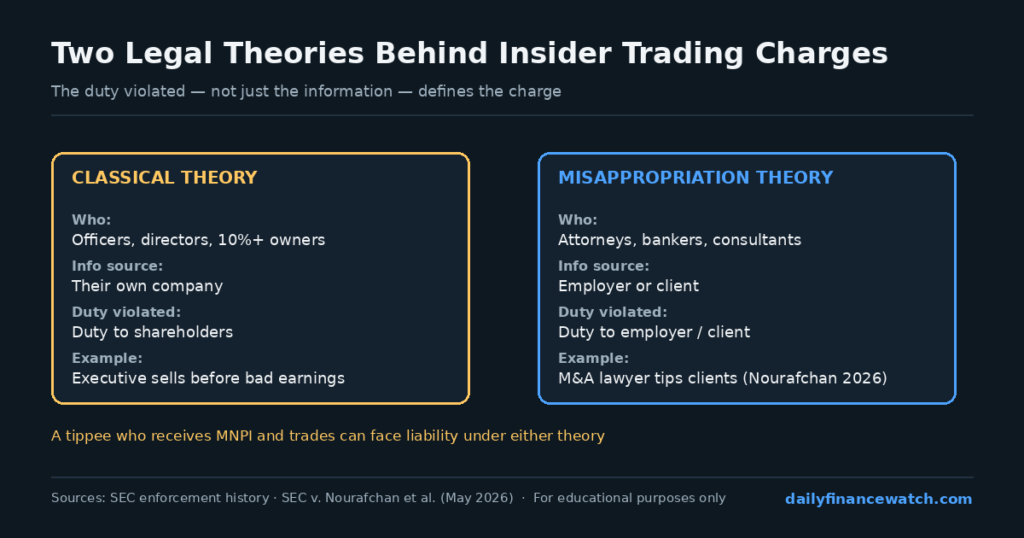
The duty, not just the information, determines whether a trade crosses the legal line.
Classical Theory vs Misappropriation Theory
The classical theory applies when a corporate insider trades their own company’s shares while holding MNPI.
For example, a pharmaceutical executive who sells shares before announcing a failed drug trial fits this category. In contrast, the misappropriation theory extends liability to outsiders who steal confidential information from a trusted source. In the 2026 Nourafchan case, an M&A attorney owed a duty of confidentiality to his law firm’s clients. Violating that duty to pass tips transformed a securities trade into a federal offense.
| Type | Who it covers | Information source | Duty violated |
|---|---|---|---|
| Classical theory | Officers, directors, 10%+ owners | Their own company | Duty to shareholders |
| Misappropriation | Attorneys, bankers, consultants | Employer or client | Duty to employer/client |
| Tipping liability | Recipients of tips (tippees) | Someone with MNPI | Duty of tipper extends to them |
Source: SEC investor guidance on insider trading; SEC enforcement history.
How the SEC Detects Violations
The SEC and FINRA run automated surveillance systems that flag unusual volume or price movement before major announcements. Specifically, algorithms monitor options activity, abnormal share purchases, and timing patterns relative to earnings releases, merger announcements, and regulatory decisions. According to the SEC’s FY2025 enforcement report, the agency filed 456 actions that year.
Insider trading charges appeared in cases involving a pharmaceutical VP, an international trading ring, and a former equity trading head — all flagged by pattern analysis.
The Tipping Chain: How Liability Spreads
Moreover, a person does not need to be a company insider to face insider trading liability. The SEC’s tipping doctrine holds that a MNPI recipient can face charges too. The key condition is that the recipient knew, or should have known, the information came from a breach of trust. In the Nourafchan scheme, traders received tips and kicked back a share of profits to the attorney. Consequently, that kickback structure became the evidence that recipients knew the information was confidential.
Most guides describe insider trading as “trading on secret information.” However, that framing is incomplete on two counts. First, it collapses legal and illegal insider trades into one bucket. The legal version fills an SEC database every business day.
Second, it omits the duty element. In reality, the legal boundary is not secrecy alone but the violation of a specific trust relationship. A hedge fund analyst who independently discovers the same fact an executive knows commits no crime. The key variable is how the information arrived, not just what it says.
What Legal Insider Trades Signal to Investors
Market observers watch Form 4 filings closely. Legal insider purchases represent a voluntary bet by someone with deep company knowledge. For instance, cluster buying — multiple insiders purchasing shares within a short window — can reflect confidence in a company’s trajectory.
However, insider sales carry less diagnostic weight, because executives sell for many personal reasons unrelated to company outlook. Furthermore, the bid-ask spread in thinly traded stocks means large insider transactions can move price even when fully disclosed. By contrast, undisclosed ones are crimes.
Common Misconceptions Beginners Carry
A common beginner assumption says that any trade by a company employee qualifies as illegal insider trading. In reality, an employee who buys shares without MNPI access, files Form 4 on time, and avoids blackout periods breaks no law. A separate assumption holds that insider trading only involves executives. Consequently, the SEC’s 2026 case against Nicolo Nourafchan and others — involving 21 charged individuals — shows that insider-trading liability can travel far beyond the original MNPI source.
Nevertheless, understanding insider trades requires holding two ideas at once. The same legal framework that criminalizes secret trading also creates a mandatory transparency system that anyone can access through EDGAR. Therefore, a disciplined investor uses that public data as one signal among many. The critical distinction is whether they disclosed it — in two business days, or in a federal courtroom.
Related articles:
Is it illegal for company executives to buy or sell their own stock?
No. Corporate officers, directors, and major shareholders buy and sell company stock legally as part of normal business life. The key requirements are filing Form 4 within two business days, avoiding blackout-period trades, and not using MNPI. In addition, the SEC’s EDGAR database publishes every Form 4, making these transactions fully transparent to the public.
What is material nonpublic information in insider trading?
Material information is any fact that a reasonable investor would consider important in deciding whether to trade. Nonpublic means it has not been released to the general investing public. Examples include pending merger announcements, unreleased earnings results, drug trial outcomes, and major contract wins or losses. The combination — material and nonpublic — sets the legal threshold, not either element alone.
How does the SEC catch insider traders?
The SEC and FINRA run automated surveillance systems that monitor trading patterns around corporate announcements. Unusual volume in options or shares before a merger, earnings release, or regulatory decision triggers review. The SEC also receives whistleblower tips, reviews Form 4 filings for timing anomalies, and coordinates with DOJ on criminal referrals. According to the SEC’s FY2025 report, 456 enforcement actions were filed that year, with insider trading cases among the priorities.
This content is for educational purposes only and is not personalized financial advice. Investing involves risk, including possible loss of principal.
© 2026 Daily Finance Watch. Excerpts under 50 words with attribution and a link back are permitted. Full-article reproduction requires written permission.