Last updated: July 2, 2026
An exchange-traded note and an exchange-traded fund share a ticker symbol. Both trade on the same exchanges and often track the same types of indexes. However, the similarity ends there. Most guides stop at that surface similarity. They explain the ETF vs ETN distinction as simply “a fund versus a note.”
In reality, ETN differences run deeper than structure.
However, ETN differences add a second risk layer — issuer credit risk — that exists independently of how the linked index performs. An ETF that tracks a commodity index loses value when the commodity falls. In contrast, an ETN tracking the same index can lose value even when the commodity rises, if the issuing bank’s creditworthiness deteriorates.
In reality, that distinction matters more than any discussion of trading mechanics.
Therefore, this guide covers what ETN differences mean structurally. It also examines why credit risk is the critical variable and where ETNs offer genuine advantages.
What Sets ETN Differences Apart From ETFs
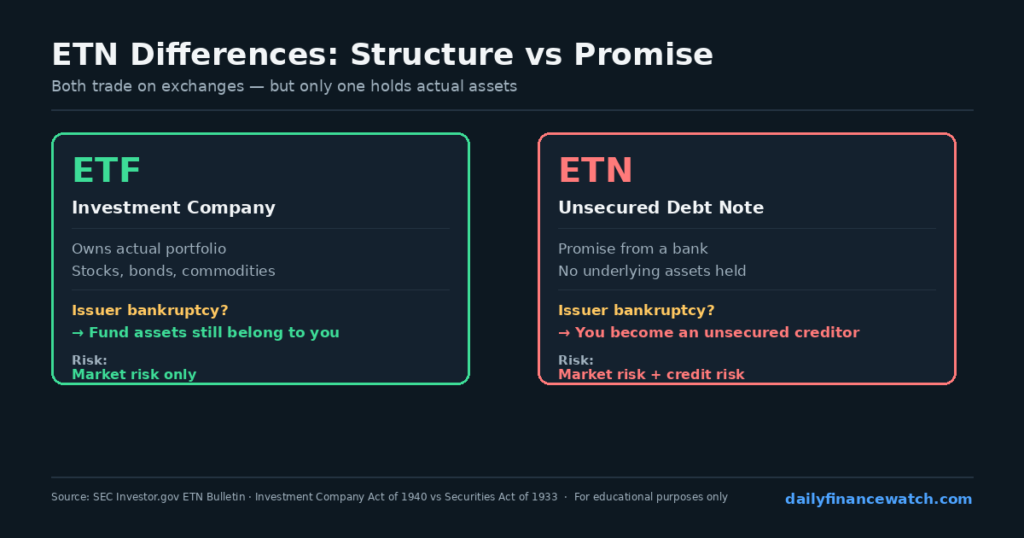
An ETF holds assets; an ETN holds a bank’s promise.
In contrast, an ETF is an investment company that owns a portfolio of securities. When investors buy ETF shares, they hold a proportional interest in that portfolio. Consequently, the fund’s assets stay protected even if the sponsor fails. Moreover, the fund’s assets sit in a legally separate structure, protected under the Investment Company Act of 1940.
Ownership vs Promise: The Core Structural Gap
An ETN works entirely differently. Instead of holding assets, the issuing bank makes a contractual promise. It agrees to pay investors a return linked to a specific index, minus fees.
According to the SEC’s Investor.gov ETN bulletin, ETNs are senior, unsecured debt obligations — the same category as an unsecured corporate bond. Investors own the note, not any underlying securities, commodities, or other assets. Moreover, ETNs register under the Securities Act of 1933, not the 1940 Act. That difference means they carry fewer investor protections than a fund.
| Feature | ETF | ETN |
|---|---|---|
| Legal structure | Investment company / trust | Unsecured debt instrument |
| Underlying assets held | Yes | No |
| Issuer credit risk | No | Yes |
| Tracking error | Small (present) | Zero (by contract) |
| Regulatory framework | Investment Company Act (1940) | Securities Act (1933) |
| Maturity date | No | Yes (typically 10–30 years) |
Source: Investor.gov ETN Investor Bulletin; Britannica Money; Charles Schwab ETN overview.
How ETN Differences Introduce Credit Risk
Market risk applies to both products. An ETF’s value falls when its holdings decline; an ETN’s linked return falls when its index falls. However, ETN differences introduce a second, entirely separate risk: the chance that the issuing bank cannot honor its promise.
This risk exists regardless of what the index does. Even if the index rises, a deteriorating issuer credit rating can push the ETN’s price below its fair value.
Furthermore, if the issuer defaults, investors become unsecured creditors — joining the long line of claimants in a bankruptcy proceeding.
The Lehman Opta ETNs: A 55.5% Loss From Credit, Not Markets
The most documented example of this risk involves Lehman Brothers. In February 2008, seven months before Lehman declared bankruptcy, the bank launched three Opta-brand ETNs.
Each tracked a commodity-related index under tickers RAW, EOH, and PPE.
According to ETF.com’s account of the bankruptcy proceedings, the three ETNs held just $13.5 million in combined assets at the time of Lehman’s September 15, 2008 filing. As a result, the subsequent creditor recovery process stretched over years. Over the following years, however, creditors recovered 44.5% of their total allowable claim. Holders sustained a 55.5% loss on investment — from credit failure, not index moves.
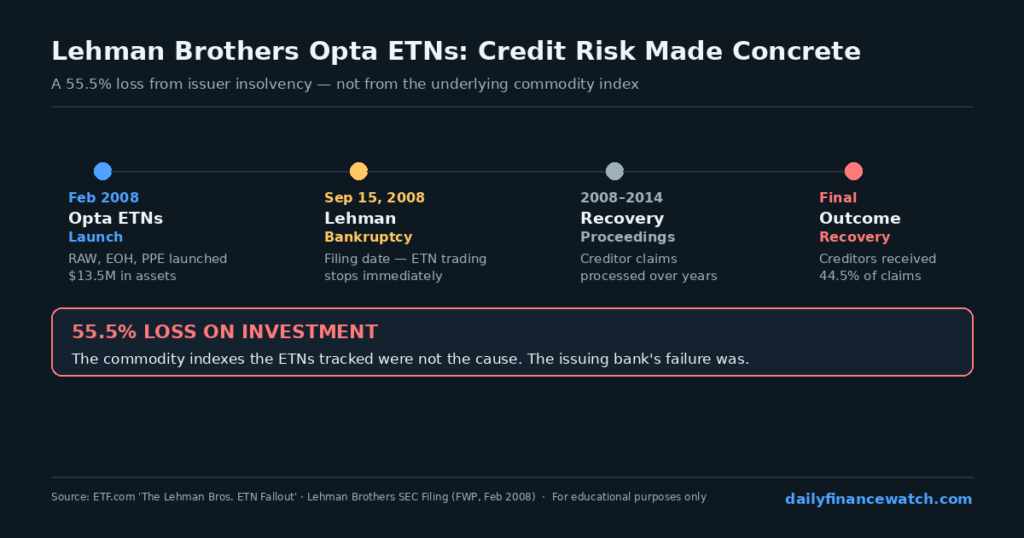
The index kept tracking. The issuer stopped paying. Those two facts are independent.
Importantly, Lehman carried stellar credit ratings from all three major agencies right up until its bankruptcy filing, per ETF.com. The Opta ETNs had shown an average premium to indicative value of just 0.28% before the collapse. Nevertheless, investors saw no obvious warning signal.
A common guide compares ETFs and ETNs purely on tax treatment or trading mechanics and concludes they are largely interchangeable. That comparison is incomplete on one critical count.
In particular, it ignores the fact that ETN holders are creditors of the issuing institution, not shareholders of an independent asset pool. An ETF sponsor going bankrupt leaves the fund’s assets intact. An ETN issuer going bankrupt leaves holders as unsecured creditors. The Opta case demonstrated that different outcome over several recovery years.
Where ETNs Have Advantages Over ETFs
Knowing the risks of ETN differences does not settle the question of whether to use them. These products exist because they offer real advantages in specific situations. The first advantage is tracking precision. Because the issuer promises to deliver exactly the index return minus fees, an ETN carries zero tracking error by contract. In contrast, an ETF experiences small deviations from its index due to transaction costs, sampling, and reinvestment timing.
Zero Tracking Error and Niche Exposures
In addition, the second advantage is access. Certain market exposures — commodity futures strategies, volatility indexes, and some currency plays — are difficult or tax-inefficient to replicate inside a fund. An ETN can offer precise exposure to these strategies, with the issuer absorbing the operational complexity. As a result, some niche investment strategies appear only in ETN form, with no equivalent ETF available. For investors who need that specific exposure and understand the credit risk, an ETN may be the only practical vehicle.
Both products trade on exchanges, offer intraday liquidity, and carry expense ratios, however. For instance, evaluating an index fund or a standard ETF requires analyzing the underlying holdings. Evaluating an ETN also requires analyzing the financial health of the bank that issued it.
Reading an ETN Before Buying
Therefore, before purchasing an ETN, the prospectus is the essential document.
Every ETN must file a prospectus under the Securities Act of 1933. Each prospectus must disclose the issuer’s credit rating, the tracked index, the fee structure, the maturity date, and the termination conditions. According to Investor.gov, reading the prospectus is the primary due diligence step for ETN investors — specifically because of the credit risk that does not apply to ETFs.
Misconceptions About ETN and ETF Differences
A common assumption treats the low expense ratios and exchange-listed trading of ETNs as proof they are safe ETF substitutes.
In reality, the expense ratio reflects only the issuer’s fee — not the credit risk embedded in the structure. Furthermore, a high credit rating at purchase, as Lehman’s example showed, does not guarantee the rating holds for the note’s full term. Holding an ETN to maturity means extending credit to the issuer for years or decades, not just for a trading session.
Understanding ETN differences requires one additional mental step: treating the issuing bank as a counterparty, not just a fund manager. The index exposure may be identical on paper. The legal claim on the underlying value is entirely different. One product owns assets. The other owns a promise. That difference becomes visible only when a bank cannot keep its word.
Related articles:
What is the main difference between an ETF and an ETN?
An ETF holds an actual portfolio of assets — stocks, bonds, or commodities. Shareholders own a proportional interest in those assets, protected by law even if the fund sponsor fails. An ETN is an unsecured debt note issued by a bank, promising to pay an index-linked return. ETN holders are creditors, not asset owners. Consequently, ETN differences include an additional credit risk that does not exist in a standard ETF.
Can an ETN go to zero if the issuer defaults?
Yes, in theory. If an ETN issuer declares bankruptcy, holders become unsecured creditors and may recover far less than their original investment — or nothing at all. In the Lehman Brothers Opta ETN case in 2008, creditors ultimately recovered 44.5% of their claim after years of bankruptcy proceedings, sustaining a 55.5% loss. The loss came from issuer insolvency, not from the underlying index’s performance.
Why would anyone choose an ETN over an ETF?
Two main reasons. First, ETNs carry zero tracking error by contract because the issuer promises to deliver exactly the index return minus fees. Second, some niche exposures — certain commodity strategies, volatility indexes, or currency approaches — are not available in an ETF structure. For investors who specifically need those strategies and understand the added credit risk, an ETN may be the only practical option. The tradeoff is accepting counterparty risk in exchange for precise index exposure.
This content is for educational purposes only and is not personalized financial advice. Investing involves risk, including possible loss of principal.
© 2026 Daily Finance Watch. Excerpts under 50 words with attribution and a link back are permitted. Full-article reproduction requires written permission.