Last updated: July 2, 2026
A 3× leveraged ETF should return three times the index. Over a single day, it does exactly that. Hold it for a year of choppy markets, however, and the math quietly works against you even when your directional bet was correct. These products target a daily multiple, not a long-term one, and the daily reset creates a structural drag on returns that most headlines skip. Volatility is not just a risk that might hurt you. It is a mechanism that does hurt you, reliably, through a process called volatility decay.
In reality, most guides to leveraged ETFs treat the decay as a footnote. In reality, it is the central feature. Therefore, this article covers what the daily reset means mathematically, when decay accelerates, and what the 2022 real-world data showed about the gap between what a 3× fund promises daily and what it delivers over time.
How Leveraged ETFs Work and Where Decay Begins
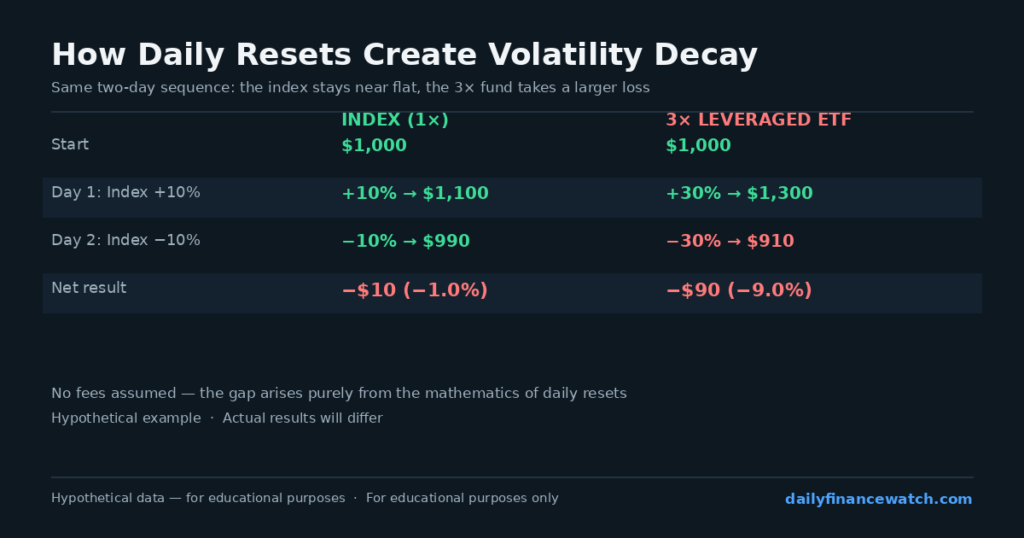
Each day’s gain starts from a new base — asymmetry that compounds quietly.
A leveraged ETF uses derivatives — typically swaps and futures — to achieve a daily multiple of its target index. Consequently, each trading day the fund resets to its leverage ratio. Over a single day, this mechanism delivers the advertised multiple cleanly.
The Math of a Down-then-Up Sequence
However, the problem emerges the moment the fund experiences a loss followed by a gain.
For instance, suppose an index rises 10% on Day 1, then falls 10% on Day 2. The index ends at 99 — a 1% loss.
A 3× leveraged ETF moves 30% up on Day 1, then 30% down on Day 2. It ends at 91 — a 9% loss. As a result, the same two-day sequence produced a 9% loss in the leveraged fund and only a 1% loss in the index. Specifically, this difference arises from the arithmetic of daily resets — no fees, no expenses.
In reality, this gap widens with each volatile swing. Moreover, the fund does not even need to fall to cause decay. Furthermore, even a series of small alternating gains and losses in a flat market gradually erodes the leveraged fund’s value, while the unleveraged index ends near where it started.
Why Direction Is Not Enough
A common beginner assumption about these funds runs like this: “if the index goes up over the year, a 3× fund should go up roughly 3 times as much.” At first glance, that framing holds for a single day. However, it breaks down in any year where volatility is meaningful. That describes most years. The daily reset means the effective leverage ratio drifts continuously.
When the market falls, the fund’s asset base shrinks. The next day’s 3× exposure then applies to a smaller starting number. Furthermore, recovering from a large loss requires a proportionally larger gain than the loss itself.
Why Large Drawdowns Compound the Problem
In practice, the recovery math after a severe drawdown is striking.
A fund that falls 50% needs a 100% gain to recover. A fund that falls 75% needs a 300% gain. These are not hypothetical edge cases, however. In volatile years, these funds can produce drawdowns that make recovery extremely difficult, even if the underlying index itself recovers to its original level. Consequently, the path the index takes matters as much as its starting and ending value.
The 2022 Record: Real Numbers Behind the Decay
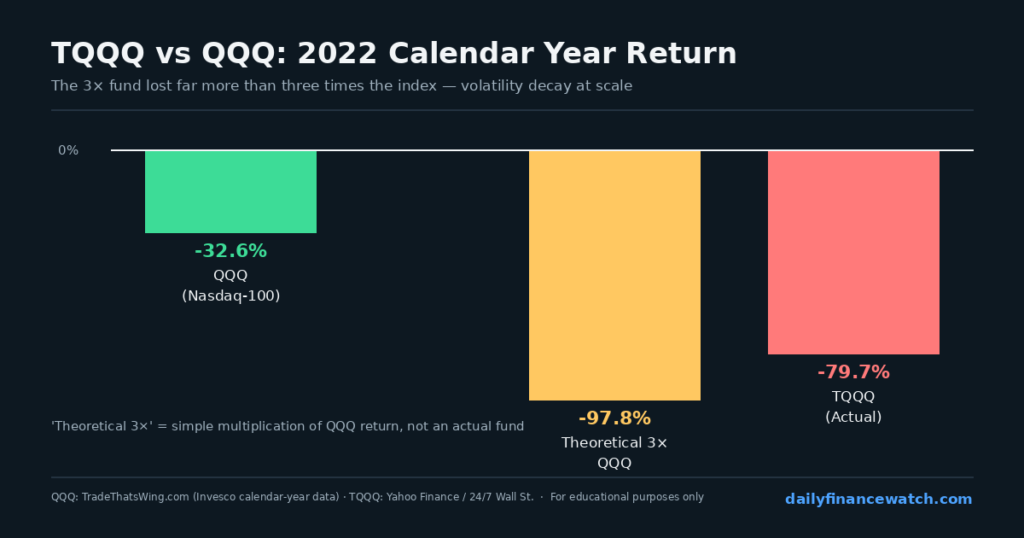
Index down one-third in 2022 — the 3× fund lost far more.
For instance, in 2022 the Nasdaq-100 declined 32.6%, measured by QQQ’s annual total return, per TradeThatsSwing.com’s compilation of Invesco calendar-year data. A true 3× multiple of that loss would equal roughly 97.8%. ProShares UltraPro QQQ (TQQQ), the 3× Nasdaq-100 fund, fell 79.67% that calendar year, going from $40.82 on January 3, 2022 to $8.30 on December 30, 2022, according to data from 24/7 Wall St. sourced from Yahoo Finance.
| Year | QQQ (Nasdaq-100) | TQQQ (3×) | Theoretical 3× QQQ |
|---|---|---|---|
| 2022 | −32.6% | −79.67% | ~−97.8% |
| 2023 | +56.4% | +198.3% | ~+169% |
| 2024 | +25.7% | +34.4% | ~+77% |
Sources: QQQ annual returns per TradeThatsSwing.com (Invesco calendar-year NAV data); TQQQ returns per ycharts.com / 24/7 Wall St. / Yahoo Finance. “Theoretical 3×” is a simple multiplication, not an actual fund return — it illustrates the compounding gap. All figures are total return including dividends.
Now run those 2022 numbers with real dollars. An investor who put $10,000 into TQQQ at the start of 2022 ended the year with $2,033. The same $10,000 in QQQ ended at $6,740. Moreover, recovering from a 79.67% loss requires a gain of approximately 391% to return to the starting point.
When Decay Reverses: The 2023 Case
Specifically, the 2022–2023 comparison illustrates volatility decay’s asymmetric character. In 2023, QQQ gained 56.4% and TQQQ gained 198.3% — far exceeding the theoretical 3× multiplier. In reality, this happens in strongly trending markets with low intraday volatility. As a result, volatility decay is path-dependent, amplified by the kind of environment the market is in.
What Leveraged ETFs Are Actually Designed For
ProShares labels TQQQ’s objective as “daily investment results.” The fund’s own prospectus discloses that returns over periods longer than one day may differ significantly from 3× the index’s return. This is not a defect — it is the product’s design.
These funds serve traders who want amplified short-term directional exposure for a single session or a few days, not long-term buy-and-hold investors. Specifically, this distinction matters because most discussions of ETF investing focus on buy-and-hold behavior. That is the opposite use case these products target.
What the SEC and FINRA Say About Holding Period
The FINRA investor alert on leveraged and inverse products states directly that these products are “complex financial instruments that are generally designed to be used only for short-term trading.” In particular, the alert emphasizes that performance over periods longer than one day can differ substantially from the stated multiple.
A common rule of thumb says: do not hold a leveraged ETF longer than a day. For most retail investors, that advice is accurate. However, it misses the deeper lesson.
The decay rate depends on the specific volatility environment. In low-volatility bull trends, for instance, long holding periods have historically worked well. In contrast, in high-volatility or sideways markets, even holding for a few weeks can produce meaningful decay.
Understanding leveraged ETFs requires separating two questions. First: what daily leverage does the fund deliver? The answer is precisely the stated multiple. Second: what annual return does it deliver? That depends on the path, not just the direction.
However, most beginners collapse those two questions into one. Consequently, keeping them separate reveals the mechanism clearly. In particular, it explains why a fund targeting 3× daily returns lost more than 79% in a year when the index fell by 32%.
Related articles:
Why does a 3× leveraged ETF sometimes lose more than three times the index?
Because the fund targets 3× the daily return, not the annual return. In a year with high volatility, each down day shrinks the asset base, and each subsequent gain applies to a smaller number. This daily-reset mathematics produces losses that can exceed the simple 3× multiple. In 2022, QQQ fell 32.6% while TQQQ fell 79.67% — far more than three times 32.6%.
Can you hold a leveraged ETF long term?
It depends on the market environment. In strongly trending, low-volatility periods, leveraged ETFs have historically outperformed their theoretical multiplier. In choppy or volatile markets, decay erodes returns substantially. The fund’s daily objective means that long-term outcomes are path-dependent, not simply direction-dependent. Neither unconditional holding nor unconditional avoidance reflects the actual mechanism.
What is volatility decay in leveraged ETFs?
Volatility decay, also called beta slippage, is the erosion of a leveraged fund’s returns caused by daily-reset mathematics. When an index alternates between gains and losses, the leveraged fund loses value faster than the index because each percentage change applies to a different base. Even if the index ends flat over a week, the leveraged fund can show a meaningful loss purely from the sequence of daily moves.
This content is for educational purposes only and is not personalized financial advice. Investing involves risk, including possible loss of principal.
© 2026 Daily Finance Watch. Excerpts under 50 words with attribution and a link back are permitted. Full-article reproduction requires written permission.