Last updated: July 2, 2026
For example, consider owning 100 shares of a company that has 1,000 shares outstanding — a 10% stake. Issue 1,000 new shares, and that same holding becomes a 5% stake. In all cases, share dilution is the mechanism at work: the total ownership pie expands, and each existing slice gets proportionally smaller. However, the size of your slice is not the only thing that changes. The value also depends on what the company did with the money it raised.
Most guides, however, treat share dilution as purely harmful. In reality, the reason behind each issuance determines the outcome almost entirely. Therefore, this article covers how dilution works mathematically and the three main ways it appears. It also explains how to distinguish distress-driven issuances from growth-financing ones.
What Share Dilution Does to Ownership

The pie grows, but your slice of it shrinks proportionally.
In fact, dilution reduces every existing shareholder’s ownership percentage whenever a company increases its total share count. However, the mechanism is identical regardless of why the new shares exist. Consequently, both a struggling company selling stock to pay bills and a thriving one funding an acquisition trigger dilution for current holders. The difference lies in what happens to company value — and therefore per-share value — afterward.
The Ownership Math Behind New Shares
Consider a concrete example. A company has 1 million shares outstanding, trading at $10 each — a $10 million market cap. It issues 250,000 new shares at $10, raising $2.5 million. Total shares become 1.25 million. An investor who previously held 100,000 shares owned 10% of the company. After the issuance, those same shares represent 8% ownership. However, if the $2.5 million generates returns that expand company value, the per-share price may rise even as the ownership percentage falls.
Three Ways New Shares Enter the Market
Three channels, three different signals about why the share count is rising.
Share dilution does not occur only through direct stock sales. Three mechanisms account for most dilution investors encounter. The first is secondary offerings. A company issues new shares directly to the public, raising cash for expansion, debt reduction, or operating needs.
Second is stock-based compensation, where a company grants stock options or restricted stock units (RSUs) to employees. As those options vest and employees convert them to shares, the share count rises gradually. The third is convertible securities: bonds or preferred shares that holders can convert into common stock. These increase share count without a new public offering.
Stock-Based Compensation: The Quiet Diluter
Companies report earnings per share on two bases. Basic uses only currently outstanding shares; diluted adds all shares that would exist if every option, warrant, and convertible exercised today.
The gap between basic and diluted EPS reveals the potential dilution already embedded in the company’s compensation structure. According to the SEC’s earnings-per-share guidance, companies must disclose diluted EPS to help investors see this full picture. Consequently, a company where diluted EPS runs meaningfully below basic EPS carries more latent dilution than the headline share count suggests.
AMC 2020–2021: When the Price of Survival Was Dilution
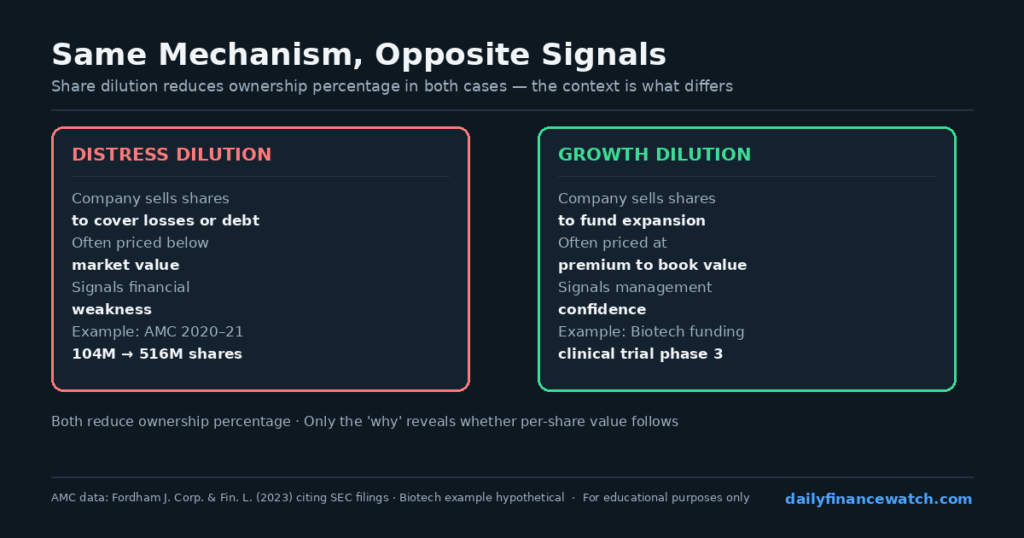
Not all share dilution, however, sends the same signal.
AMC Entertainment’s experience from 2020 to 2021 provides one of the most extensively documented examples in recent market history.
According to a 2023 Fordham Journal of Corporate and Financial Law article citing SEC filings, AMC had approximately 104 million shares outstanding in June 2020. By the end of 2021, that count stood at approximately 516 million.
The expansion of roughly 5× in 18 months funded the company’s survival through the pandemic shutdown. AMC used the elevated meme-stock price to raise capital and extend its financial runway.
AMC: Using Equity to Avoid Bankruptcy
For AMC, the share issuance prevented a near-term bankruptcy. However, it came directly at the expense of existing shareholders’ per-unit value.
The total shares at Q1 2020 averaged 104,245 thousand, as reported in AMC’s SEC 10-Q for the quarter ended March 31, 2021. By Q2 2021, average basic shares had consequently reached 480,731 thousand, per the SEC 10-Q for the quarter ended June 30, 2021. In this context, the dilution represented emergency capital — necessary for survival, though not a signal of business strength.
By contrast, consider a company that issues 10% additional shares at a significant premium. It uses proceeds to acquire a business that immediately adds to earnings per share. That dilution also reduces ownership percentage. However, the acquired earnings can grow the numerator faster than the new shares grow the denominator of the EPS calculation. Consequently, two companies can both report dilution and reach opposite outcomes for existing shareholders.
How to Evaluate Share Dilution in Practice
In practice, evaluating any dilution event requires asking two questions before judging. First: why did the company issue new shares? For instance, a secondary offering to fund an acquisition differs from one to make payroll. Second: at what price relative to book value and earnings power? By contrast, issuing at a premium suggests management confidence and strong investor demand.
Common Misconceptions About Dilution
At first glance, a common assumption treats dilution as automatically harmful to existing shareholders. In reality, dilution reduces the ownership percentage but does not automatically reduce the dollar value of a position.
Growth-stage technology and biotech companies routinely issue shares to fund research or expansion. Consequently, disciplined investors analyze whether the capital raised generates returns that exceed the dilution cost. Furthermore, the SEC investor guidance directs investors to compare diluted EPS across periods. This reveals whether earnings per share grew despite a rising share count. The signal depends on why and at what price the company issued them, not on dilution alone.
The practical lesson is to hold both questions simultaneously. When a company reports rising revenue and earnings alongside moderate dilution, the expansion may be the cost of growth. When a company reports falling revenue, mounting losses, and accelerating dilution, the expansion may dilute not just ownership but value. AMC’s 5× expansion in 18 months represented the second pattern, specifically. In turn, knowing which pattern applies turns share dilution from a scary headline into a solvable analysis question.
Related articles:
Does share dilution always hurt existing shareholders?
Not always. Dilution reduces ownership percentage in every case, but it does not automatically reduce per-share value. When a company issues shares at a premium and generates earnings that outpace the share increase, existing holders can see their diluted EPS rise even as their ownership percentage falls. The signal depends on why and at what price the company issued them, not on dilution alone.
What is the difference between basic and diluted shares outstanding?
Basic shares count only shares currently issued and trading. Diluted shares add all potential shares from outstanding options, warrants, and convertibles — on the assumption that every holder converts today. The gap between the two shows the latent dilution already embedded in the company’s compensation and debt structure. A large gap means more dilution could arrive without any new financing announcement.
How do investors track ongoing share dilution?
The easiest method uses the share count disclosed on each quarterly 10-Q and annual 10-K, available free on the SEC’s EDGAR database. Comparing basic and diluted shares outstanding across multiple quarters reveals whether the count trends up or down. Specifically, a rising count alongside declining EPS often signals value-destructive dilution. A rising count alongside rising EPS suggests the dilution is funding growth that more than offsets the expanded denominator.
This content is for educational purposes only and is not personalized financial advice. Investing involves risk, including possible loss of principal.
© 2026 Daily Finance Watch. Excerpts under 50 words with attribution and a link back are permitted. Full-article reproduction requires written permission.