Last updated: July 3, 2026
A stock buyback carries a simple reputation: the company reduces share count, earnings per share rise, and existing shareholders benefit. However, that rule of thumb breaks down in a specific and measurable condition. When a company repurchases shares at a price above intrinsic value, the buyback boosts EPS. However, it simultaneously transfers wealth from long-term holders to the sellers who exit. The mechanism is real. However, the benefit is not guaranteed — it depends on the price paid relative to what the business is worth.
Therefore, this article covers how a stock buyback works mechanically and why the EPS math alone does not determine shareholder benefit. It also explains what Apple’s $110 billion 2024 authorization illustrates about reading buyback announcements.
What a Stock Buyback Actually Does
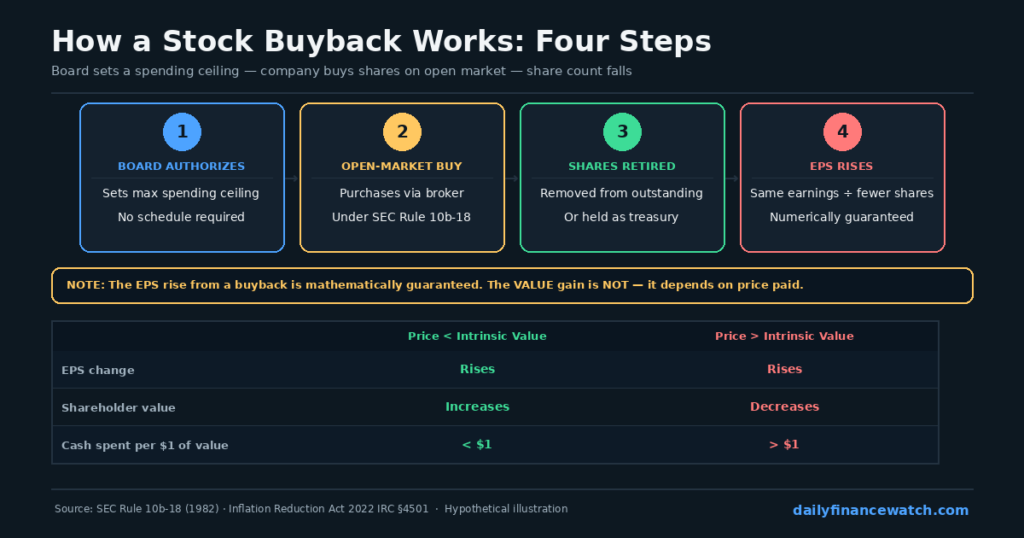
Buyback mechanics are simple — value impact depends entirely on the price paid.
In practice, a stock buyback begins when a company’s board of directors authorizes a repurchase program.
The authorization sets a ceiling — a maximum dollar amount the company may spend. Specifically, it does not obligate the company to execute the full amount. No schedule governs when purchases must occur. The company then purchases its own shares on the open market. The acquired shares are either retired or held as treasury stock. Consequently, the total shares outstanding falls.
The Open-Market Method and SEC Rule 10b-18
Most repurchase programs use the open-market method, regulated by SEC Rule 10b-18. The SEC adopted Rule 10b-18 in 1982 to provide a voluntary safe harbor from market manipulation charges. It applies when companies repurchase their own common stock.
In practice, the rule sets four conditions: one broker per day; purchases only after the opening trade; price at or below the higher of the best independent bid or last transaction price; and volume capped at 25% of the average daily trading volume over the prior four weeks.
A company that follows all four conditions receives the safe harbor. However, one that violates any single condition loses it for that entire trading day.
How EPS Changes When Share Count Falls
In practice, the arithmetic of earnings per share is straightforward. A company earning $10 billion with 1 billion shares outstanding reports $10.00 EPS. Furthermore, if that same company repurchases 100 million shares, the outstanding count drops to 900 million. The same $10 billion in earnings now produces $11.11 EPS. Specifically, only the denominator changed.
The Price Problem in Buyback Decisions
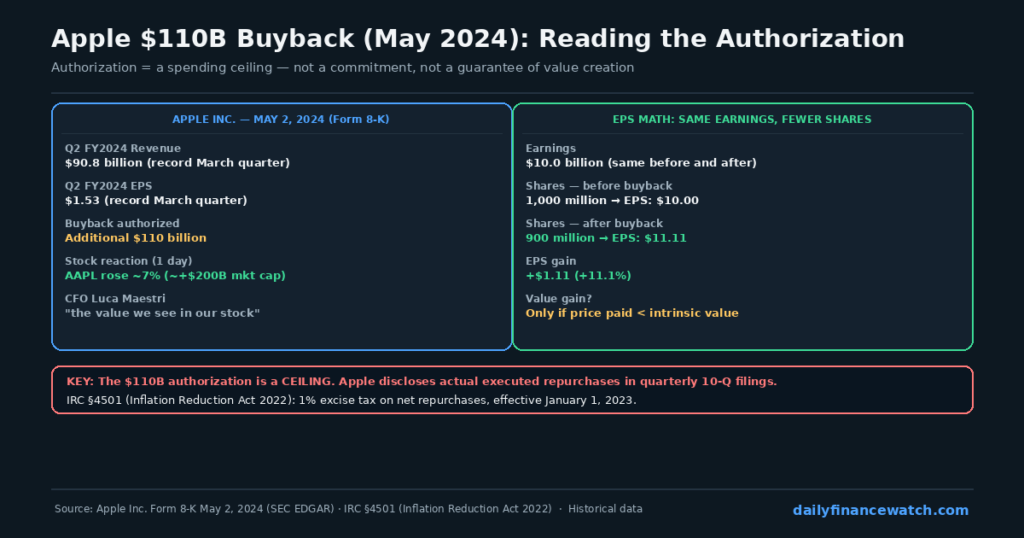
Same EPS gain, opposite wealth outcomes — price paid is the deciding variable.
In contrast, the market price a company pays for its own shares determines whether the transaction transfers value toward or away from remaining holders.
Consider a company whose shares are worth $100 in intrinsic value but currently trade at $130. A buyback at $130 spends $130 of the company’s cash to retire a claim worth $100. The $30 difference flows to the selling shareholders, not to the remaining ones. Consequently, the company and its long-term investors are poorer by $30 per share repurchased. In each case, EPS still improves regardless.
A common piece of guidance frames buyback announcements as straightforwardly positive signals — a company buying its own stock must believe the shares are undervalued, so investors should follow.
In reality, companies buy back stock for many reasons beyond intrinsic value conviction. These include offsetting dilution from stock options, meeting EPS targets tied to executive compensation, or deploying cash when no superior investment exists. In other words, an authorization announcement tells investors that the board has approved a program. It does not disclose the price criteria management will apply when executing. Consequently, the EPS improvement that follows may reflect genuine value creation or may simply reflect math with a smaller denominator.
Apple’s May 2024 Authorization: The Numbers
Specifically, Apple’s May 2, 2024 buyback announcement illustrates how to read a repurchase authorization in context.
Apple’s Board of Directors authorized an additional $110 billion for share repurchases. This coincided with fiscal Q2 2024 results: revenue of $90.8 billion and diluted EPS of $1.53, a record for the March quarter. According to Apple’s Form 8-K filed with the SEC EDGAR, CFO Luca Maestri cited the Board’s “confidence in Apple’s future and the value we see in our stock.” Consequently, the announcement was the largest single repurchase authorization in U.S. corporate history.
What the $110 Billion Figure Means in Practice
Following the announcement, AAPL shares rose approximately 7%. That added roughly $200 billion in market capitalization — nearly double the authorization’s face value.
In other words, the market’s reaction exceeded the authorization’s dollar amount. However, the $110 billion figure is a ceiling — not a commitment to spend.
Apple discloses actual quarterly repurchase activity in its 10-Q filings, including the average price paid and shares repurchased each month.
Furthermore, the Inflation Reduction Act of 2022 added IRC Section 4501, imposing a 1% excise tax on net stock repurchases by publicly traded U.S. corporations, effective January 1, 2023. A company repurchasing $110 billion while issuing $10 billion owes the tax on the net $100 billion. Consequently, that cost reduces the program’s effective return.
What Investors Should Know Before a Buyback Announcement
Investors can track buyback programs through two disclosure points. First, the initial authorization typically appears in a Form 8-K filed the same day as quarterly earnings. Notably, the 8-K discloses the authorized ceiling and the program’s expiration date. Second, actual execution appears in the 10-Q and 10-K filings. These report the number of shares repurchased each month and the average price paid per share.
Tracking SEC filings for both disclosures gives investors a clearer picture than the press release alone.
Reading the Form 8-K for Repurchase Details
In practice, a Form 8-K announcing a buyback program says nothing about when or at what price the company will execute.
Consequently, the gap between authorization and execution is the most important metric investors rarely track. A company with a $50 billion authorization executing $5 billion per quarter takes two and a half years to deploy the full ceiling. Furthermore, debt-financed buybacks introduce leverage risk that authorization announcements rarely highlight. In turn, investors who read only the announcement headline miss the execution data that determines whether the buyback benefited remaining shareholders.
In other words, understanding how a stock buyback works — the safe-harbor mechanics, the EPS arithmetic, and the price-paid variable — shifts the analytical frame. The question is not “is this company buying back stock?” but “is this company buying back stock below intrinsic value?” The first produces a headline. The second produces a judgment.
Related articles:
What is a stock buyback and how does it work?
A stock buyback occurs when a company purchases its own shares on the open market, reducing the total number of shares outstanding.
The board authorizes a maximum spending ceiling. Management executes purchases under SEC Rule 10b-18, which sets conditions on price, timing, volume, and broker usage. Repurchased shares are retired or held as treasury stock. The resulting reduction in share count increases earnings per share, since the same earnings are divided among fewer shares.
Do stock buybacks always benefit shareholders?
Not necessarily. A stock buyback benefits remaining shareholders when the company repurchases shares at a price below intrinsic value — returning more value than the cash spent represents. However, when a company buys back shares at a price above intrinsic value, it transfers the difference to the shareholders who sell, not to those who hold. The earnings-per-share figure rises in either scenario, because fewer shares divide the same earnings. EPS improvement and shareholder value creation are not the same outcome.
How are stock buybacks taxed?
Shareholders who sell into a buyback recognize a capital gain or loss, taxed at the applicable capital gains rate.
For the corporation, the Inflation Reduction Act of 2022 added IRC Section 4501. This imposes a 1% excise tax on the net fair market value of stock repurchases by publicly traded U.S. corporations, effective January 1, 2023. Net repurchases equal total shares repurchased minus shares issued in the same year. A $1 million de minimis threshold applies below which the excise tax does not trigger.
This content is for educational purposes only and is not personalized financial advice. Investing involves risk, including possible loss of principal.
© 2026 Daily Finance Watch. Excerpts under 50 words with attribution and a link back are permitted. Full-article reproduction requires written permission.