Last updated: July 2, 2026
Imagine a mutual fund brochure that lists the firm’s top performers over the last decade. It shows ten funds with impressive returns, for example, and nothing else. What it does not show is the seven funds the firm launched at the same time. Those funds were quietly merged or closed because they performed poorly.
This investing bias — survivorship bias — is the systematic error that results from analyzing only survivors while ignoring the ones that failed. In reality, it functions as a hidden upward adjustment baked into nearly every published fund track record, textbook return figure, and investment advertisement. Therefore, this article covers what the bias is and where it concentrates. It also shows what survivorship-adjusted data reveals.
What Survivorship Bias Does to Investing Data
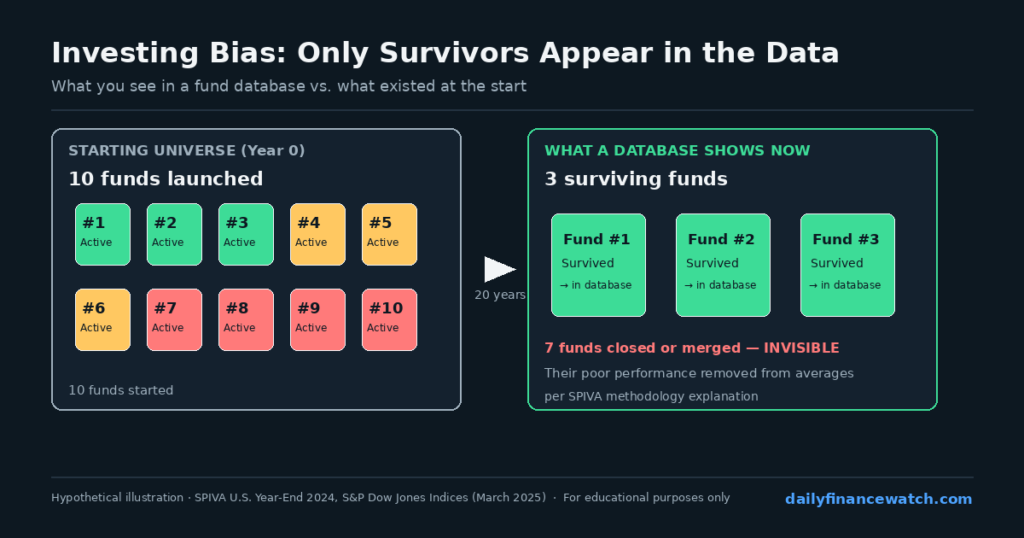
The visible scoreboard shows only the teams still playing — not everyone who started.
When a fund underperforms its benchmark long enough, the company typically merges it into a better-performing fund or liquidates it.
Investors who then look up the firm’s average returns see only surviving funds. By definition, those funds performed well enough to still exist. Consequently, the average looks better than the experience of an investor who chose randomly fifteen years ago.
The Graveyard No One Talks About
According to the SPIVA U.S. Year-End 2024 scorecard, published March 4, 2025, by S&P Dow Jones Indices, nearly 64% of domestic stock funds were shuttered or folded into other portfolios over the 20-year period ending December 2024.
These are not obscure micro-funds — they represent the majority of the starting universe. An investor who picked a domestic stock fund in 2004 faced better-than-even odds of holding a fund that no longer exists. However, the advertised track record at the time of purchase offered no protection.
How Investing Bias Inflates Reported Returns
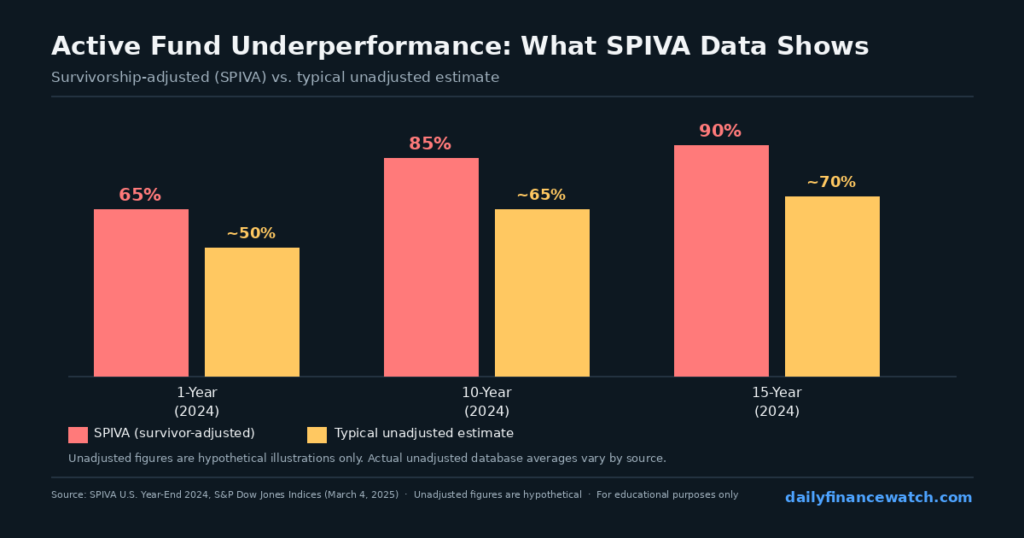
Reported averages and survivor-corrected averages start from different populations.
Survivorship bias inflates reported returns through a simple mechanism. Databases that exclude closed or merged funds count only winners. Any average return calculated from survivors overstates what a randomly chosen investor from the starting pool would have achieved. In categories with high turnover, the inflation runs highest, specifically.
The SPIVA Correction: Adding Back the Dead
SPIVA corrects for this investing bias by using the CRSP Survivor-Bias-Free U.S. Mutual Fund Database, which includes funds that merged or liquidated during every measurement period.
According to SPIVA’s Year-End 2024 data, specifically, 65% of active large-cap U.S. equity funds underperformed the S&P 500 in 2024 alone — worse than the 24-year annual average of 64%. Moreover, over the 15-year period ending December 2024, zero of 22 U.S. equity fund categories showed majority outperformance.
These figures include every fund that existed at the start of the measurement window, whether or not it survived.
| Measurement period | Active large-cap funds underperforming S&P 500 | Fund survival context |
|---|---|---|
| 1-year (2024) | 65% | Survivorship-adjusted; included all starting-period funds |
| 15-year (through 2024) | Majority underperformed in all 22 categories | No category showed majority outperformance |
| 20-year (through 2024) | ~64% of domestic stock funds closed or merged | Most starting funds no longer exist |
Source: SPIVA U.S. Year-End 2024, S&P Dow Jones Indices (published March 4, 2025). IFA.com citing S&P SPIVA methodology.
Where Survivorship Bias Shows Up in Practice
This investing bias appears in more places than most investors realize — but the same distortion runs much wider. For instance, mutual fund databases are the most visible example. However, the same mechanism affects newsletter performance records, hedge fund return averages, stock screener results, and historical stock index data.
Mutual Fund Track Records and the Missing Funds
When a fund company advertises ‘our funds have averaged X% over 10 years,’ it almost certainly reports that figure using only existing funds. In particular, this is not necessarily deceptive — it reflects what current customers would have experienced. However, it excludes former customers who held funds now merged or closed. Furthermore, the funds a firm closes tend to be its worst performers. By removing them, the reported average drifts upward compared to any investor who chose randomly at the beginning of the period.
A common guide describes this investing bias as a reason why past performance disclaimers exist. That framing understates the issue. The more precise problem is that most investors can’t access the pre-survivorship data. It no longer exists in mainstream form. However, SPIVA exists precisely to fill that gap.
Standard databases typically do not attempt to rebuild the starting universe; they simply report whatever remains. As a result, the benchmark most retail investors use to judge a fund is already tilted in the fund’s favor before the comparison begins.
How to Adjust for Investing Bias When Reading Performance
The most reliable protection is using survivorship-adjusted data sources like SPIVA rather than standard fund databases that only track existing funds. In practice, investors cannot completely remove survivorship bias from everyday reading without access to survivor-bias-free databases. However, they can apply practical adjustments when evaluating any performance claim.
First, look at the time horizon and ask how many funds the firm managed at the start of that window. If the firm offers fewer funds now than at the start, ask what happened to the ones no longer listed.
Second, compare the fund’s performance to an index fund rather than to the firm’s other active funds. Peer-relative comparisons magnify the bias because underperforming peers disappear, making relative rankings look better than they should.
Common Misconceptions About Fund Performance
A common assumption says that checking a fund’s long-term track record protects against this bias, since the fund clearly survived.
However, a long survivor is not necessarily a consistent outperformer. It may have survived simply because it had average performance, enough to avoid closure. In reality, survivorship confirms only survival, not quality. Furthermore, top-quartile performance rankings suffer from the same distortion. For example, a fund that ranks in the top 25% of its category today competes only against peers that survived. Many of the original competitors already disappeared. Therefore, the ranking system measures performance relative to a narrowing field.
The better question shifts from ‘what did this fund return?’ to ‘what would a randomly selected fund from this category have returned, including the ones that no longer exist?’ SPIVA’s answer to that second question — which is the more honest one — shows that over 15 years, no equity category clears the bar of majority outperformance. Funds investors see are the survivors. Ones they never see tell the other half of the story.
Related articles:
What is survivorship bias in investing?
Survivorship bias occurs when only successful funds, strategies, or stocks remain in a dataset. The failed ones disappear through closure, merger, or delistment. According to SPIVA Year-End 2024 data, nearly 64% of domestic stock funds were shuttered or merged over the prior 20 years. A database of current funds therefore excludes the majority of what once existed.
Does survivorship bias affect index funds the same way it affects active funds?
Survivorship bias affects active fund performance comparisons more directly than it affects index funds themselves. Index funds track a defined list of securities; their benchmark does not disappear. However, stock indexes do replace failed or delisted companies with new ones over time. This can introduce a mild form of the same bias into very long-term index performance data. The bias is far more severe and documented in active fund databases than in broad market index comparisons.
How can investors protect against survivorship bias when comparing funds?
The most reliable protection is using survivorship-bias-adjusted data sources like SPIVA, rather than standard fund databases that only track existing funds. When reading a performance record, check the fund count the manager operated at the start of the period versus the number still open. Furthermore, comparing a fund’s return to a relevant index rather than to peer funds reduces bias. The index does not lose its underperforming peers the way a peer-group comparison does.
This content is for educational purposes only and is not personalized financial advice. Investing involves risk, including possible loss of principal.
© 2026 Daily Finance Watch. Excerpts under 50 words with attribution and a link back are permitted. Full-article reproduction requires written permission.