Last updated: July 2, 2026
In practice, not every share in a public company is equal. Many companies issue more than one class of common stock, each carrying different voting rights, conversion privileges, or access rules.
In fact, the label “Class A” or “Class B” does not carry a universal meaning across companies. For instance, at one company, Class B might grant founders ten times the voting power of a public shareholder. At another, Class B is simply the affordable version of an expensive institutional share. Understanding class shares means reading the specific company’s charter, not assuming the letters explain themselves.
At first glance, most beginners assume Class A is always superior to Class B. However, that assumption collapses immediately when comparing Alphabet to Berkshire Hathaway. Therefore, this article covers what class shares actually are and why companies create them. It also explains how to read voting and economic rights without relying on the letter alone.
What Class Shares Actually Are
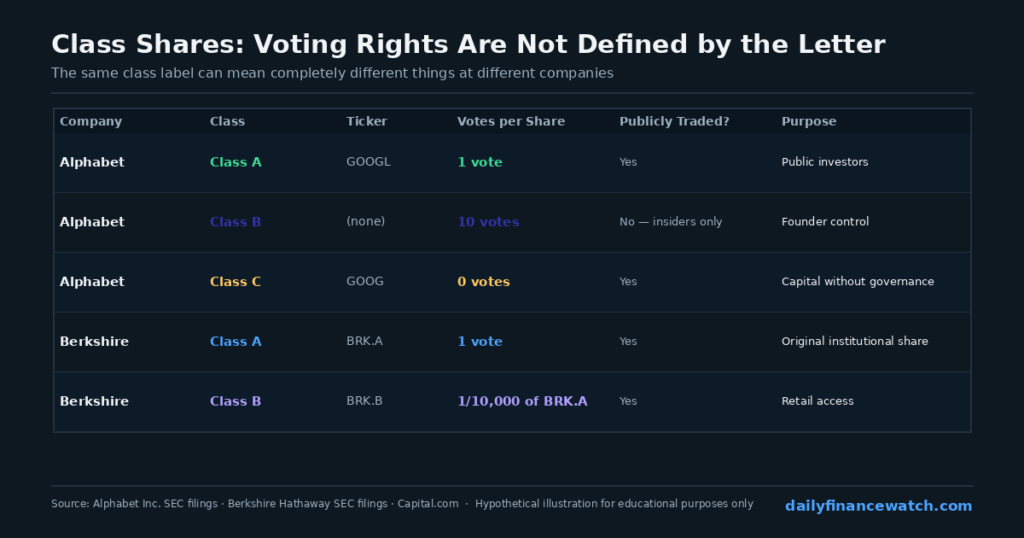
The class letter is a label. The company’s charter is the actual definition.
A share class is a category of common stock with a defined set of rights. Those rights differ from other categories issued by the same company.
In most cases, companies create different class shares to separate voting control from economic ownership. Founders and early insiders often want to raise capital without surrendering their ability to make long-term decisions. Issuing shares with reduced voting rights to the public accomplishes exactly that goal. Founders retain super-voting shares for themselves.
Voting Rights vs. Economic Rights: Two Different Things
Voting rights determine how much say a shareholder has in corporate decisions. These include electing board members, approving major transactions, and endorsing management compensation.
Economic rights determine the shareholder’s claim on the company’s financial performance. These include dividends, buybacks, and the proportional share of any acquisition premium. In many multi-class structures, different class shares carry identical economic rights. However, their voting rights can differ dramatically. According to SEC investor education materials, understanding both dimensions is essential. Investors should check these rights before purchasing stock in any company with multiple share classes.
Why the Same Class Letter Means Different Things
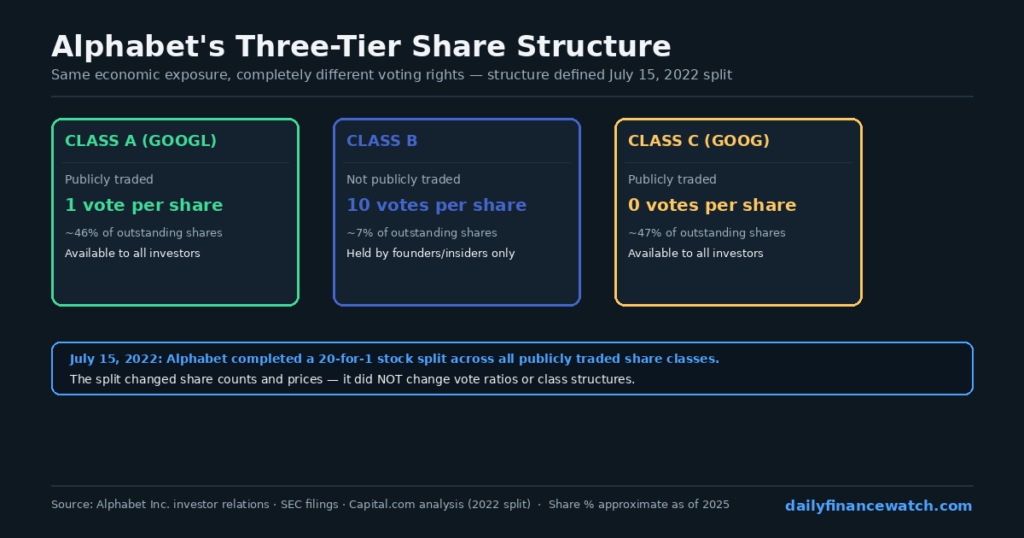
Same letters, opposite structures — the charter always defines the difference.
The confusion that beginners encounter with class shares comes from a reasonable but incorrect assumption. They assume Class A always beats Class B and that both labels carry fixed meanings.
In reality, however, no regulatory standard defines what “Class A” or “Class B” must mean. Instead, each company’s articles of incorporation define the exact rights attached to each class. Consequently, two companies using the same class letters can produce completely different structures.
Alphabet: Three Class Shares, Three Structures
Specifically, Alphabet, the parent company of Google, operates one of the most widely cited multi-class structures in U.S. markets.
Specifically, Alphabet’s charter defines three distinct classes: Class A, Class B, and Class C. Class A shares, traded publicly under GOOGL, carry one vote per share. However, Class B shares carry ten votes per share — a super-voting advantage held only by insiders, not publicly traded. In contrast, Class C shares, traded under GOOG, carry zero votes per share. Economically, however, Class A and Class C deliver identical exposure to Alphabet’s performance.
On July 15, 2022, Alphabet completed a 20-for-1 stock split across all publicly traded classes. Consequently, the split reduced share prices to make them more accessible to retail investors. However, it preserved the existing vote ratios exactly. Class A retained one vote per share, Class B ten votes, and Class C zero. Before the split, GOOGL traded above $2,200 per share. After the split, shares opened at approximately $112.
| Class | Ticker | Votes per share | Publicly traded? |
|---|---|---|---|
| Class A | GOOGL | 1 vote | Yes |
| Class B | (none) | 10 votes | No — insider only |
| Class C | GOOG | 0 votes | Yes |
Source: Alphabet Inc. investor relations; SEC filings; Capital.com.
Berkshire Hathaway: Class Shares Built for Accessibility
Berkshire Hathaway’s Class A and Class B structure reflects a completely different purpose than Alphabet’s.
In 1996, Berkshire Hathaway’s board introduced Class B shares to address a specific practical problem. BRK.A shares had climbed above $30,000 apiece — well beyond most retail investors’ reach. Accessibility, not governance, was the issue.
Moreover, fund operators were creating investment vehicles that mimicked Berkshire’s portfolio but charged additional fees. Consequently, Buffett introduced BRK.B to give smaller investors direct access without the intermediary layer.
Berkshire’s Conversion Rule and Voting Asymmetry
Each BRK.B share represents one fifteen-hundredth (1/1,500) of the economic interest of one BRK.A share. However, voting rights do not follow the same ratio. According to Berkshire Hathaway’s SEC filings, each BRK.B share carries one ten-thousandth (1/10,000) of the voting power of one BRK.A share.
Consequently, 1,500 BRK.B shares match BRK.A’s economic value. However, they provide only 1,500/10,000 = 15% of BRK.A’s voting power per dollar invested.
Furthermore, BRK.A shareholders can convert their shares into 1,500 BRK.B shares at any time. The conversion works in one direction only. BRK.B shareholders cannot convert back to BRK.A. BRK.A has never been split. BRK.B underwent a 50-for-1 split in 2010 to maintain the 1:1,500 pricing relationship.
A common piece of advice tells investors to prefer Class A shares because they carry more voting rights. That framing misses the actual structure in both cases above.
For Alphabet, Class A carries just one vote — meaningful compared to Class B’s ten, but not superior to Class C for retail investors focused on economic exposure. For Berkshire, Class A’s primary practical distinction is price, not governance. In practice, Buffett’s holdings already provide decisive voting control regardless of which class public investors hold.
The realistic question is not which class label sounds better. It is whether the class an investor buys carries the same dividend and appreciation rights as other classes.
What Investors Watch When Evaluating Class Shares
When a company discloses a multi-class structure, four specific items clarify what each class actually means. First, the vote count per share for each class determines governance influence. Second, the dividend policy determines economic parity — whether all classes receive equal dividends per share.
Third, the conversion provisions state whether one class can be exchanged for another. Fourth, the sunset clause specifies whether super-voting rights expire when founders’ ownership drops below a threshold. Without checking these four items in the company’s SEC proxy statement or prospectus, the class letter provides no reliable information about what a shareholder actually owns.
When Voting Rights Matter — and When They Don’t
For most retail investors holding hundreds or a few thousand shares, voting rights rarely change corporate outcomes. A shareholder with 0.00001% of total votes will not determine a board election.
In contrast, institutional investors, activist funds, and pension managers may specifically seek voting rights as a governance lever. Furthermore, when a company faces a contested acquisition or an executive pay vote, the class structure determines who controls the outcome. In fact, every annual proxy statement filed with the SEC EDGAR system discloses this clearly. The Alphabet structure means founders retain strategic control regardless of how many Class A or Class C shares the public holds.
Understanding class shares ultimately requires one reading habit. Check the proxy statement before assuming any class letter defines the share’s rights. The charter tells the complete story. For any company issuing class shares, the class letter alone tells almost none of it.
Related articles:
What is the difference between Class A and Class B shares?
Class A and Class B shares are different categories of common stock issued by the same company, each with specific rights defined in the company’s charter. The difference varies by company — there is no universal standard.
For instance, at Alphabet, Class B shares carry ten votes and are not publicly traded, while Class A shares carry one vote. At Berkshire Hathaway, Class B shares are simply a more affordable version of Class A, with 1/10,000 the voting rights but equivalent economic exposure per 1,500 shares.
Do Class A shares always have more voting rights than Class B shares?
No. The voting power attached to each class depends entirely on the issuing company’s charter and articles of incorporation. Some companies assign more votes to Class B shares than Class A shares — Alphabet’s Class B carries ten votes versus Class A’s one vote. Other companies, like Berkshire Hathaway, assign fewer votes to Class B. Investors should read the company’s proxy statement or SEC filing, not assume any class letter carries a fixed voting weight.
Should I buy Class A or Class B shares of the same company?
For most retail investors, the practical choice depends on price accessibility and dividend equality, not voting rights. In most cases, both classes provide identical economic exposure — the same dividends and proportional participation in price appreciation — while differing only in voting power and price per share. For instance, for Berkshire Hathaway, BRK.B is the practical choice for most investors given the lower entry price. For Alphabet, GOOGL and GOOG offer virtually the same economic return, with GOOGL adding a symbolic voting right.
This content is for educational purposes only and is not personalized financial advice. Investing involves risk, including possible loss of principal.
© 2026 Daily Finance Watch. Excerpts under 50 words with attribution and a link back are permitted. Full-article reproduction requires written permission.