Last updated: July 3, 2026
Specifically, a stock listed on the Nasdaq or New York Stock Exchange must meet that exchange’s ongoing listing requirements. However, when a company falls below those standards — or chooses to leave — stock delisting occurs.
Specifically, this is the formal removal of its shares from that exchange’s trading system. However, the word “delisting” covers two very different events. A company forced off for failing financial tests sends a different signal. A company that leaves voluntarily as part of an acquisition sends a completely different one. Treating both as identical is the most common mistake investors make.
At first glance, most guides describe stock delisting as something that happens to failing companies. In reality, however, voluntary delistings happen for entirely separate reasons and sometimes benefit shareholders directly. Therefore, this article covers both paths and how the formal process unfolds. It also explains what shareholders can realistically do once shares leave a major exchange.
What Stock Delisting Actually Means
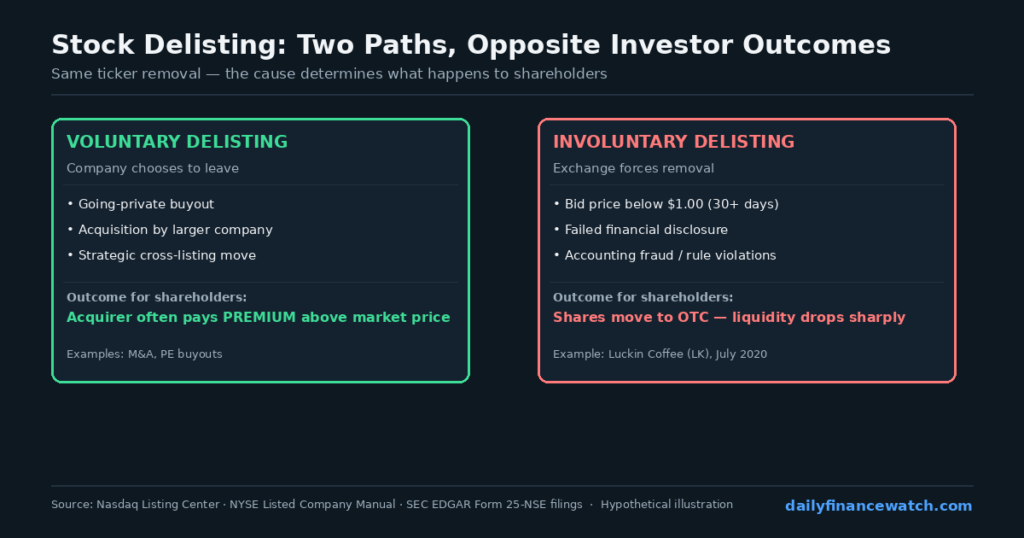
Two types of delisting — same outcome on the ticker, different story underneath.
In practice, stock delisting removes a company’s shares from a specific exchange’s automated trading systems. After delisting, however, the shares do not simply disappear. Consequently, they move to over-the-counter markets, where trading continues with less oversight and often dramatically reduced liquidity. The exchange itself notifies the SEC by filing a Form 25, which formally terminates the listing. Notably, investors who held shares through the delisting retain their ownership — but the market conditions change significantly.
Two Paths Out: Voluntary and Forced Removal
In particular, voluntary delisting occurs when a company files to remove itself from an exchange. Acquisitions drive the most common case. When a buyer purchases a public company outright, the acquiring entity absorbs the shares and removes them from the exchange.
Companies going private — accepting buyout offers from private equity — also voluntarily delist. In many cases, they pay existing shareholders a premium above the trading price. By contrast, forced delisting occurs when an exchange determines that a company no longer meets its continuing listing standards. The exchange issues a formal notice. The company then either cures the deficiency within the allotted time or loses its listing.
How Exchanges Issue a Delisting Notice
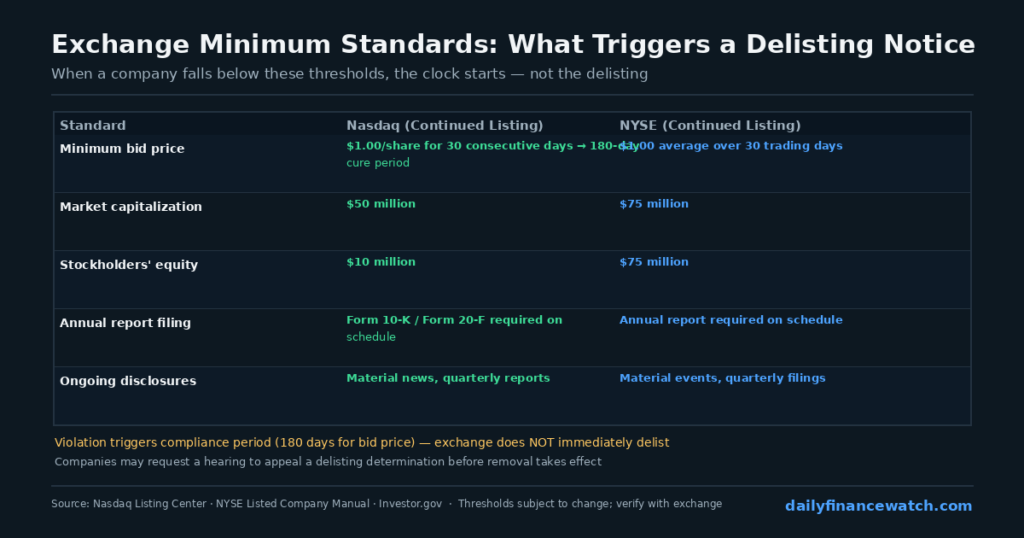
A minimum bid price violation starts a 180-day clock before the exchange acts.
Both Nasdaq and the NYSE set continuing listing standards across several dimensions. These include minimum bid price, market capitalization, stockholders’ equity, and disclosure obligations.
For example, Nasdaq requires a minimum bid price of $1.00 per share. If shares fall below $1.00 for 30 consecutive trading days, the exchange notifies the company. Consequently, it grants a 180-day compliance period to cure the deficiency. According to Nasdaq Listing Center resources, companies may request an additional 180-day extension if they meet other initial listing standards. NYSE applies a similar $1.00 average closing price standard.
Nasdaq and NYSE Minimum Listing Requirements
| Standard | Nasdaq (continued listing) | NYSE (continued listing) |
|---|---|---|
| Minimum bid price | $1.00/share for 30 days | $1.00 average over 30 days |
| Market capitalization | $50 million | $75 million |
| Stockholders’ equity | $10 million | $75 million |
| Disclosure compliance | Form 10-K/20-F required on schedule | Annual report required on schedule |
Source: Nasdaq Listing Standards; NYSE Listed Company Manual; Investor.gov.
Specifically, Luckin Coffee’s 2020 delisting illustrates how multiple violations accumulate. On April 2, 2020, the company disclosed that its COO had directed fabrication of approximately $310 million in revenue during 2019.
Nasdaq issued a formal delisting notice on May 15, 2020. The notice cited Listing Rules 5101 and 5250 — general qualification standards and ongoing compliance obligations. The exchange subsequently cited a second basis. Luckin had failed to file its Form 20-F annual report on time, violating Nasdaq Listing Rule 5250(c)(1).
Luckin withdrew its appeal request on June 24, 2020. Trading on Nasdaq stopped on June 29, 2020. Nasdaq filed Form 25 with the SEC effective July 13, 2020. In December 2020, the SEC settled accounting fraud charges with Luckin for a $180 million penalty, confirming the scale of the misstatement.
What Shareholders Face When a Company Leaves an Exchange
Notably, shareholders who hold shares through a stock delisting do not lose their shares automatically. Ownership rights, however, remain intact. However, the trading environment changes in ways that matter significantly.
In contrast, OTC markets have no centralized order book the way Nasdaq or the NYSE operate. Consequently, spreads between bid and ask prices typically widen, making it more expensive to enter or exit a position. Institutional investors and major index funds often exit positions in delisted companies immediately. Their mandates typically require exchange-listed holdings.
OTC Markets: Where Delisted Shares Land
The OTC Markets system organizes stocks into tiers. OTCQX and OTCQB require companies to meet financial and reporting standards; the Pink Market imposes fewer requirements. Consequently, most involuntarily delisted companies land in the Pink Market, where ongoing disclosure is optional.
According to the OTC Markets Group tier structure, companies in the lowest tiers (Pink Limited or Expert Market) restrict retail investor access.
At first glance, a common piece of guidance tells investors to hold through a delisting if they believe in the company’s long-term value. In reality, that framing is incomplete in two important ways.
First, it ignores the liquidity risk. Selling a Pink Market stock in meaningful size without moving the price is genuinely difficult, especially for retail investors. Second, it conflates voluntary and involuntary delistings. Holding through a going-private delisting — where the acquirer typically purchases remaining shares at a set price — differs entirely from a fraud-driven delisting. No such purchase obligation exists in the latter case.
How to Read Delisting Risk Before It Arrives
In practice, investors who track the right signals can identify stock delisting risk before an exchange issues a formal notice. Moreover, three specific indicators appear consistently before a formal notice. First, sustained trading below $1.00 per share triggers the 30-day clock at Nasdaq and NYSE. Consequently, monitoring daily closing prices against this threshold costs nothing beyond attention.
Second, going-concern language in the auditor’s report signals doubt about the company’s ability to continue operating. This often precedes the financial failures that lead to non-compliance.
Warning Signs Before a Stock Delisting Notice
Third, missed financial filings create immediate compliance problems. Nasdaq Rule 5250(c)(1) requires timely filing of all periodic financial reports — the same rule Luckin Coffee violated in 2020.
In turn, an investor who tracks SEC EDGAR filings can see missed deadlines directly.
Related articles:
What is stock delisting and what causes it?
Stock delisting is the formal removal of a company’s shares from an exchange’s trading system. It occurs in two distinct forms. Voluntary delisting happens when a company chooses to leave — typically through an acquisition or a going-private transaction. Involuntary delisting happens when an exchange determines the company no longer meets its listing standards. These include Nasdaq’s $1.00 minimum bid price and its periodic reporting requirements.
Do I lose my shares if a stock gets delisted?
No. Shareholders retain ownership of their shares after a stock delisting. However, the shares typically move to OTC markets, where trading conditions change materially. Spreads widen, volume often drops sharply, and institutional investors frequently exit due to mandate restrictions on non-exchange-listed securities. The shares remain legally owned. However, selling them at a fair price becomes significantly harder compared to exchange trading.
How long does the delisting process take?
The timeline varies by violation type. A minimum bid price deficiency at Nasdaq triggers a 180-day compliance period. A possible 180-day extension means a company could take up to 360 days to cure or be delisted. Violations of disclosure obligations or fraud-related listing rules move faster. Luckin Coffee’s process ran from May 15 to July 13, 2020. That is approximately two months from the first formal notice to the SEC filing that confirmed removal.
This content is for educational purposes only and is not personalized financial advice. Investing involves risk, including possible loss of principal.
© 2026 Daily Finance Watch. Excerpts under 50 words with attribution and a link back are permitted. Full-article reproduction requires written permission.