Last updated: July 3, 2026
Most tax-advantaged accounts offer one or two tax benefits. An HSA is structured to deliver three simultaneously — and then quietly transforms into a different kind of account once the account holder turns 65.
What an HSA Account Is
A health savings account (HSA) is a tax-advantaged deposit account available to individuals enrolled in a qualifying high-deductible health plan (HDHP). Contributions reduce taxable income, growth inside the account is tax-free, and withdrawals for qualified medical expenses face no federal tax at all. No other widely available U.S. account combines all three of those features at the same time.
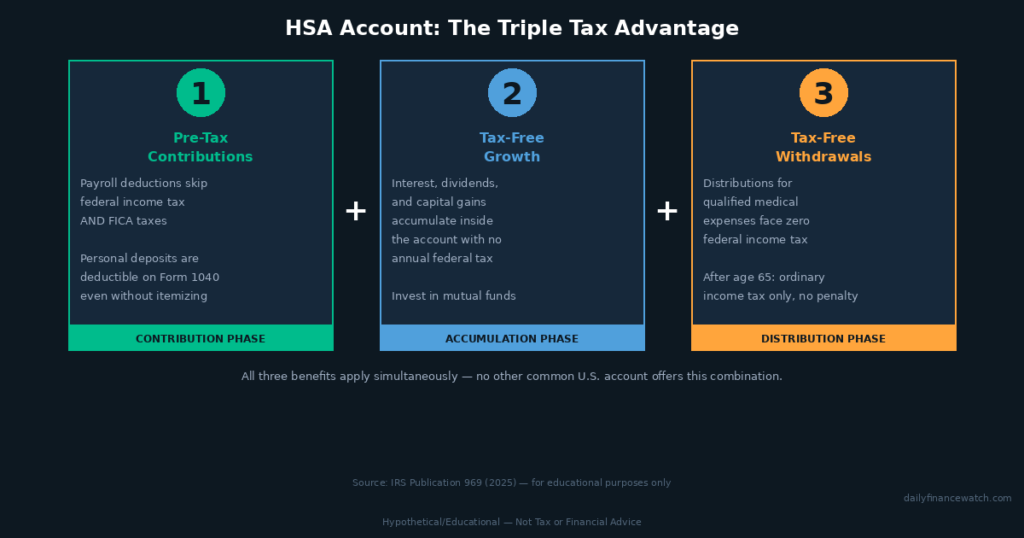
A diagram illustrating the three simultaneous tax benefits of an HSA account: pre-tax contributions, tax-free growth, and tax-free qualified withdrawals.
Unlike a flexible spending account (FSA), the HSA balance rolls over indefinitely. There is no annual “use it or lose it” requirement. The IRS governs HSA rules under IRC Section 223 and publishes the full framework in Publication 969, which covers contribution limits, qualified expenses, and distribution rules.
Who Qualifies for an HSA Account
Eligibility requires enrollment in an HSA-qualifying HDHP on the first day of any month. The plan must meet IRS thresholds for minimum annual deductibles and maximum out-of-pocket expenses. For 2026, the minimum deductible is $1,700 for self-only coverage and $3,400 for family coverage. The maximum out-of-pocket limit is $8,500 for self-only and $17,000 for family coverage, per IRS Rev. Proc. 2025-19 published May 1, 2025.
Four conditions disqualify an otherwise eligible individual: enrollment in Medicare, coverage under a non-HDHP health plan, being claimed as a dependent on another person’s return, or participation in a general-purpose health FSA. Each condition removes eligibility for the months it applies, regardless of HDHP enrollment status.
2026 Contribution Limits
For 2026, the annual HSA contribution limit is $4,400 for self-only HDHP coverage and $8,750 for family coverage, according to IRS Rev. Proc. 2025-19. These figures represent the combined total from all sources — including employer contributions, employee payroll deductions, and personal deposits. Individuals aged 55 or older who have not yet enrolled in Medicare may contribute an additional $1,000 catch-up contribution annually. The contribution deadline aligns with the federal tax return due date — April 15 of the following year.
The Triple Tax Benefit in Practice
The three-layer tax structure separates HSAs from every other common savings vehicle. First, contributions made through payroll avoid both federal income tax and FICA taxes. Personal contributions above the payroll deduction route are deductible on Form 1040 regardless of whether the taxpayer itemizes. Second, any investment returns inside the account — interest, dividends, or capital gains — accumulate free of federal tax. Third, distributions for qualified medical expenses face no federal income tax at all.
By contrast, a traditional IRA provides a deduction at contribution and defers tax until withdrawal. A Roth IRA provides no deduction but offers tax-free growth and tax-free withdrawal. The HSA provides a deduction at contribution AND tax-free growth AND tax-free withdrawal — but only when distributions go toward qualified medical expenses.
The Experience Anchor: How Large the Market Has Grown
According to the CFPB’s May 2024 HSA Issue Spotlight, approximately 36 million HSA accounts existed in 2023, holding over $116 billion in assets — a growth of more than 500% since 2013. Data from Devenir published in early 2025 updated that figure to nearly $147 billion in total HSA assets across more than 39 million accounts as of December 31, 2024. The Bureau of Labor Statistics found that 41% of private-sector and state and local government workers had access to an HSA through their employer in 2025. That expansion reflects both the rise of HDHPs as employer-offered plans and the growing recognition of the HSA’s long-term accumulation potential. You can review the CFPB’s full analysis at consumerfinance.gov.
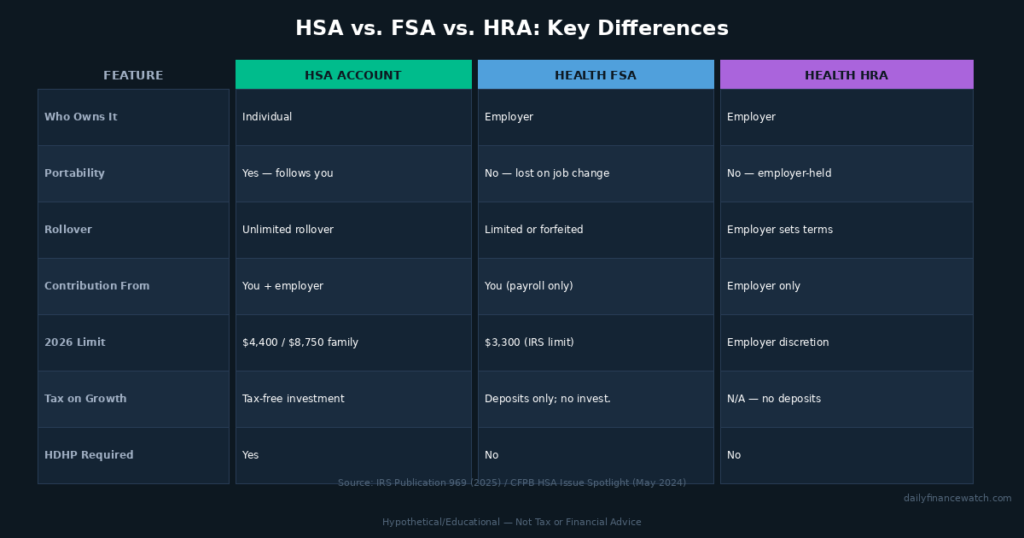
A comparison table showing key differences between an HSA account, a flexible spending account, and a health reimbursement arrangement.
What Counts as a Qualified Medical Expense
The IRS defines qualified medical expenses primarily through Publication 502. Common examples include deductibles, copayments, prescription drugs, dental and vision care, and some over-the-counter products. Premiums for most health insurance plans do not qualify — with specific exceptions for long-term care premiums, COBRA continuation coverage, and Medicare premiums for account holders aged 65 or older.
Non-qualified withdrawals before age 65 trigger both ordinary income tax and a 20% penalty on the amount withdrawn. However, after age 65, the 20% penalty disappears entirely. At that point, non-qualified withdrawals simply face ordinary income tax — exactly the same treatment as a traditional IRA distribution. This age-65 transition is the mechanism behind the thesis: an HSA accumulated over working years converts into a flexible retirement account, even if the account holder never faces large medical bills.
Investing Inside an HSA
Most HSA trustees allow account holders to invest the balance above a minimum threshold in mutual funds or other instruments. Returns inside the account accumulate tax-free regardless of how they are invested. An account holder who contributes consistently and invests the balance through working years can build a substantial pool of tax-advantaged dollars available for healthcare in retirement — or, after 65, for any purpose at ordinary income tax rates.
HSA vs. FSA: The Key Differences
Both accounts allow pre-tax contributions for medical expenses. However, FSAs do not belong to the employee — the employer holds the funds. FSA balances typically do not roll over beyond the employer’s grace period or carryover limit. FSAs are not portable; changing employers generally forfeits unused balances. HSAs belong to the individual permanently. Funds roll over without limit, carry over between employers, and remain available after leaving the workforce. Those structural differences make the HSA the stronger long-term accumulation tool for individuals who can maintain HDHP eligibility.
Building an HSA alongside other savings complements broader personal finance goals — including the net worth tracking discussed in our guide on what is net worth.
The Anti-Advice Reminder
An HSA’s tax advantages only exist within the context of HDHP enrollment, and an HDHP is not the right health plan for every financial situation. Individuals with frequent medical needs, ongoing prescriptions, or chronic conditions may find that an HDHP’s higher deductible produces higher total out-of-pocket costs than a lower-deductible plan — even accounting for HSA tax benefits. The right health plan choice depends on projected healthcare utilization, premium differences, and individual cash flow, not solely on the tax structure. Consulting IRS Publication 969 and a qualified tax or financial professional is advisable before making enrollment decisions based primarily on HSA eligibility.
The triple tax benefit of the HSA account is real and distinctive. However, accessing it requires maintaining eligibility through continued HDHP enrollment — a constraint that changes the calculus depending on each individual’s health and financial situation.
This article is for educational purposes only and does not constitute tax or financial advice. HSA rules, contribution limits, and qualified expense definitions are subject to change.
© 2026 Daily Finance Watch. All rights reserved.