Last updated: July 3, 2026
A money market account combines features of a savings account and a checking account, and many savers confuse it with a completely different product that shares part of its name. One is protected by federal deposit insurance. The other can lose value — and once did, dramatically, in 2008.
What a Money Market Account Is
A money market account (MMA) is a deposit account offered by banks and credit unions. It typically pays a higher interest rate than a standard savings account. Many MMAs include check-writing privileges and a debit card, while still limiting the number of monthly transactions.
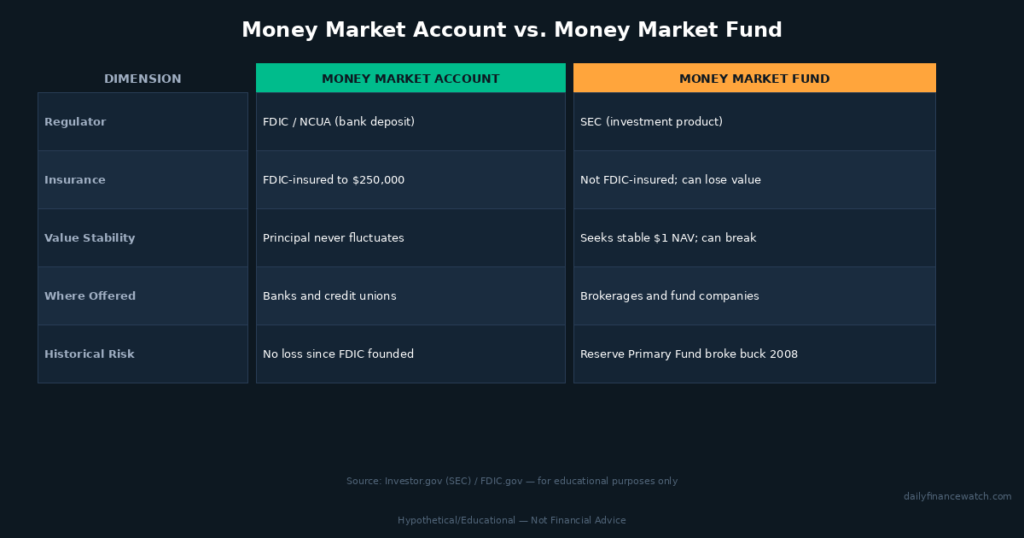
A side-by-side comparison of a money market account and a money market fund across five key risk and structure dimensions.
MMAs are FDIC-insured up to $250,000 per depositor, per institution, per ownership category — the same coverage that applies to savings accounts and CDs. Credit union equivalents carry NCUA insurance at the same threshold. According to Bankrate’s national survey published in June 2026, the average MMA APY stood at 0.46%, while competitive institutions offered rates above 4% at the same time.
MMA vs. a Money Market Fund
Here is where confusion causes real financial risk. A money market fund is an entirely different product — a mutual fund regulated by the SEC rather than a bank deposit regulated by the FDIC. Investor.gov’s bulletin on the fund type, updated November 2024, states plainly that money invested in it is not guaranteed by the FDIC, unlike an MMA.
The fund invests in short-term debt securities, cash, and cash equivalents. Most seek to maintain a stable net asset value (NAV) of $1.00 per share. However, “seek to maintain” is not the same as “guaranteed.” When the fund’s NAV drops below $0.995 per share, it is said to “break the buck” — a rare but historically real event.
The Experience Anchor: When the Fund Actually Broke
On September 16, 2008, the Reserve Primary Fund — then a $62.6 billion fund — broke the buck. Following Lehman Brothers’ bankruptcy filing the previous day, it held $785 million in Lehman-issued debt securities that instantly became nearly worthless. Redemption requests exceeded $40 billion within two days. The board valued its Lehman holdings at zero and reset the NAV to $0.97 per share — a loss investors did not expect from what most treated as a cash-equivalent holding.
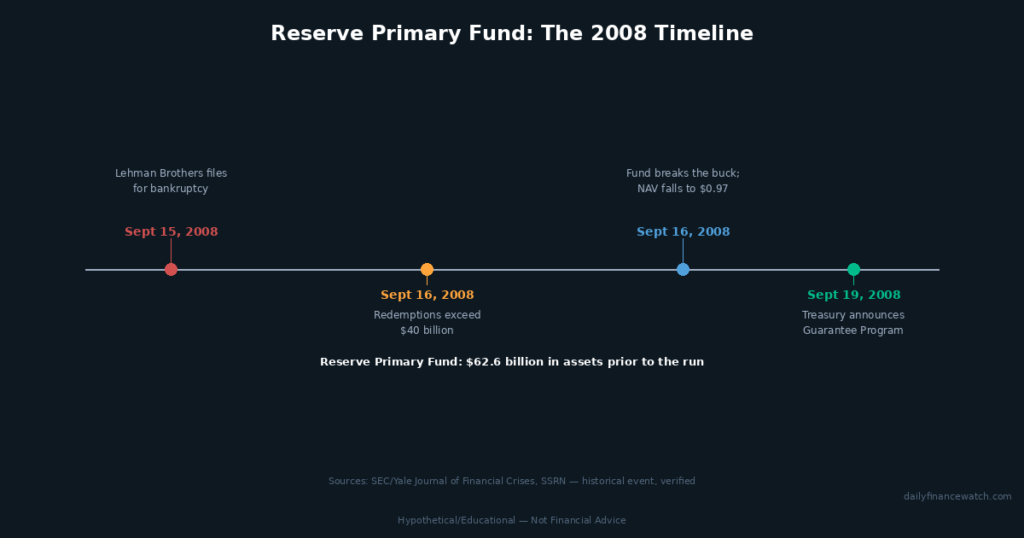
A timeline of the Reserve Primary Fund’s September 2008 collapse, from the Lehman Brothers bankruptcy filing to breaking the buck.
This event triggered a broader run on prime funds industry-wide. The U.S. Treasury responded on September 19, 2008, with a Temporary Guarantee Program to stabilize the sector. The episode remains the clearest historical demonstration that this fund type, despite its cash-like reputation, carries genuine investment risk that an MMA does not share.
Why the Name Similarity Matters
Both products reference short-term, high-liquidity financial instruments, which explains the shared naming. That overlap is the root of the confusion. An MMA holds your deposit directly at an FDIC-insured institution. The fund alternative pools investor money to purchase securities on the open market, and its value depends on those underlying securities.
This distinction connects to a broader theme covered in our guide on what is a certificate of deposit: understanding exactly what protection a financial product offers — and does not offer — matters more than comparing advertised rates alone.
Common Features of an MMA
Most accounts of this type share several structural features. Tiered interest rates reward higher balances with better APYs. Monthly transaction limits — often six per statement cycle for certain transfer types — apply under most account agreements, though enforcement varies by institution. Minimum balance requirements, sometimes $2,500 or higher, are common for earning the top advertised rate.
Comparing an MMA to Other Deposit Options
An MMA sits between a high-yield savings account and a certificate of deposit in terms of features. It offers more liquidity than a CD but potentially fewer check-writing conveniences than a checking account. Compared to a high-yield savings account, discussed in our guide on high-yield savings accounts, an MMA often provides similar rates with the added benefit of check-writing access — though not always at a materially higher yield.
What FDIC Insurance Actually Protects
FDIC insurance protects the principal and accrued interest in an MMA up to $250,000, dollar-for-dollar, in the event of a bank failure. This protection is automatic and requires no application. The insurance covers the risk of the bank itself failing — not market risk, since a deposit account does not fluctuate with market prices. You can review the official FDIC framework at fdic.gov/resources/deposit-insurance.
By contrast, the fund alternative carries SEC oversight rather than FDIC insurance. The SEC’s investor protections focus on disclosure requirements, fund structure rules, and, since 2016, mandatory liquidity fee provisions for certain fund types during periods of heavy redemption — protections designed to manage investment risk, not eliminate it.
The Anti-Advice Reminder
Choosing between an MMA and other deposit or investment vehicles depends on your liquidity needs, risk tolerance, and time horizon. Neither product is inherently superior — each serves different purposes within a financial plan. An account of this type suits money that needs FDIC protection and periodic access. The fund alternative may suit an investor comfortable with minimal but real investment risk in exchange for potentially different yield characteristics. Reading the specific terms, insurance status, and fee structure of any account before opening it remains the most reliable way to avoid surprises.
The Reserve Primary Fund’s stability ended in a single afternoon in September 2008 — a reminder that shared terminology describes an investment category, not a guarantee. Knowing which version applies to your account is the distinction that actually protects your cash.
This article is for educational purposes only and does not constitute financial advice. FDIC insurance limits and fund regulations are subject to change.
© 2026 Daily Finance Watch. All rights reserved.