Last updated: July 3, 2026
A certificate of deposit trades liquidity for a rate premium. The exchange seems simple. Understanding when that trade works in your favor — and when it works against you — requires looking at how CD rates behave across interest-rate cycles.
What a Certificate of Deposit Is
A certificate of deposit, commonly called a CD, is a time deposit offered by FDIC-insured banks and NCUA-insured credit unions. When you open one, you deposit a fixed sum for a predetermined term — typically ranging from three months to five years. In exchange, the institution pays a fixed APY for the full duration. You receive the principal plus all accrued interest when the term ends, a date called the maturity date.
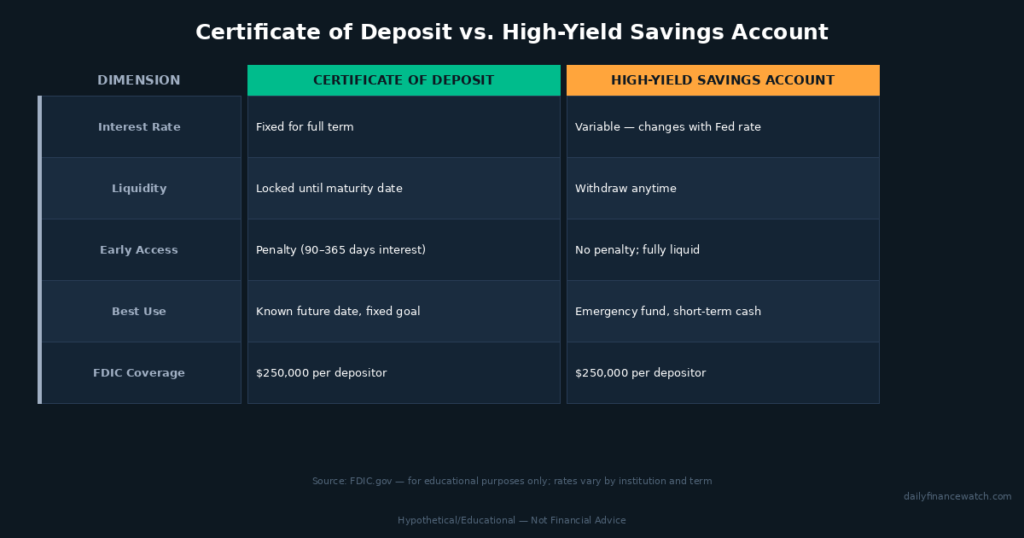
A comparison table showing key differences between a certificate of deposit and a high-yield savings account across five dimensions.
Unlike a high-yield savings account, a CD locks in its rate at opening. The rate does not change regardless of what the Federal Reserve does afterward. That feature is the core of both the appeal and the risk. The FDIC’s consumer guide to shopping for CDs at fdic.gov outlines the key terms and risks to evaluate before opening any CD.
How CD Rates Work
CD rates move with the federal funds rate but then freeze at the moment of opening. Banks set their offered APYs based partly on the current rate environment and partly on competitive pressure. When the Fed raises its benchmark rate, CD rates at competitive institutions tend to rise. When the Fed cuts, newly issued CD rates typically fall — but existing CDs continue paying their original rate until maturity.
This mechanism is the source of the thesis: the timing of the lock-in determines whether a fixed rate becomes an advantage or a constraint. In late 2023, competitive one-year CD rates peaked above 5% as the Fed held its benchmark near a 22-year high. Savers who locked in at that peak continued earning those elevated rates through 2024 and 2025, even as the Fed cut its benchmark six times over those two years. Conversely, savers who opened CDs in 2021 — when one-year rates averaged below 0.5% — found their cash tied up at near-zero yields as inflation surged to 40-year highs. According to Bankrate’s rate survey data as of July 2, 2026, the national average one-year CD yield stood at 1.99% APY, with competitive institutions offering up to 4.10%.
The Early Withdrawal Penalty
Accessing funds before maturity triggers an early withdrawal penalty. The penalty varies by institution and term length, but typically ranges from 90 days to 365 days of interest. Shorter-term CDs carry smaller penalties; longer-term CDs carry larger ones. In some cases, withdrawing early on a long-term CD forfeits enough interest to cut into principal — meaning a depositor receives back less than the original deposit. This makes it essential to evaluate the penalty terms before opening any CD, especially for terms of two years or more.
The Rate History Perspective
CD rates in the United States have moved through wide cycles over decades. According to St. Louis Federal Reserve data sourced from Bankrate’s historical analysis, the average three-month CD rate reached approximately 18.3% in May 1981, when the Fed pushed rates to historic highs to combat double-digit inflation. Rates then fell steadily through subsequent decades. Between 2009 and 2021, the national average one-year CD APY remained below 1% for most of the period, offering savers little premium over a basic savings account.
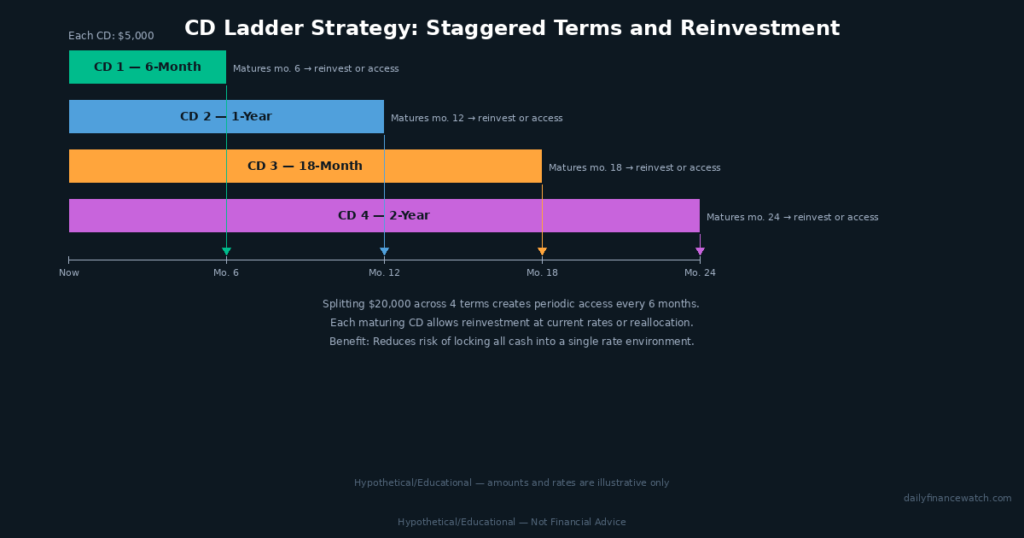
A diagram illustrating a CD ladder strategy across four terms, showing staggered maturity dates and reinvestment points.
The 2022–2023 rate hiking cycle reversed that pattern sharply. It also illustrated what makes the timing of a lock-in matter: savers opening long-term CDs in early 2022 locked in rates still near historic lows, only to watch short-term CD rates climb past them within months. This asymmetry — between what existing CDs pay and what newly issued ones offer — is built into the fixed-rate structure.
CD Laddering as a Response to Rate Uncertainty
A CD ladder distributes deposits across multiple terms to reduce the timing risk of any single lock-in. Instead of placing $20,000 into a single two-year CD, a laddering approach might split the deposit across four $5,000 CDs with six-month, one-year, eighteen-month, and two-year maturities. As each CD matures, the depositor can reinvest at current rates or redirect the funds elsewhere. Laddering does not guarantee a higher return than a single CD. However, it reduces the risk of being locked into an unfavorable rate for a long period.
Tax Treatment of CD Interest
Interest earned on a CD is taxable as ordinary income in the year it is credited to the account, regardless of whether the CD has reached maturity. For multi-year CDs that compound interest annually, this means tax liability accrues each year even though the depositor cannot access the funds until maturity. The IRS requires banks to issue Form 1099-INT for interest payments of $10 or more per year. Investors holding CDs inside tax-advantaged accounts — such as IRAs — defer this tax liability until withdrawal.
What CDs Do Not Protect Against
FDIC insurance protects a CD’s principal and accrued interest up to $250,000 per depositor per insured bank per ownership category. The insurance covers the risk of bank failure. It does not protect against inflation risk. If a CD pays 2% APY and inflation runs at 4%, the real purchasing power of the deposit declines even though the dollar balance grows. This inflation risk became visible during 2021–2022, when many depositors held CDs earning sub-1% yields while the Consumer Price Index climbed above 8%. FDIC deposit insurance rules are available at fdic.gov/resources/deposit-insurance.
Comparing your CD’s expected return to the high-yield savings account rate in our guide on high-yield savings accounts helps clarify which instrument fits a specific goal. CDs suit money with a known time horizon. High-yield savings accounts suit money that may be needed at any time.
The Anti-Advice Reminder
Whether a CD makes sense depends on the specific rate environment, your time horizon, the terms of the penalty clause, and what alternatives currently offer. A CD that looks attractive today may lock in a rate that falls behind both inflation and newly issued CDs within months. No single factor — not the APY, not the term, not the penalty size — determines whether a CD is appropriate for a given situation. Understanding the mechanics is a starting point. Before committing cash to any time deposit, reviewing the full account disclosure and considering the liquidity implications of the chosen term are reasonable steps.
The fixed-rate structure of a CD makes timing the core variable — not the rate number itself. Knowing that the lock-in date, not the stated APY, drives the long-run outcome changes how to think about CDs at any point in an interest-rate cycle.
This article is for educational purposes only and does not constitute financial advice. CD rates and terms vary by institution and change frequently.
© 2026 Daily Finance Watch. All rights reserved.