Last updated: July 4, 2026
Most articles describing Roth IRA income limits stop at the phase-out chart. However, few explain that the limit only blocks one of two doors into a Roth account. Notably, the other door has stayed open for over fifteen years.
The Core Difference: When You Pay Tax
A traditional IRA and a Roth IRA both offer tax-advantaged retirement savings. However, they tax your money at opposite ends of the timeline. Traditional IRA contributions may be tax-deductible in the year you contribute. Then, the funds grow tax-deferred until withdrawal. At that point, the withdrawal gets taxed as ordinary income. Roth IRA contributions, by contrast, receive no upfront deduction. Instead, qualified withdrawals in retirement are entirely tax-free, including all investment growth.
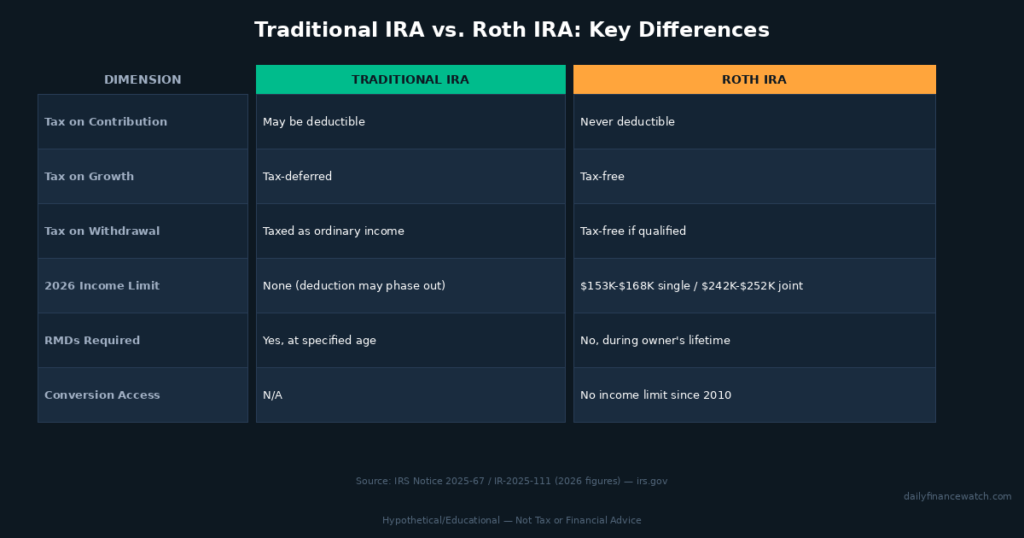
A comparison table showing key differences between a traditional IRA and a Roth IRA across contribution rules, tax treatment, and withdrawal terms.
For 2026, the combined annual limit across all traditional and Roth IRAs is $7,500. Additionally, savers aged 50 and older can contribute $8,600. This limit applies whether you use one account type or split contributions between both. You can review the full 2026 figures at irs.gov.
Income Limits: Where the Two Accounts Diverge
Traditional IRA contributions have no income limit at all. Anyone with earned income can contribute. However, the deduction phases out based on income if you or your spouse has a workplace plan. Specifically, for 2026, that phase-out runs from $81,000 to $91,000 for single filers covered by a workplace plan.
Roth IRA contributions work differently. For 2026, single filers can contribute the full amount below $153,000 in modified adjusted gross income. Then, contributions phase out completely at $168,000. Meanwhile, married couples filing jointly face a phase-out between $242,000 and $252,000. Above these thresholds, direct Roth contributions are not allowed.
The Thesis: Why “Locked Out” Is the Wrong Framing
Here is what most explainers miss. The income limit above applies only to direct Roth contributions. It does not apply to Roth conversions. Instead, a Roth conversion moves existing funds from a traditional IRA into a Roth IRA. This move triggers ordinary income tax on the converted amount that year. Unlike direct contributions, conversions have carried no income limit since January 1, 2010.
The Experience Anchor: How the Conversion Loophole Was Created
Before 2010, converting a traditional IRA to a Roth IRA required adjusted gross income below $100,000. Then, the Tax Increase Prevention and Reconciliation Act of 2005 (TIPRA, P.L. 109-222) eliminated that limit for conversions. This change took effect January 1, 2010. Congress structured the provision this way partly for revenue timing reasons. Under budget reconciliation rules, converted amounts get taxed as income in the year of conversion. Consequently, this treatment helped the bill’s near-term revenue numbers.
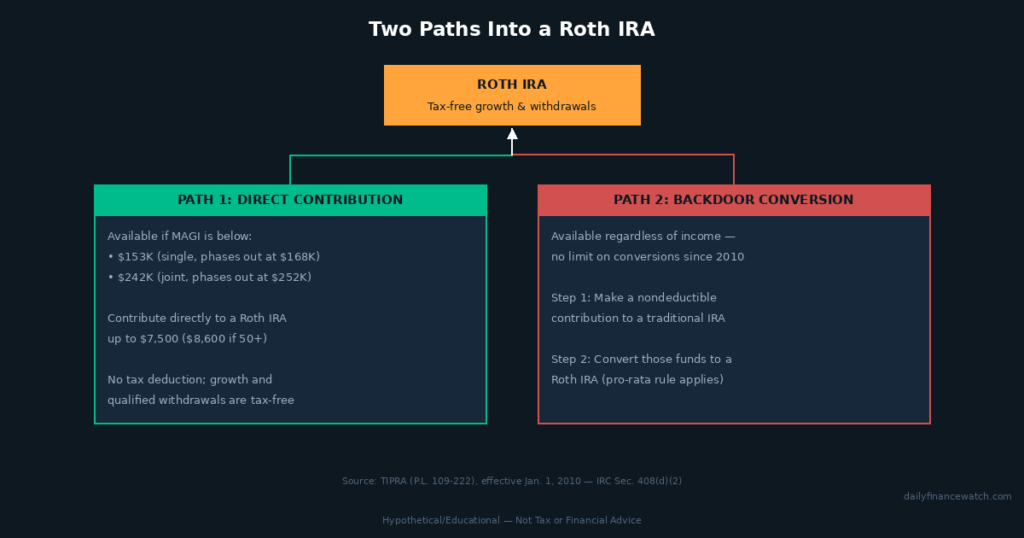
A diagram showing the two paths into a Roth IRA: direct contribution below the income limit, and the backdoor conversion path for earners above it.
The removal of the conversion limit left the direct-contribution limit in place. Together, these two rules created what is now called the “backdoor Roth IRA.” First, a high earner makes a nondeductible contribution to a traditional IRA. Then, that person converts it to a Roth shortly afterward. This asymmetry between the two limits has persisted for more than fifteen years. Several legislative proposals have targeted the strategy for elimination, including provisions in the 2021 Build Back Better framework. However, none have passed as of this writing.
The Pro-Rata Rule Complication
The backdoor Roth strategy works cleanly only under one condition. Specifically, the taxpayer must hold no other pre-tax IRA balances. Otherwise, the IRS applies a pro-rata rule under IRC Section 408(d)(2). This rule aggregates all of a taxpayer’s traditional, SEP, and SIMPLE IRA balances together. As a result, a taxpayer with existing pre-tax funds cannot convert only the new contribution. Instead, the conversion gets taxed proportionally across all IRA balances combined. Ultimately, this complication often decides whether the backdoor strategy makes sense.
Deciding Between Traditional and Roth When You Qualify for Both
For savers under the Roth income limit, the decision often comes down to one comparison. Specifically, how does your current tax bracket compare to your expected bracket in retirement? A traditional IRA tends to favor savers who expect a lower rate later, since the deduction is worth more now. Conversely, a Roth tends to favor savers who expect a similar or higher rate later. This is because tax-free withdrawals become more valuable as rates rise. Also, our guide on Roth IRA vs 401(k) covers a related decision using similar logic for employer accounts.
Required Minimum Distributions: Another Point of Divergence
Traditional IRAs require the account holder to begin taking required minimum distributions (RMDs). This requirement starts at a specified age under current law. Roth IRAs, however, carry no RMD requirement during the original owner’s lifetime. Essentially, the government has already collected tax on the contributions. As a result, it has no future revenue interest in forcing withdrawals. This difference makes Roth accounts useful for savers who want flexibility. Some want to leave retirement funds untouched for legacy planning. Others simply want more control over their own timeline.
The Anti-Advice Reminder
Choosing between a traditional IRA, a Roth IRA, or a combination of both depends on several factors. Specifically, these include your current tax bracket, your expected retirement bracket, and your income relative to the Roth thresholds. Also, whether the backdoor strategy fits your specific IRA holdings matters. Overall, no single account type is correct for every saver. Predicting your future tax bracket also involves genuine uncertainty. Before executing a Roth conversion, review your full tax situation with a qualified tax professional. This step helps avoid costly mistakes, particularly around the pro-rata rule.
The income limit that seems to lock high earners out of Roth accounts only closes one of two doors. Notably, the conversion path has remained open since 2010. Understanding this changes the entire framing of who actually has access to Roth savings.
This article is for educational purposes only and does not constitute tax or financial advice. IRA rules and contribution limits are subject to change by Congress and the IRS.
© 2026 Daily Finance Watch. All rights reserved.