Last updated: July 4, 2026
Many people assume a step-up in cost basis is a perk reserved for estates large enough to trigger estate tax. Actually, these two rules operate independently. For one unusual year, Congress split them apart entirely.
What a Step-Up in Cost Basis Does
A step-up in cost basis resets the cost basis of an inherited asset to its fair market value on the date of the original owner’s death. Consider an example. Someone buys stock for $50,000, and it grows to $500,000 by the time they die. Ordinarily, selling that stock would trigger tax on $450,000 of gain. With a step-up, the heir’s basis becomes $500,000 instead. As a result, an immediate sale produces no taxable gain at all.
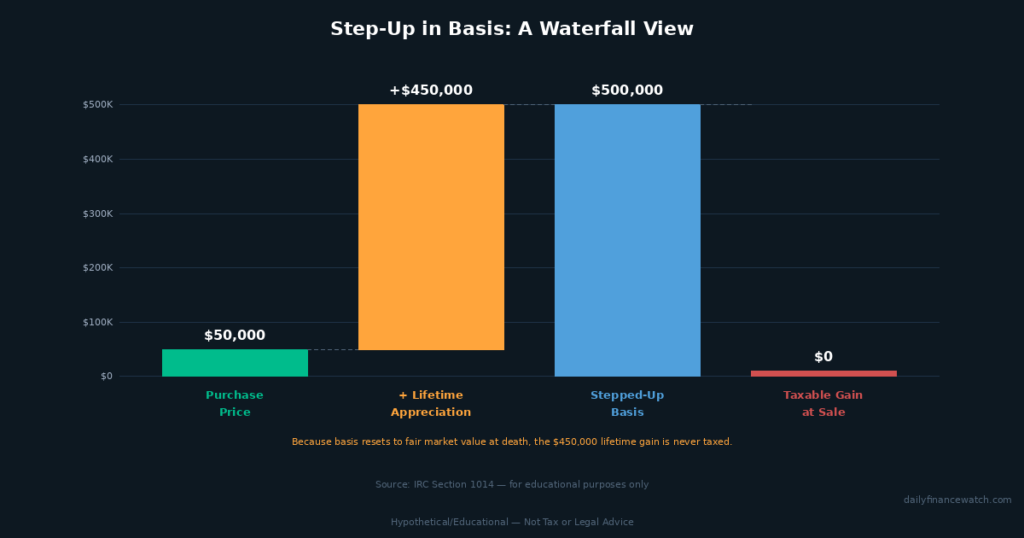
A diagram showing how a step-up in cost basis resets an inherited asset’s basis to its fair market value at death, eliminating tax on lifetime appreciation.
This rule comes from IRC Section 1014. You can review the full statutory text at Cornell Law School’s Legal Information Institute. Under this section, unrealized appreciation built up during the original owner’s lifetime disappears for tax purposes. Only appreciation after the date of death remains taxable when the heir eventually sells.
Why People Conflate This With Estate Tax
Here is the source of confusion. Step-up in basis and the federal estate tax exemption often get discussed together, since both relate to what happens when someone dies. However, they are governed by entirely separate parts of the tax code. Estate tax determines whether a decedent’s estate owes tax on its total value above an exemption threshold. Step-up in basis determines what tax basis heirs use when they eventually sell inherited assets. These are two distinct questions with two distinct answers.
For 2026, the federal estate tax exemption is $15,000,000 per individual, according to the IRS. This means only a small fraction of estates ever owe federal estate tax. Step-up in basis, by contrast, applies to virtually every inheritance regardless of size. A modest estate worth $200,000 receives the same basis reset as a $50 million estate.
The Thesis: What 2010 Actually Proved
Here is the mechanism behind the thesis. For calendar year 2010 only, Congress allowed the federal estate tax to expire under a sunset provision in a 2001 law. In its place, a new “modified carryover basis” system replaced the automatic step-up. Executors could allocate only $1.3 million in basis increases across an estate, plus an additional $3 million for property passing to a surviving spouse. Anything beyond those amounts retained the decedent’s original, lower basis.
The Experience Anchor: The Year Congress Split the Two Rules Apart
This arrangement created a genuine dilemma for estates settled in 2010. Congress retroactively reinstated the estate tax in December 2010 through new legislation, but gave executors of 2010 decedents a choice. They could either apply the reinstated estate tax and receive the full step-up in basis, or elect no estate tax and accept the limited carryover basis instead. Executors had until September 2011 to decide, according to the Journal of Accountancy’s coverage of the transition. Some estates with highly appreciated assets actually chose to pay estate tax specifically to preserve the more valuable step-up in basis.
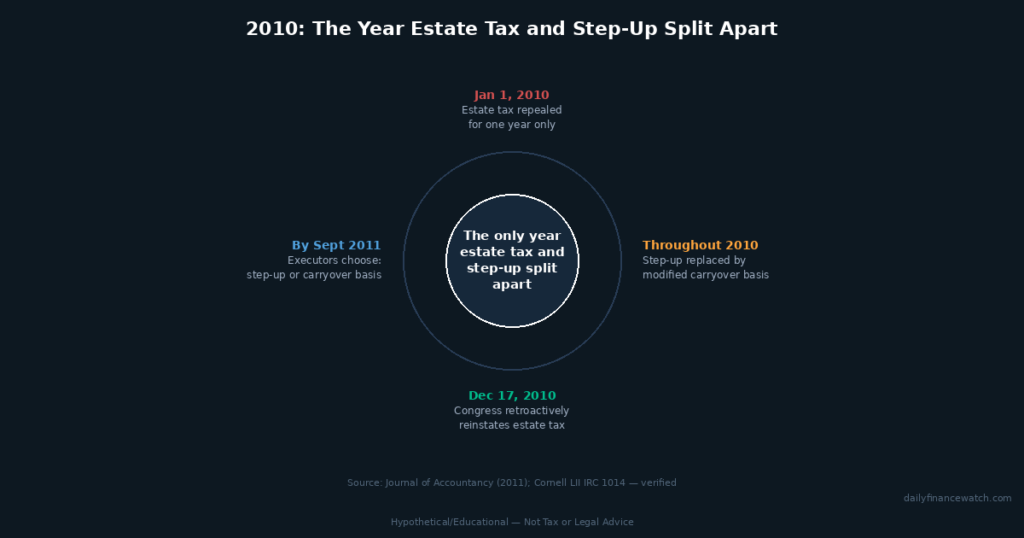
A timeline of 2010’s unique estate tax repeal, showing how Congress temporarily separated the estate tax from the automatic step-up in basis before reinstating both.
This one-year experiment demonstrated something that rarely gets stated plainly. Estate tax and step-up in basis are two separate levers, and Congress can move one without moving the other. The fact that they usually move together is a policy choice, not a structural necessity.
What Assets Do Not Receive a Step-Up
Not every asset qualifies for this treatment. Retirement accounts, including traditional and Roth IRAs, do not receive a step-up in basis, since they are treated as “income in respect of a decedent” rather than ordinary capital assets. Our guide on traditional IRA vs Roth IRA explains how these accounts handle taxation differently from a standard brokerage account. Gifted property also does not receive a step-up during the giver’s lifetime. Instead, gifts carry over the original basis, which is a meaningfully different outcome than inheriting the same asset after death.
Community Property States Offer a Broader Version
In the nine community property states, both halves of a married couple’s jointly owned property receive a full step-up when one spouse dies, under IRC Section 1014(b)(6). In separate-property states, only the deceased spouse’s half typically receives the adjustment. This distinction can meaningfully change the tax outcome for a surviving spouse who later sells shared property.
Step-Up in Basis and the Tax-Loss Harvesting Connection
Step-up in basis interacts directly with the deferral concept covered in our guide on tax-loss harvesting. When an investor defers a taxable gain by holding an appreciated replacement investment, that deferred gain can become permanent if the investor holds the asset until death. The heir then receives a stepped-up basis, and the gain the original investor deferred simply disappears from the tax system entirely. This connection is one reason “buy and hold until death” remains a recognized tax strategy for appreciated assets.
The Anti-Advice Reminder
Whether step-up in basis meaningfully benefits a specific estate depends on the size of the estate, the types of assets involved, and state-level tax rules that vary significantly. Some states impose their own estate or inheritance taxes with much lower thresholds than the federal exemption, which can change the calculus for planning purposes. Before making decisions based on step-up in basis, such as choosing whether to gift or bequeath an appreciated asset, consulting a qualified estate planning attorney or tax professional is advisable given how much these rules depend on individual circumstances.
Step-up in basis and the estate tax exemption sound like they belong to the same conversation, but they answer different questions entirely. The single year Congress separated them showed exactly how independent these two rules really are — and why understanding both matters more than assuming a large estate is the only kind that benefits.
This article is for educational purposes only and does not constitute tax, legal, or financial advice. Estate tax and cost basis rules are subject to change by Congress and the IRS.
© 2026 Daily Finance Watch. All rights reserved.