Last updated: July 4, 2026
Most explanations of the inherited IRA “10-year rule” describe it as one simple deadline. Actually, it splits into two different tracks. Which one applies to you depends on a single fact about the person who died.
What an Inherited IRA Is
An inherited IRA is an account a beneficiary receives after the original owner dies. The rules governing how quickly you must withdraw the money depend heavily on your relationship to the deceased and when they died. The Setting Every Community Up for Retirement Enhancement (SECURE) Act, effective for deaths after December 31, 2019, eliminated the old “stretch IRA” strategy for most non-spouse beneficiaries. Before this law, beneficiaries could spread withdrawals across their own life expectancy, sometimes for decades.
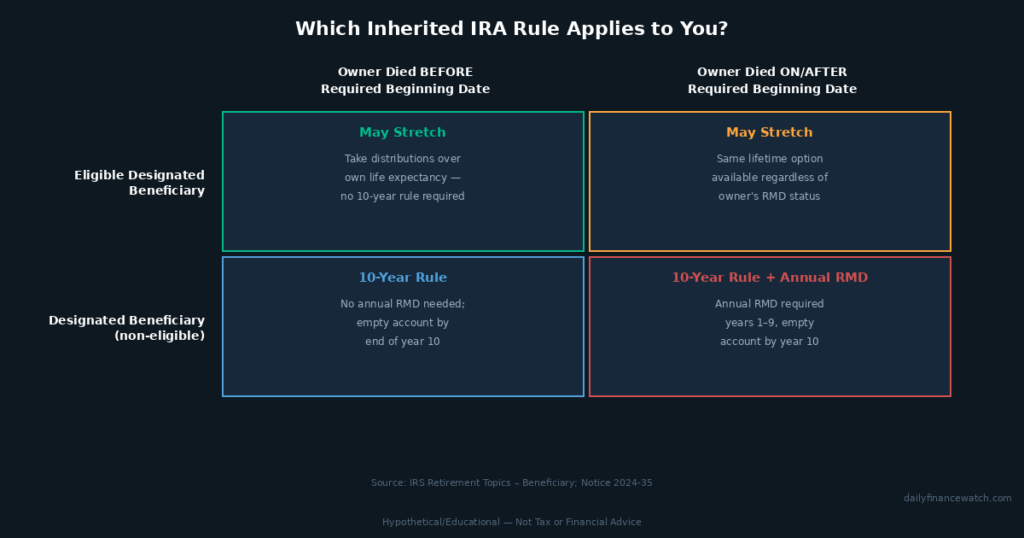
A matrix diagram showing which of four inherited IRA distribution rules applies, based on beneficiary type and the original owner’s RMD status at death.
Since 2020, most non-spouse beneficiaries fall under a “10-year rule” instead. However, that phrase hides an important distinction most explainers skip entirely.
The Two Hidden Tracks Inside the 10-Year Rule
Here is the mechanism behind the thesis. Whether you owe annual withdrawals during years one through nine depends on one factor. Specifically, it depends on whether the original owner had already reached their “required beginning date” for RMDs before they died.
If the owner died before reaching that date, you face no annual withdrawal requirement at all. You can wait until year ten, take distributions along the way, or skip years entirely. The only rule is that the account must be empty by December 31 of the tenth year. If the owner died on or after that date, a different rule applies. You must take annual RMDs in years one through nine, based on your own life expectancy, and empty the remaining balance by year ten. Skipping an annual RMD under this second track can trigger a penalty.
Why This Distinction Caused Years of Confusion
The SECURE Act itself did not clearly state whether annual RMDs applied during the 10-year window. On February 24, 2022, the IRS published proposed regulations in the Federal Register that surprised many practitioners. The proposal confirmed that annual RMDs would be required in years one through nine for beneficiaries in the second track above. Many advisors had assumed the 10-year rule worked like a simple deadline, similar to the older 5-year rule.
The Experience Anchor: How Long It Took the IRS to Settle This
Faced with widespread confusion and missed distributions, the IRS issued three separate relief notices. Notice 2022-53 waived penalties for missed 2021 and 2022 distributions. Notice 2023-54 extended that relief through 2023. Notice 2024-35 extended it once more through 2024. You can review Notice 2024-35 directly at irs.gov. Finally, on July 19, 2024, the Treasury Department and IRS issued 260 pages of final regulations. These confirmed the original 2022 interpretation and set the rule’s applicability date at January 1, 2025.
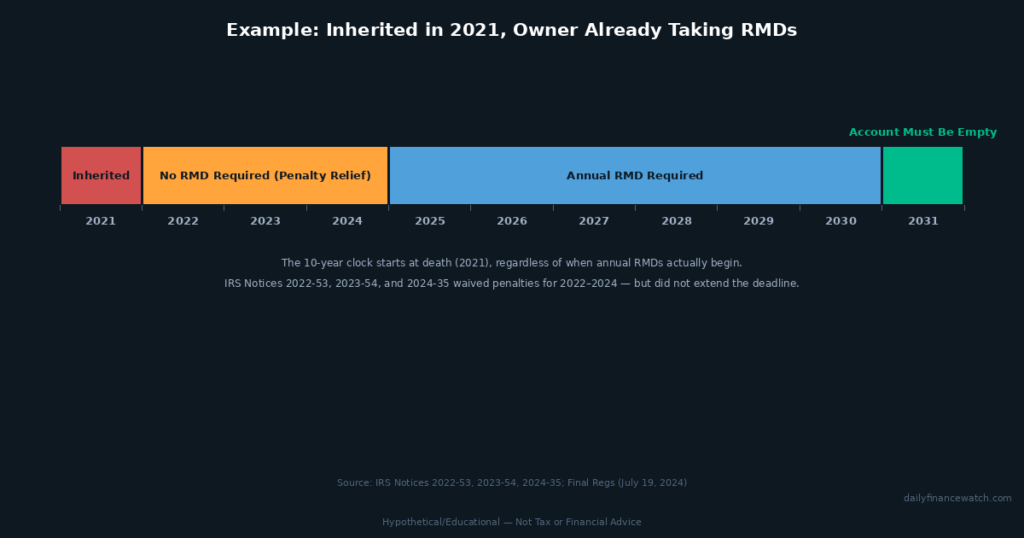
A segmented bar showing how the 10-year rule played out for someone who inherited an IRA in 2021, including the years covered by IRS penalty relief.
Consider a beneficiary who inherited an IRA in 2021 from someone already taking RMDs. That person owed no annual distribution in 2022, 2023, or 2024, thanks to the relief notices. However, they must take annual RMDs from 2025 through 2030 and empty the account entirely by the end of 2031. The 10-year clock started in 2021, regardless of when the annual requirement actually began.
Special Rules for Certain Beneficiaries
Not every beneficiary faces the 10-year rule. The IRS defines an “eligible designated beneficiary” as a surviving spouse, a minor child of the account owner, a disabled or chronically ill individual, or someone not more than 10 years younger than the original owner. These beneficiaries may stretch distributions over their own life expectancy instead of following the 10-year rule. You can review the full definitions at the IRS’s Retirement Topics – Beneficiary page.
Spousal Beneficiaries Have the Most Flexibility
A surviving spouse can roll the inherited IRA into their own account, delay distributions until the deceased spouse would have reached RMD age, or treat the account as their own entirely. This flexibility does not extend to other beneficiaries, including adult children, who almost always fall under the standard 10-year rule. Our guide on traditional IRA vs Roth IRA covers how ownership rules differ for original account holders, which is a useful comparison point when thinking through inherited account options.
Inherited Roth IRAs Follow Similar Timing, Different Tax Treatment
Inherited Roth IRAs generally follow the same 10-year framework as traditional IRAs. However, since Roth contributions were already taxed, qualified withdrawals of earnings remain tax-free for the beneficiary. The step-up in basis rules covered in our guide on step-up in cost basis do not apply to IRAs of either type, since retirement accounts receive different tax treatment than a standard brokerage account.
The Anti-Advice Reminder
Which rule applies to your specific inherited IRA depends on several factors working together: your relationship to the original owner, their age and RMD status at death, and whether you qualify as an eligible designated beneficiary. Missing an annual RMD under the wrong assumption can trigger a 25% excise tax on the shortfall, though this drops to 10% if corrected within two years. Before making withdrawal decisions on an inherited IRA, confirming your specific track with a tax professional or the plan custodian helps avoid a costly miscalculation.
The “10-year rule” name suggests one clean deadline, but two different sets of requirements sit underneath it. Knowing which track applies to your specific inherited IRA — based on a single fact about when the original owner started their own RMDs — matters far more than memorizing the ten-year number itself.
This article is for educational purposes only and does not constitute tax or financial advice. Inherited IRA rules are subject to change by Congress and the IRS.
© 2026 Daily Finance Watch. All rights reserved.