Last updated: July 7, 2026
A new offer lands in your inbox. Move your balance here, it says, and pay 0% interest for over a year. That’s the pitch behind every balance transfer card. Before you apply, it helps to see the real math behind the offer.
This guide explains how balance transfer cards actually work and what they cost. It also covers how to tell whether a balance transfer makes sense for your situation.
This guide focuses specifically on balance transfers. For the full toolkit, including minimum payments, consolidation loans, and credit counseling, see our guide to paying off credit card debt.
Key Takeaways
- A balance transfer moves debt from one card to another. The goal is usually a lower promotional APR for a limited time.
- Most transfers charge an upfront fee, typically 3% to 5% of the amount moved, added directly to your new balance.
- The math only works if you can pay off most or all of the balance before the promotional period ends.
- In a sample $5,000 transfer, paying it off within an 18-month promo period saved about $843. That’s compared with keeping the balance on the original card.
- Common mistakes include missing the payoff deadline and adding new charges to either card.
How balance transfer cards work
A balance transfer moves an existing balance from one credit card to a different card. That new card usually offers a lower introductory rate. You apply for the new card, request the transfer, and the new issuer pays off your old balance directly. From that point, you owe the new card instead of the old one.
The transfer fee
Most balance transfer offers charge a fee, even when the promotional rate is 0%. Federal rules permit this fee on zero-percent offers too. The fee typically runs 3% to 5% of the amount you move. It gets added to your new balance right away. A $5,000 transfer at a 3% fee starts you at $5,150, not $5,000.
The promotional period
Federal rules require an introductory rate to last at least six months, according to the Consumer Financial Protection Bureau. Many balance transfer offers run longer in practice, often 12 to 21 months. New purchases on the new card usually don’t get that same low rate. Interest on those can start right away instead. Fall more than 60 days behind, and the issuer can raise your rate on the entire balance. That includes the part you transferred.
Is a balance transfer worth it?
There’s no universal answer. It depends on your fee and your new rate. It also depends on whether you can realistically pay off the balance before the promotional period ends. The clearest way to check is to run the numbers on your own situation.
Worked example: a $5,000 balance transfer
Say you have a $5,000 balance at 21.52% APR, the average rate on credit card accounts carrying a balance. You can put $300 a month toward it.
Without a transfer, that balance takes about 20 months to pay off. Total interest along the way comes to about $993.
With a balance transfer, a 3% fee adds $150 to your balance, bringing it to $5,150. At 0% APR, the same $300 a month clears it in 18 months. That’s right at the edge of a typical promo window. Total cost is just the $150 fee.
That’s a savings of about $843 for the same monthly payment.
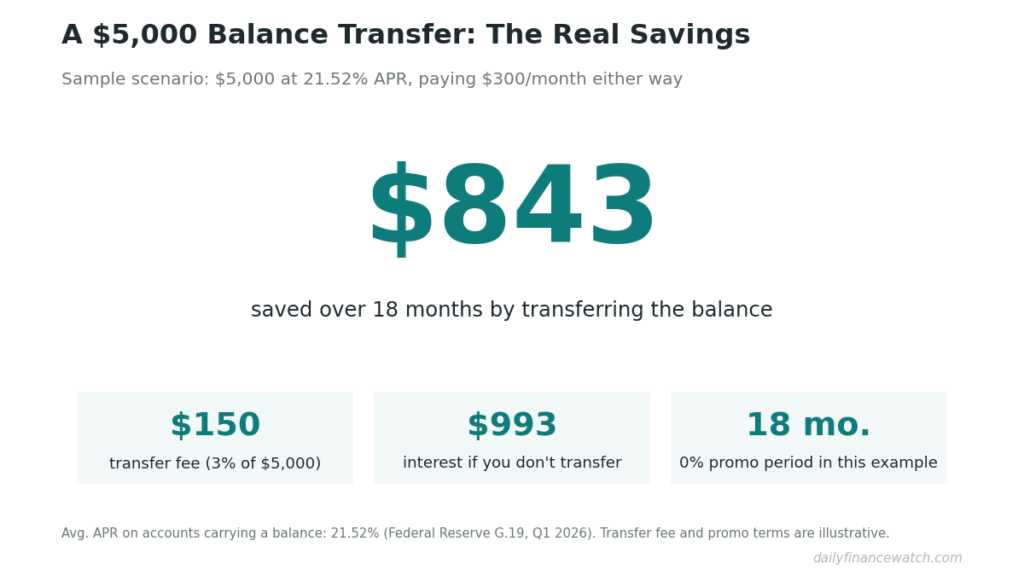
A sample $5,000 balance transfer saves about $843 over 18 months compared with not transferring, once the 3% fee is factored in (average card APR from the Federal Reserve’s G.19 report, Q1 2026).
Where people trip up with balance transfers
Mistake one: not paying it off before the promo ends
Whatever balance is left when the promotional period ends starts accruing interest at the card’s standard rate. That rate is often as high, or higher, than what you started with. A balance transfer only saves money if most or all of the balance is gone before the deadline.
Mistake two: adding new charges to either card
Running up the old card again defeats the purpose of the balance transfer. New purchases on the new card can also start accruing interest immediately. They don’t usually share the 0% promotional rate. Treat both cards as off-limits until the transferred balance is paid off.
Other things to check before you apply
A few details matter beyond the headline rate. Balance transfers usually require good to excellent credit. That’s because the new issuer is taking on your existing debt. You typically can’t transfer a balance between two cards from the same issuer. Opening a new card also triggers a hard inquiry. That can cause a small, temporary dip in your credit score.
Getting started with a balance transfer
Add up your current balance, APR, and monthly payment on the card you want to move. Compare balance transfer offers, focusing on the fee and the length of the 0% period, not just the rate. Divide your balance plus the fee by the number of months in the promo. That tells you the fixed payment you’d need to clear it in time. Set up automatic payments at that amount. Leave both cards unused until the transferred balance hits zero.
Frequently Asked Questions
A few quick answers to common questions about balance transfer cards.
How much does a balance transfer usually cost?
Most cards charge 3% to 5% of the amount you move, added to your new balance right away. On a $5,000 transfer, that’s $150 to $250 before any interest applies.
Does a balance transfer hurt my credit score?
It can cause a small, temporary dip from the credit check on the new card. Paying down the balance over time can help your score more than that initial dip hurts it.
Can I transfer a balance between two cards from the same bank?
Usually not. Most issuers only allow balance transfers from a different company’s card, not between two cards they already issued to you.
What happens if I don’t pay off the balance before the promo ends?
The remaining amount starts accruing interest at the card’s standard ongoing rate. That rate applies only to what’s left, not retroactively to the entire original transfer. It can still erase much of what you saved, though.
The bottom line
A balance transfer can genuinely lower your interest cost, but the fee and the deadline both matter. Run the math on your own balance and rate before you apply. If you can’t realistically pay off the balance during the promotional period, the fee may cost more than it saves. With a clear payoff plan, a balance transfer can be one of the cheaper ways to cut interest costs.
This article is for general educational purposes only and is not personalized financial advice. Your own budget categories and amounts should reflect your actual income, expenses, and financial goals, not the averages cited here.