Last updated: July 7, 2026
Three credit card bills land on the same day, each with its own due date and its own rate. A debt consolidation loan promises to replace all of that with one bill, one due date, and one rate. Before you apply, it helps to see what that trade actually looks like in real numbers.
This guide explains how debt consolidation loans work and how they compare with your current cards. It also covers what to check before you sign.
Debt consolidation is one of several tools for tackling credit card debt. Balance transfers and the payoff methods covered elsewhere in this series are two others.
Key Takeaways
- A debt consolidation loan replaces multiple debts with one fixed-rate, fixed-term loan and a single monthly payment.
- Personal loan rates are typically much lower than credit card rates. The average is 11.40%, versus 21.52% for cards carrying a balance.
- In a sample $8,000 consolidation, a 3-year loan cut the monthly payment. It also saved about $1,497 in interest, compared with paying the cards down at a similar pace.
- A low “teaser” rate that later increases can erase the savings. So can a longer term that lowers the payment but raises the total cost.
- Consolidation only works if you stop adding new charges to the cards you paid off.
How debt consolidation loans work
A debt consolidation loan is money you borrow from a bank, credit union, or online lender to pay off several other debts at once. You use the loan proceeds to pay each existing balance directly. From there, you make one fixed payment on the new loan instead of several payments on the old debts.
Fixed rate, fixed term
Unlike a credit card, a personal loan used for debt consolidation usually has a fixed interest rate. It also has a fixed number of payments, often two to seven years. Your payment amount and payoff date are locked in from the start, as long as you keep paying on schedule.
What it typically costs
As of February 2026, the average rate on a two-year personal loan from a commercial bank was 11.40%. That’s well below the 21.52% average rate on credit card balances that carry interest. Some lenders also charge an origination fee, often 1% to 8% of the loan amount. That fee gets taken out of the funds before they reach you.
Is debt consolidation worth it?
The math depends on your rate, your term, and the rate on the debts you’re replacing. A lower rate helps. A longer term can quietly erase the benefit by stretching out how long you pay interest.
Worked example: consolidating $8,000 in credit card debt
Say you owe $8,000 spread across three credit cards, all at the average 21.52% APR. Paying $300 a month across all three takes about 37 months. Total interest comes to about $2,980.
Consolidate that same $8,000 into a personal loan at 11.40% APR over 36 months. The fixed payment comes to about $263 a month. Total interest drops to about $1,483.
That’s a lower monthly payment and a savings of about $1,497 in interest, for a payoff timeline that’s almost identical.
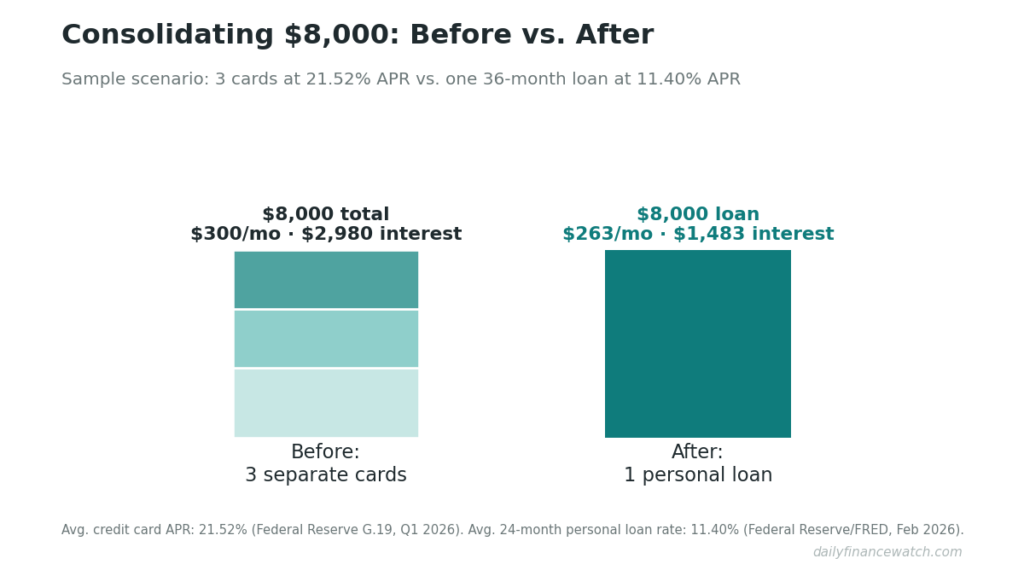
Consolidating $8,000 in credit card debt into a 36-month personal loan cuts the monthly payment and saves about $1,497 in interest (sample scenario; average card and personal loan rates from the Federal Reserve, Q1 2026 and February 2026).
Where people trip up with debt consolidation
Mistake one: missing the “teaser rate” warning
Some lenders advertise a low introductory rate that only applies for a limited time. Once that period ends, the rate can rise, and your payment along with it. Always ask whether the advertised rate is fixed for the full term or just the first stretch.
Mistake two: stretching the term to shrink the payment
A longer loan term can lower your monthly payment. It usually raises the total interest you pay, though. A consolidation loan can end up costing more overall than your original debts, even at a lower rate. Fees and a longer timeline are usually why.
Other things to check before you apply
A few details affect whether debt consolidation makes sense for you. Lenders look closely at your credit score and income. They’re extending a lump sum with no collateral in most cases. An origination fee reduces how much cash you actually receive. An $8,000 loan with a 3% fee only nets you $7,760. Closing the cards you pay off can also affect your credit utilization and average account age.
Getting started with debt consolidation
List every debt you want to fold into one loan, along with its balance and rate. Get quotes from a few banks, credit unions, and online lenders. Compare the APR, not just the advertised rate. Confirm the rate and term are fixed for the life of the loan. Use the loan to pay off the old debts directly, then leave those accounts unused. Set up automatic payments on the new loan so it never falls behind.
Frequently Asked Questions
A few quick answers to common questions about debt consolidation loans.
Does debt consolidation hurt my credit score?
It can cause a small, temporary dip from the credit check on the new loan. A track record of on-time payments and lower credit card balances helps more over time. That effect outweighs the initial dip.
Is a debt consolidation loan the same as a balance transfer?
No. A balance transfer moves debt onto a credit card, usually with a temporary 0% period. A debt consolidation loan is a separate installment loan with a fixed rate and term. It can also combine more than just credit card debt.
What credit score do I need for debt consolidation?
Requirements vary by lender. The lowest rates typically go to borrowers with good to excellent credit. Lower scores can still qualify, often at a higher rate.
Can I consolidate more than credit card debt?
Yes. Personal loans used for debt consolidation can often combine medical bills and other personal loans. Some other unsecured debts qualify too, not just credit cards.
The bottom line
A debt consolidation loan can lower your rate, simplify your payments, and even reduce your monthly bill. But the fixed term and any fees are part of the real cost. Compare the APR and total interest against what you’re paying now before you sign. Used well, alongside a plan to stop adding new debt, debt consolidation can be a predictable way to pay off what you owe.
This article is for general educational purposes only and is not personalized financial advice. Your own budget categories and amounts should reflect your actual income, expenses, and financial goals, not the averages cited here.
[4] Image
Placement: inside Body Copy, directly below the worked-example section (marker included above)
Filename: personal-loan-debt-consolidation-graphic.png
Caption: Consolidating $8,000 in credit card debt into a 36-month personal loan cuts the monthly payment and saves about $1,497 in interest (sample scenario; average card and personal loan rates from the Federal Reserve, Q1 2026 and February 2026).
Alt text: Bar chart comparing $8,000 in credit card debt across three cards versus one debt consolidation loan, showing lower payment and interest.