Last updated: July 7, 2026
You’ve finally built up some emergency savings. It’s sitting in the same checking account you use for groceries and bills. Because of that, it’s earning nothing, and it’s one impulse purchase away from disappearing. Having the money set aside is half the job. Where you keep it matters just as much.
This guide compares the real options for emergency savings and what each one actually pays. It also covers where you probably shouldn’t keep this money at all.
Key Takeaways
- The national average savings account rate is just 0.38%, according to FDIC data. However, many high-yield savings accounts pay several times that.
- A high-yield savings account is the most common home for emergency savings. The FDIC insures it, and it’s easy to access and pays real interest.
- On a $10,000 fund, the gap between a low-rate account and a high-yield one can add up fast. In fact, it can mean hundreds of dollars a year in interest, for the same safety and access.
- Money market accounts and CDs can play a role, though each comes with trade-offs that make them less ideal for the entire fund.
- Checking accounts, cash at home, and investments all carry real downsides for money you might need on short notice.
What makes a good home for emergency savings?
Three things matter most: safety, access, and some return. First, the money needs protection if the bank fails. Second, it should be available within a day or two when you need it. Finally, it ideally earns something better than nothing while it waits.
Traditional savings accounts vs. high-yield savings accounts
A traditional savings account at a big, familiar bank carries FDIC insurance and is easy to access. However, it also tends to pay very little. The national average sits at just 0.38%. An online bank, on the other hand, usually offers a high-yield savings account instead. It carries the same federal insurance and similar access, but it pays meaningfully more. In fact, many currently pay several times the national average.
Money market accounts
A money market account works much like a high-yield savings account, carrying the same FDIC or NCUA insurance up to $250,000. Still, it comes with a few differences. It sometimes pays a bit more than a standard savings account. Still, it may also require a higher minimum balance or limit certain withdrawals.
Certificates of deposit (CDs)
A CD can pay a competitive rate, but it locks up your money for a set term. Withdrawing early usually triggers a penalty. Because of that trade-off, a single CD makes a poor home for your entire emergency fund. A CD ladder, on the other hand, splits savings across CDs with staggered terms. That approach can work well for money beyond your core, most-liquid reserve.
Worked example: the cost of the wrong account
Say you keep a $10,000 emergency fund in a traditional savings account paying the national average of 0.38%. Over one year, that earns about $38 in interest. Now move the same $10,000 into a high-yield account paying 4.00% instead, a realistic example rate at several online banks. That same year earns about $400 instead.
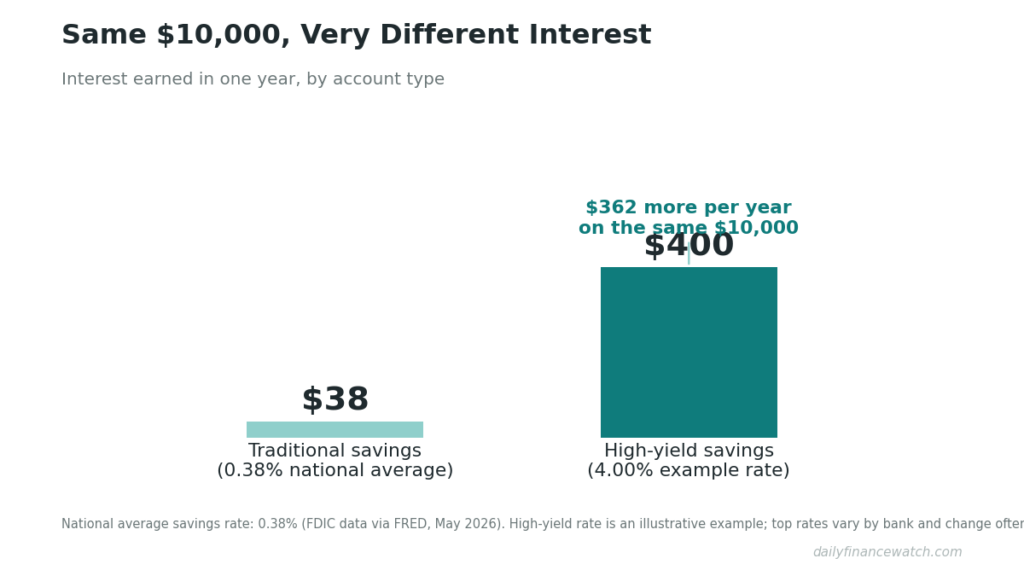
The same $10,000 emergency fund earns about $362 more in a year in a high-yield savings account than in an account paying the national average rate (FDIC data via FRED, May 2026; high-yield rate is illustrative).
Where you probably shouldn’t keep it
A regular checking account makes emergency savings too easy to spend on everyday purchases. Keeping cash at home is another common instinct. But it earns nothing, carries no insurance, and can disappear to loss, theft, or damage. Stocks or other investments bring a different risk. They can lose value at the exact moment you need to sell, since markets don’t wait for your emergencies. For all these reasons, emergency savings need to be stable and available, not growing as fast as possible.
Making sure it’s actually protected
The FDIC or NCUA protects deposit accounts at banks and credit unions. Coverage typically runs up to $250,000 per depositor, per institution, per ownership category. Before opening any account for your emergency fund, confirm the institution carries this coverage. Most banks and credit unions offer it standard. Still, it’s worth a quick check with a newer or less familiar online bank.
Where people trip up
Mistake one: chasing the highest rate at the cost of access
An account with a slightly higher rate isn’t worth much if transfers take a week. It’s just as much a problem if the institution is hard to reach when you need money fast. In this specific case, access matters just as much as yield.
Mistake two: keeping it in the same account as everyday spending
When emergency savings sit in the same account as grocery money, dipping into it feels easy. A separate account, on the other hand, creates a small but meaningful pause before you spend it.
Getting started
First, compare a few high-yield savings accounts at FDIC-insured banks or NCUA-insured credit unions. Next, confirm each option’s current rate, any minimum balance, and how quickly you can transfer money out. Then open the account and move your existing emergency savings over. After that, set up a small automatic transfer to keep building the fund. Finally, leave the account untouched except for genuine emergencies.
Frequently Asked Questions
A few quick answers to common questions about where to keep emergency savings.
Is a high-yield savings account safe?
Yes, as long as the FDIC insures the bank or the NCUA insures the credit union. Either way, your deposit carries the same protection a traditional savings account has, up to $250,000 per depositor, per institution.
Should I keep emergency savings in a CD?
Not the whole fund. A CD’s early-withdrawal penalty works against the whole point of emergency savings: having fast access. That said, a CD ladder can make sense for money beyond your immediate reserve.
How much should I keep in a checking account versus savings?
Keep enough in checking to cover regular bills with a small buffer. Then move the rest of your emergency savings to a separate, higher-paying account, where it’s less tempting to spend.
Can I lose money in a high-yield savings account?
FDIC or NCUA insurance protects your principal up to the coverage limit. The rate itself can go down over time, since it’s variable. Still, your balance won’t shrink from market losses the way an investment account’s might.
The bottom line
Emergency savings need a specific kind of home. That means safe, quick to access, and paying something better than nothing while it sits there. Overall, a high-yield savings account or money market account at an insured institution usually fits best. So confirm your coverage, compare a few real rates, and keep the account separate from your everyday spending.
This article is for general educational purposes only and is not personalized financial advice. Your own budget categories and amounts should reflect your actual income, expenses, and financial goals, not the averages cited here.