Last updated: July 7, 2026
Your car breaks down, and the repair bill comes to $900. Without an emergency fund set aside, that single bill can turn into a stressful scramble. Or it becomes a new balance on a credit card. The question most people ask at that point is how much they should have set aside in the first place.
This guide covers how much to actually keep in an emergency fund and how prepared other Americans really are. It also covers how to build yours without feeling overwhelmed.
Key Takeaways
- Just 55% of U.S. adults have enough savings to cover three months of expenses if they lost their income. That’s according to the Federal Reserve’s latest household survey.
- The classic rule of thumb is three to six months of essential expenses. The right number for you depends on job stability, dependents, and other income in your household.
- 48% of adults could cover an emergency of $2,000 or more using savings alone. Meanwhile, 18% couldn’t cover even $100 this way.
- Saving regularly matters more than hitting an exact number right away. 85% of adults who always have money left over at month’s end have a three-month emergency fund. Just 13% of those who never do have one.
- Building the habit today matters more than reaching a specific target on day one.
What is an emergency fund, and how much do you actually need?
An emergency fund is money set aside specifically to cover unexpected costs or a loss of income. It’s kept separate from your everyday spending. It’s meant to be there when something breaks, someone gets sick, or a paycheck stops arriving.
The classic three-to-six-month rule
The most common guideline is to save three to six months of essential expenses. Think housing, food, utilities, insurance, and minimum debt payments. Three months is often considered a reasonable floor. Six months gives more of a cushion for a longer gap between jobs.
When to save more, or less
Some situations call for a bigger cushion. Single-income households, people with variable or commission-based pay, and those supporting dependents often lean toward six months or more. A stable dual-income household with low fixed costs might reasonably feel comfortable closer to three months. Some go even lower while paying down high-interest debt first.
How prepared are Americans, really?
In 2024, 55% of adults said they had set aside enough money for three months of expenses. They called it an emergency or “rainy day” fund. That’s up slightly from 54% in 2023, but down from a high of 59% in 2021.
The picture varies sharply by income. Only 24% of adults with family income under $25,000 had a three-month fund. That compares with 75% of those earning $100,000 or more. Age matters too: 36% of adults age 18 to 29 had one, compared with 72% of those 60 and older.
What actually counts as an emergency?
A true emergency is unplanned and necessary: a job loss, a medical bill, an urgent home or car repair. A planned expense isn’t an emergency just because you haven’t saved for it yet. That’s true even for a large one, like a holiday trip or a known upcoming bill. Keeping that distinction clear protects the fund for the moments it’s actually meant for.
Worked example: how long it takes to build a three-month fund
The average U.S. household spent about $6,545 a month in 2024, according to the Bureau of Labor Statistics. Three months of that comes to $19,635. Your own target should use your real monthly expenses, not this national average. Still, it’s a useful example to see the math in action.
Saving $200 a month toward that goal takes about 98 months, or a little over 8 years. Bump that to $400 a month, and the timeline drops to about 49 months, roughly 4 years. At $600 a month, the same fund is done in about 33 months, under 3 years.
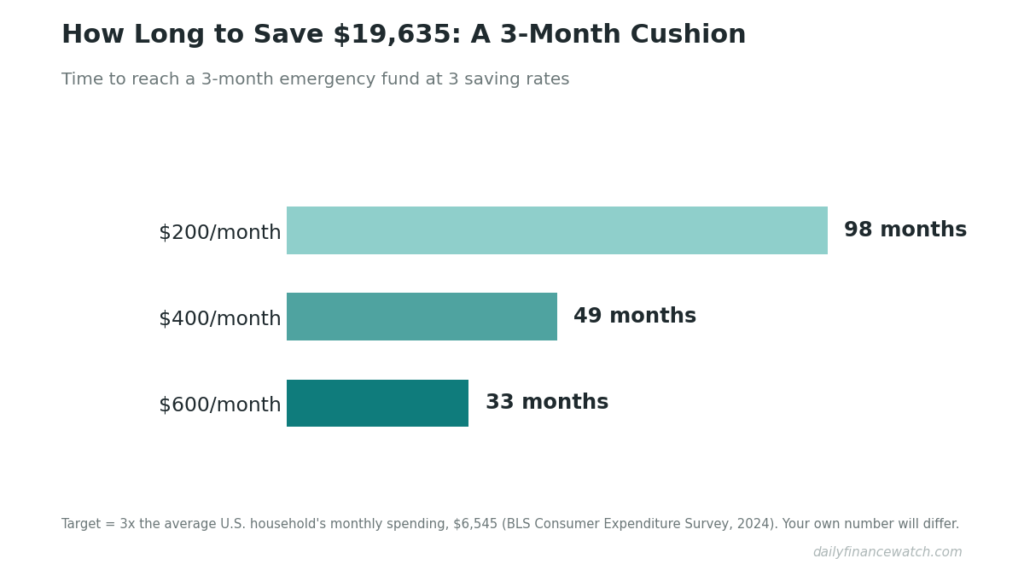
Reaching a 3-month emergency fund of $19,635 takes anywhere from about 33 months to over 8 years, depending on how much you save each month (target based on average household spending, BLS Consumer Expenditure Survey, 2024).
Where to keep your emergency fund
The short answer is somewhere safe and easy to access. It shouldn’t be so easy that you dip into it for everyday spending. A dedicated savings account, separate from your checking account, is the most common choice. Our guide on where to keep emergency savings walks through the specific account types and trade-offs.
Where people trip up building an emergency fund
Mistake one: waiting for a lump sum before starting
Some people delay starting because they’re waiting for a bonus, tax refund, or raise to kick things off. A fund built from small, regular amounts still grows, and it starts protecting you long before it’s full.
Mistake two: treating it as a second checking account
Dipping into the fund for non-emergencies, like a sale or a nice purchase, quietly drains it before you need it. Keeping it in a separate account, out of sight from daily spending, helps preserve the boundary.
Getting started
Add up your essential monthly expenses: housing, utilities, food, insurance, and minimum debt payments. Multiply that number by three to set your first target. Open a dedicated savings account if you don’t already have one. Set up an automatic transfer for whatever amount fits your budget, even a small one. Increase that amount whenever your income grows or a bill gets paid off.
Frequently Asked Questions
A few quick answers to common questions about emergency funds.
How much should I really have in an emergency fund?
Most guidance points to three to six months of essential expenses. Three months is a reasonable starting target for most people. Six months tends to suit single-income households or less stable income better.
Is it bad to keep too much in an emergency fund?
Not dangerous, but potentially inefficient. Cash sitting well beyond six to nine months of expenses could often do more for you elsewhere. A retirement account or other investment might fit better, depending on your broader financial goals.
Should I build my emergency fund or pay off debt first?
Many people do both at once. They start with a smaller fund of $500 to $1,000, pay down high-interest debt, then build the fund further once that debt is gone.
What if I can’t save $200 a month right now?
Start with whatever amount is realistic, even $20 or $25. The habit of saving consistently matters more at first than the size of any single deposit.
The bottom line
An emergency fund doesn’t need to be perfect on day one. Three months of essential expenses is a reasonable target for most people. Aim for more with less stable income, and less while you tackle high-interest debt. What matters most is starting now, saving consistently, and keeping the fund separate from your everyday spending.
This article is for general educational purposes only and is not personalized financial advice. Your own budget categories and amounts should reflect your actual income, expenses, and financial goals, not the averages cited here.