Last updated: July 8, 2026
Your car starts making a grinding noise every time you brake. You already know what that means — brake pads wear down on a schedule, not by accident. The stress isn’t the noise, but the fact that you have no cash for a bill you saw coming. A sinking fund fixes exactly that kind of gap.
It’s a savings account you build on purpose, a little at a time. It covers one specific expense you already know is coming. Instead of scrambling when the bill arrives, you simply pay yourself back.
Key Takeaways
- A sinking fund is money set aside on a regular schedule for one specific, predictable expense — not a general safety net.
- It’s different from an emergency fund, which covers surprises like a layoff or an unexpected medical bill.
- The math is simple: divide the expense by the months until you need it, then save that amount monthly.
- U.S. households spend an average of $984 a year on vehicle repairs and maintenance (Bureau of Labor Statistics) — a common first sinking fund.
- Giving each sinking fund its own labeled account makes it easier to track and harder to accidentally spend.
What is a sinking fund?
A sinking fund is money you set aside gradually, in a dedicated account, for one specific expense. You know the expense is coming, even if you don’t know the exact date.
Businesses have used the term for more than a century, to describe cash reserved to pay off a future debt. In personal finance, it means the same idea applied to your own bills. Think insurance premiums, holiday gifts, an annual repair bill, or a trip you’re already planning.
How a sinking fund differs from an emergency fund
An emergency fund and a sinking fund both live in savings accounts, but they do different jobs. An emergency fund covers what you can’t predict, like a layoff or a broken furnace in February. A sinking fund covers what you can predict, because you already scheduled it.
If you haven’t built an emergency fund yet, treat that as the first priority. Sinking funds work best once that cushion already exists.
How much should you save, and how do you calculate it?
The formula behind every sinking fund is simple. Take the total cost of the expense. Then divide it by the number of months you have until you need the money. That answer is your monthly contribution.
Some expenses have a fixed date, like a semiannual insurance premium. Others don’t, like a car repair you’re pricing out in advance. When there’s no firm deadline, pick a reasonable savings window — twelve months is a common default. You can always adjust once the real bill shows up.
Worked example: saving for a $984 car-repair fund
The Bureau of Labor Statistics tracks how much U.S. households actually spend every year. In 2024, the average consumer unit spent $984 on vehicle maintenance and repairs alone. That covers brakes, tires, oil changes, and the occasional bigger repair.
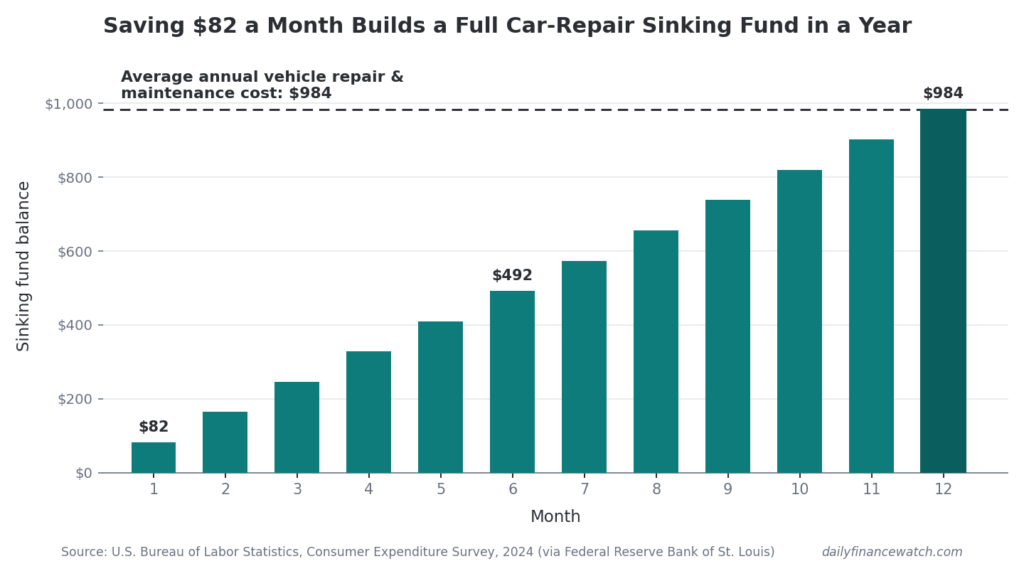
Saving $82 a month builds a full $984 car-repair sinking fund by month 12 (BLS Consumer Expenditure Survey, 2024).
Spread that over twelve months. The math gets simple: $984 divided by 12 comes out to $82 a month. Save that amount on autopilot, and the full $984 is waiting in the account by month twelve. That beats discovering the bill as a surprise charge on a credit card.
That $984 figure is a small slice of the bigger picture. The average U.S. household spent $78,535 on everything in 2024, per the same Bureau of Labor Statistics survey. A car-repair sinking fund is a little over 1% of that.
What expenses work well as sinking funds?
Almost any expense you can predict is a candidate. Three categories cover most of what people fund this way.
Predictable annual and seasonal bills
Some bills arrive on a schedule but not monthly. Think an annual or twice-a-year insurance premium, an annual subscription, property taxes paid directly, or holiday gifts every December. None of these are surprises. They’re just costly enough that paying them out of one month’s paycheck can hurt.
Occasional big-ticket repairs and replacements
Cars, appliances, and homes all wear out on their own timelines, not yours. A water heater typically lasts about a decade. A car needs brakes, tires, or a battery on no fixed calendar at all. A sinking fund turns “I’ll deal with it when it breaks” into “I already have the money.”
Spending you don’t want to feel guilty about
Not every sinking fund covers something you dread. A vacation, a wedding gift, or a holiday shopping budget all work the same way. You decide the amount in advance and save toward it on purpose. Then you spend it without a second thought when the time comes.
Where should you keep sinking fund money?
A sinking fund doesn’t need to earn a lot — it needs to stay separate and easy to reach. Many banks and credit unions let you open multiple named sub-accounts inside one regular savings account. That makes tracking simple without opening a new account for every goal. A basic savings account also works fine on its own.
Interest is a nice bonus, not the point. The FDIC’s national average savings account rate was just 0.38% in May 2026. That’s tracked via the Federal Reserve Bank of St. Louis. On a $1,000 balance, that works out to about $3.80 a year — not the reason you’re doing this.
If you’ve already looked into where to keep an emergency fund, the same accounts work here. The goal is separation from your everyday checking account, not a specific bank or app.
Where people trip up with sinking funds
Sinking funds are simple in theory. Two habits quietly undo them in practice.
Mistake one: mixing it with the emergency fund
Once the money is sitting in a savings account, it starts to look like one big pile of “extra” cash. Dip into the car-repair fund to cover a slow month. Now you’ve quietly borrowed from a bill you already know is coming. Keep each fund labeled and separate, even if that just means naming the sub-account.
Mistake two: forgetting to refill it after you spend it
A sinking fund isn’t a one-time save — it resets after every use. Pay the $984 repair bill from the fund, and the balance goes back to zero. Next year’s version of the same bill is already on its way. Treat the payout as the start of the next twelve months, not the end of the project.
Frequently Asked Questions
What is a sinking fund?
A sinking fund is money you set aside gradually, in its own account, for one expense you already know is coming. Common examples include an annual insurance premium, a holiday gift budget, or a car repair. It’s built on purpose, over time, so the bill doesn’t have to come out of one paycheck all at once.
How is a sinking fund different from an emergency fund?
An emergency fund covers costs you can’t predict, like a layoff or a sudden medical bill. A sinking fund covers costs you can predict, because you’re the one who scheduled the saving. Most people build a small emergency fund first, then layer sinking funds on top of it.
How much should you put into a sinking fund each month?
Divide the total expense by the number of months you have until you need it. A $984 annual car-repair fund, saved over 12 months, comes out to $82 a month. If the expense doesn’t have a fixed date, a 12-month window is a reasonable default.
Where should you keep sinking fund money?
A regular savings account or a labeled sub-account both work well. The important thing is keeping the money separate from everyday checking, not maximizing the interest rate. As of May 2026, the national average savings rate was only 0.38%, so growth is a minor factor here.
The bottom line
A sinking fund is one of the simplest tools in personal finance. It’s also one of the easiest to skip, because nothing forces you to start one. The payoff shows up months later.
The first time a dreaded bill arrives, the cash is already sitting there waiting. Pick one predictable expense, do the division, and automate the transfer — the rest takes care of itself.
This article is for general educational purposes only and is not personalized financial advice. Your own budget categories and amounts should reflect your actual income, expenses, and financial goals, not the averages cited here.