Last updated: July 8, 2026
You apply for your first apartment, and the leasing office runs a credit check. The report comes back thin, with barely any history to judge. That’s not a mistake — there’s just nothing on file yet. Building a credit history means creating that track record on purpose, before you need it for something bigger.
Lenders, landlords, and even some employers check that record to decide whether to trust you with credit, a lease, or a paycheck. A thin file and a rough credit history both fix the same way. It takes consistent, on-time activity that gets reported to the credit bureaus.
Key Takeaways
- Building credit means creating a track record of on-time payments that gets reported to the three credit bureaus.
- Payment history makes up 35% of a FICO Score, and amounts owed makes up another 30% (myFICO) — together, nearly two-thirds of the score.
- A FICO Score needs at least one account open for six months, with activity reported in the past six months (myFICO).
- Federal Reserve research ties a secured card kept open two years to a 24-point score gain; credit-builder loans averaged 60 points for new borrowers.
- Debit cards, cash, and prepaid cards don’t build credit at all, because those payments are never reported to a bureau.
What does it mean to build a credit history?
A credit history is a record of how you’ve borrowed and repaid money over time. Three companies — Equifax, Experian, and TransUnion — collect that record from lenders and turn it into a credit report. A credit score, like a FICO Score, is a three-digit summary of what’s in that report.
Starting from zero vs. rebuilding after a rough patch
Some people have no credit history at all — sometimes called being “credit invisible.” That often happens to young adults, recent immigrants, or anyone who has simply paid for everything in cash. Others have a history, just not a flattering one: a missed payment, a maxed-out card, a collections account. Both situations use the same toolkit — the steps that build credit from nothing are largely the same ones that repair it.
How long does it take to build a credit history?
A FICO Score has a floor requirement, not just a starting point. myFICO requires at least one account open for six months, with activity reported to a bureau in the past six months. Below that, there simply isn’t enough data to generate a score.
Worked example: what two credit-building tools actually do to a score
A Federal Reserve review of the credit-building market compared two common tools. The review tied two years of an open secured card to an average 24-point score increase.
A credit-builder loan did more. Previously unscored borrowers who used one were 24% more likely to end up with a score at all. Average gains ran about 60 points.
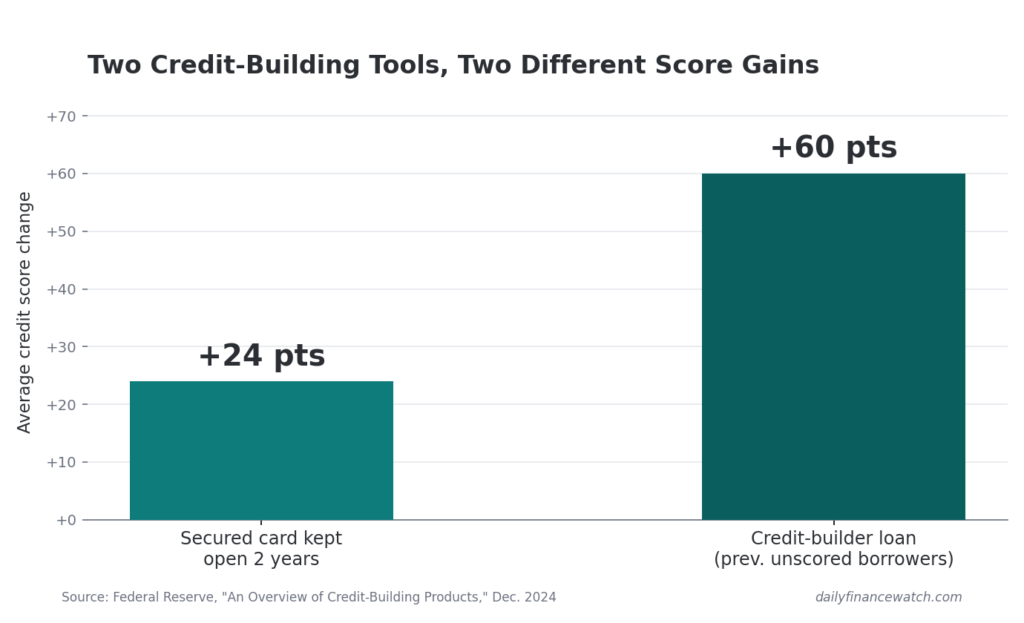
A secured card held two years links to a 24-point score gain; a credit-builder loan averaged 60 points for new borrowers (Federal Reserve, Dec. 2024).
Neither tool is free of risk. The same research tied a secured-card default to a 60-point drop, erasing more than two years of gains in a single missed cycle.
How do you actually build it?
Open a secured credit card
A secured card works like a regular credit card, but you put down a cash deposit first. The Consumer Financial Protection Bureau describes a common setup: a $500 deposit that becomes a $500 credit limit.
Your available balance refills as you pay down what you charge. On-time payments get reported to the bureaus just like an unsecured card.
Try a credit-builder loan
A credit-builder loan flips the usual order. The bank holds the loan amount in a locked savings account while you make payments, typically over six to 24 months. You get the money, plus the payment history, once the term ends.
Become an authorized user
Ask a family member to add you to their older, well-managed credit card, and some of their positive history can import onto your report. This works best when the primary cardholder pays on time and keeps balances low. Their habits become part of your file too, for better or worse. Check the account’s history first — a poorly managed card can hurt your file the same way a good one helps it.
What actually builds credit, and what doesn’t
Two factors drive most of a FICO Score: payment history at 35%, and amounts owed at 30%. Everything else follows from those two.
What counts
Reported, on-time payments count — on a credit card, a credit-builder loan, or a rent-reporting service. Keeping balances low relative to your limit counts too. So does simply letting accounts age instead of closing them.
What doesn’t count
Debit cards, cash, and prepaid cards don’t build credit at all, because those payments are never reported to a bureau. Payday loans and buy-here-pay-here auto loans skip reporting too, per the CFPB’s guidance on building credit.
Where people trip up building credit
Mistake one: closing your oldest account
Length of credit history is 15% of a FICO Score, and closing your oldest card shortens that average overnight. Keep old accounts open, even ones you rarely use, as long as there’s no annual fee working against you.
Mistake two: applying for too much credit at once
Every credit application triggers a hard inquiry, and several close together can look like financial distress to a lender. New credit only counts for 10% of a FICO Score. Still, stacking inquiries in a short window knocks off points you didn’t need to lose.
Frequently Asked Questions
What’s the fastest way to build credit?
There’s no real shortcut, but a secured card or credit-builder loan paired with on-time payments is the most direct route. Federal Reserve research links both tools to measurable score gains within about two years.
How long does it take to get your first credit score?
At least six months. A FICO Score requires one account open for six months, with activity reported to a bureau within that same window.
Does checking your own credit score hurt it?
No. Checking your own score is a soft inquiry, and soft inquiries don’t affect your score. Only hard inquiries, triggered when a lender checks your file for a new application, have any impact.
Can you build credit without a credit card?
Yes. A credit-builder loan reports to the bureaus the same way a card does. Some services now report on-time rent payments too, which helps if you don’t want another loan or card.
The bottom line
Building credit isn’t about one clever move. It’s about a boring, repeatable habit: open one reported account, pay it on time, and let it age.
The tools differ, but the mechanism doesn’t. Every method that works funnels back to the same two factors — payment history and how much of your credit you’re using.
This article is for general educational purposes only and is not personalized financial advice. Your own budget categories and amounts should reflect your actual income, expenses, and financial goals, not the averages cited here.