Last updated: July 8, 2026
Payday hits your account, and within a week, it’s gone. Rent, groceries, and a few small treats eat through it before savings gets a turn. That’s not a willpower problem — it’s an order-of-operations problem. Pay yourself first flips that order, moving money into automatic savings before you can spend it.
You treat savings like a fixed bill instead of an afterthought. It comes out right after your paycheck lands, not whenever there’s something left over. The rest of your budget simply adjusts around what remains.
Key Takeaways
- Pay yourself first means moving money into savings automatically, on payday, before you spend on anything else.
- It works through automatic savings — a recurring transfer, a split direct deposit, or a retirement contribution — not willpower.
- The average American saved just 2.6% of disposable income in April 2026, per the Bureau of Economic Analysis — thin evidence of “leftover” saving.
- On the median U.S. household income of $83,730 (Census Bureau, 2024), that 2.6% works out to about $181 a month.
- Automating even a modest, fixed amount tends to beat waiting to see what’s left over at the end of the month.
What does “pay yourself first” mean?
Pay yourself first is a savings rule, not a specific account or app. Instead of paying bills, spending on wants, and saving whatever’s left, you reverse the order. Savings comes out first, right after your paycheck lands, and everything else gets budgeted around what remains.
The name is a bit misleading, since no cash actually lands in your pocket. The money moves straight into a savings or retirement account. It works the same way a landlord or a lender gets paid automatically every month.
Why the order matters
Money sitting in your checking account is easy to justify spending. A small treat here, a slightly nicer dinner there — it adds up quietly. Moving savings out first removes that decision, so there’s nothing left to talk yourself out of.
This is also why “save whatever’s left” rarely works as a plan. There’s almost always something else competing for that same leftover cash. It might be a friend’s birthday dinner, or a sale that looked too good to skip.
How much does “leftover” saving actually add up to?
Worked example: the national savings rate in dollars
The Bureau of Economic Analysis tracks how much of their income Americans actually save. In April 2026, the personal saving rate was just 2.6% — near the low end of its usual range.
Apply that rate to the median U.S. household income of $83,730 in 2024. The math works out to about $2,177 saved a year. Spread evenly, that’s roughly $181 a month for a household earning the median.
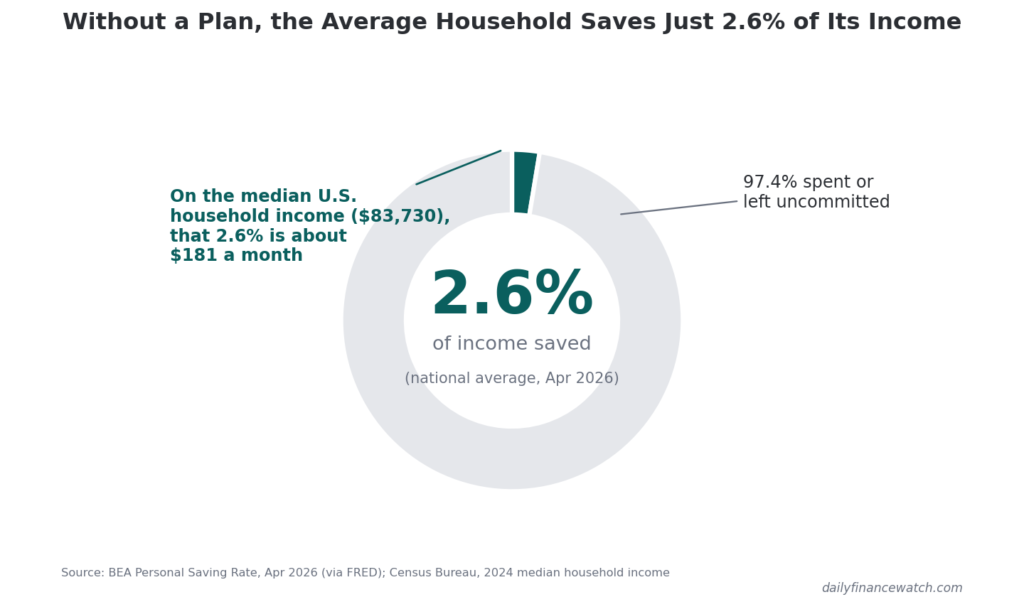
Without a plan, households save just 2.6% of income — about $181 a month on the median U.S. income (BEA, Apr. 2026; Census Bureau, 2024).
That’s what happens when saving is whatever’s left over. Pay yourself first sets the amount on purpose, instead of letting it drift with a slow month or a good one.
How do you set up automatic savings?
Setting up automatic savings takes one decision and one recurring instruction. Pick an amount, then automate the transfer so it happens without you.
Pick an amount you can actually automate
Start with an amount that won’t trigger an overdraft, even in a tight month. A modest, consistent transfer that actually happens beats an ambitious one you cancel after two paychecks.
There’s no required starting number. Many people begin with a small, round amount and raise it later. That often happens after a raise, or once a bill drops out of the budget.
Set up automatic savings at the source
The Consumer Financial Protection Bureau recommends a recurring transfer set up right after payday. Splitting your direct deposit works too, sending part of every paycheck straight into savings. Some employers let you split a paycheck between two accounts directly, skipping checking entirely.
Round-up programs work on the same principle, on a smaller scale. Each debit card purchase gets rounded up to the nearest dollar. The spare change sweeps into savings automatically, without a separate decision each time.
Let retirement contributions do it for you
A 401(k) or similar workplace plan is pay yourself first on autopilot. The contribution comes out of your paycheck before you ever see the money. It works the same way rent comes out of a checking account, on a schedule you don’t have to think about twice.
What should you pay yourself first for?
Start with the emergency fund
If you haven’t built one yet, most of that automatic transfer should go toward an emergency fund first. That’s cash for the surprises a budget can’t predict.
Then layer in sinking funds and other goals
Once that cushion exists, split the same transfer further. Some can go to sinking funds for expenses you already know are coming. Some can go toward a retirement account for the decades ahead.
Where people trip up with pay yourself first
Mistake one: automating an amount you can’t actually afford
Automatic savings only works if the amount survives contact with your real budget. Setting the transfer too high backfires. An overdraft fee or a bounced bill erases whatever you just saved.
A lot of people just turn the automation off entirely after that happens once. Start smaller than feels impressive — a transfer that survives beats one that gets canceled.
Mistake two: never revisiting the amount
An automatic transfer set up two raises ago is still just the old amount, quietly out of date. Revisit it after a raise, a paid-off debt, or a big bill that drops out of the budget.
Frequently Asked Questions
What does “pay yourself first” mean?
Pay yourself first means moving money into savings automatically, right after your paycheck arrives. It happens before you pay bills or spend on anything else. The transfer runs through automatic savings, not through willpower or memory. That might mean a recurring bank transfer, a split direct deposit, or a retirement contribution.
How much should you pay yourself first?
There’s no single required amount. Start with whatever you can automate without risking an overdraft. Increase it later, after a raise or once a bill drops out of your budget.
Is pay yourself first the same as an emergency fund?
No. Pay yourself first is the automation method — the recurring transfer itself. An emergency fund is one common destination for that money, especially before other savings goals.
What’s the easiest way to automate it?
A recurring transfer from checking to savings, timed to land right after payday, is the simplest setup. Splitting a direct deposit at the source works too, and it skips checking entirely.
The bottom line
Pay yourself first is less a strategy than a scheduling trick for automatic savings. It works because the money moves before you’re ever tempted to spend it.
Pick an amount that fits your budget today, automate the transfer, and let it run in the background. The habit compounds quietly, one payday at a time.
This article is for general educational purposes only and is not personalized financial advice. Your own budget categories and amounts should reflect your actual income, expenses, and financial goals, not the averages cited here.