Last updated: July 7, 2026
You’re at checkout, and a button offers to split the $200 charge into four payments of $50, interest-free. It feels like a smaller decision than it really is. Before you tap that button again, it helps to understand the real BNPL risks behind the convenience.
This guide explains what buy now, pay later actually is. It covers the specific BNPL risks it carries and where regulation stands right now. It also covers how to use BNPL more safely if you choose to.
Key Takeaways
- BNPL risks include “phantom debt”: multiple plans spread across different apps that no single lender can see all at once.
- About 1 in 4 BNPL users paid late in the past year, according to Federal Reserve survey data. More than half of those were charged an extra fee for it.
- BNPL loans are starting to show up on credit reports. FICO began factoring BNPL payment history into new scoring models in late 2025.
- As of mid-2025, BNPL providers aren’t required to offer the same federal protections as credit cards. That’s after the CFPB withdrew its 2024 rule.
- Treating BNPL like real debt, not “free money,” is the simplest way to avoid its biggest risks.
What is BNPL, and why does it feel risk-free?
Buy now, pay later, often called Pay-in-4, lets you split a purchase into a small number of equal payments. That’s usually four payments, typically without interest. You pay the first installment at checkout and the rest automatically over the following weeks. There’s no interest, and the first payment is small. Because of that, it doesn’t feel like taking on debt the way a credit card does.
The “phantom debt” problem
Each BNPL plan is small on its own. The risk shows up when someone holds several plans across different apps at the same time. Traditional lenders can’t see most of that debt when they check your credit. Much of it isn’t reported the way credit cards are. That gap makes it easy to take on more than you’d realize, spread across purchases that each felt manageable alone.
The real BNPL risks to know about
Missed payments and late fees
About 1 in 4 BNPL users, 24%, paid late at least once in the past year. That’s according to the Federal Reserve’s 2024 survey of household finances. More than half of those who paid late, 57%, were charged an extra fee for it. BNPL payments are usually automatic. A low bank balance on the due date can trigger a late fee, even if the miss wasn’t intentional.
Credit score impact is changing
Your BNPL history hasn’t traditionally shown up on your credit report. That’s shifting. FICO introduced new scoring models in late 2025: FICO Score 10 BNPL and FICO Score 10 T BNPL. Both factor in BNPL accounts. On-time payments can help build credit for people who are new to it. Missed payments can now hurt your score much like a late credit card bill would.
Thin regulatory protection, for now
As of mid-2025, BNPL providers generally aren’t required to give you the same protections as a credit card issuer. The CFPB had issued a rule in 2024 treating certain BNPL plans like credit cards under federal law. An industry lawsuit challenged that rule. The CFPB withdrew it in May 2025 and stated it does not plan to reissue a revised version. Some states have started to fill the gap on their own. New York, for example, has passed its own law. It requires BNPL providers to register with the state and disclose their terms clearly. This is an area worth rechecking periodically, since it has already changed once and could change again.
How to lower your BNPL risks
Keep a running list of every plan you have open, across every app, with the amount and due date. Set a personal limit for how many BNPL plans you’ll carry at once. Treat each plan as a real payment obligation in your budget, not a future problem. Turn on payment reminders in addition to autopay, so a low balance doesn’t catch you off guard. Avoid opening a new plan to cover a payment on an existing one.
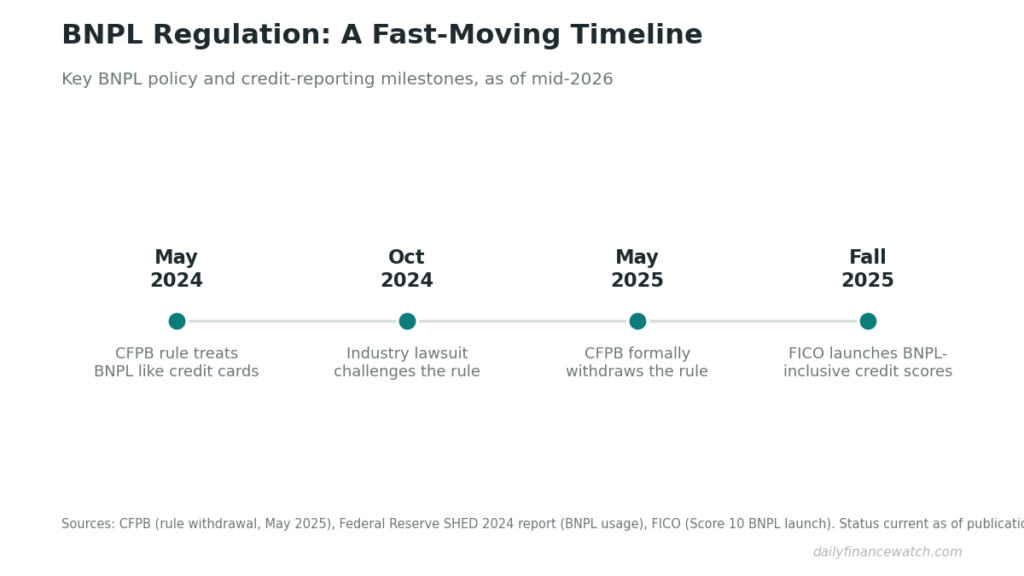
BNPL regulation has moved quickly: a 2024 CFPB rule treating BNPL like credit cards was withdrawn in 2025, while FICO began factoring BNPL data into credit scores the same year (Federal Reserve, CFPB, and FICO, as of mid-2026).
Frequently Asked Questions
A few quick answers to common questions about BNPL risks.
What are the main BNPL risks?
The biggest ones are overspending across multiple plans that no single lender can see. Late fees from missed automatic payments are another. A third is the growing effect on your credit score, as more scoring models start including BNPL data.
Does BNPL affect my credit score?
It’s starting to. New FICO scoring models introduced in late 2025 include BNPL payment history. Older, more widely used scoring models still don’t. The effect on any one score depends on which model a lender uses.
Is BNPL regulated like credit cards?
Not currently. A 2024 federal rule would have applied credit-card-style protections to some BNPL plans, but the CFPB withdrew it in 2025. Some states have since passed their own BNPL rules, so protections can vary by where you live.
Is it bad to use BNPL if I pay on time?
Not necessarily. The risk mostly comes from stacking multiple plans at once or missing payments. Someone who uses one plan at a time and pays on schedule faces far less risk than someone juggling several.
The bottom line
BNPL can be a reasonable way to spread out a purchase. But it carries real risks that don’t show up at checkout. Multiple plans can add up faster than they feel like they should. Late payments can now cost you in fees and credit score points. And federal protections are thinner than they are for credit cards. Track what you owe across every app. Keep your plan count low, and treat BNPL like the debt it actually is.
This article is for general educational purposes only and is not personalized financial advice. Your own budget categories and amounts should reflect your actual income, expenses, and financial goals, not the averages cited here.