Last updated: June 30, 2026
A beginner comparing stocks, bonds, and mutual funds tries to pick the best one of the three, as if choosing among three competitors. The comparison itself is built on a category error. Stocks and bonds are asset classes — fundamentally different types of investments. A mutual fund is not a third asset class; it is a container that holds stocks, bonds, or both. Comparing these three as equivalent options is like comparing apples, oranges, and a fruit basket. Understanding the distinction changes how a beginner approaches building a portfolio.
What Each of These Actually Is
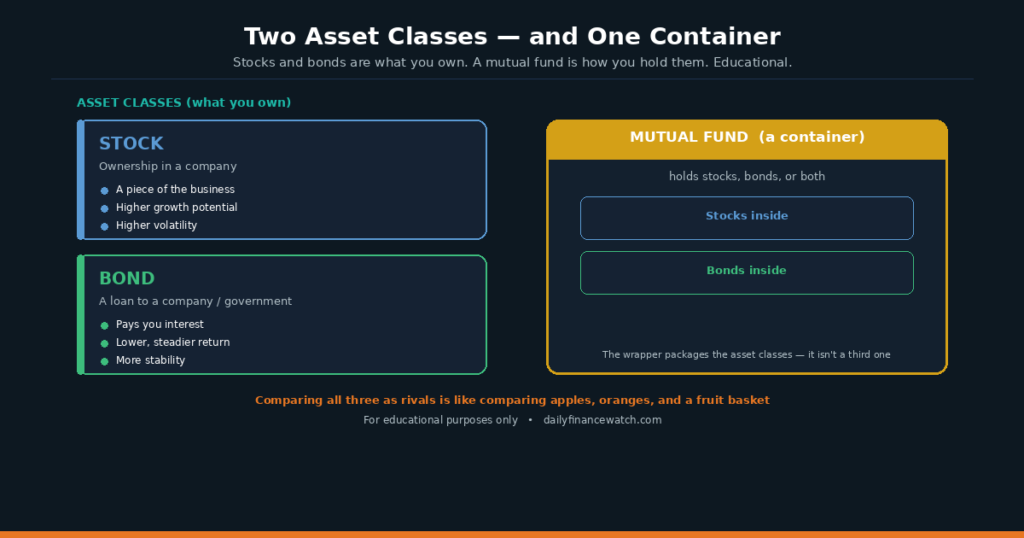
Caption: Stocks and bonds are distinct asset classes; a mutual fund is a container that can hold either or both.
A stock represents ownership in a company. When you buy a share, you own a small piece of the business and benefit if it grows, while bearing the risk if it declines. Stocks offer higher potential long-term growth with higher volatility. A bond is different in kind: it represents a loan you make to a company or government, which agrees to pay you interest and return your principal at a set date. Bonds generally offer lower returns with more stability.
A mutual fund belongs to a separate category entirely. It is a pooled investment that collects money from many investors and buys a portfolio of securities — which can be stocks, bonds, or a mix. The fund is a wrapper, not an underlying asset. So a “stock mutual fund” holds stocks, and a “bond mutual fund” holds bonds. The mutual fund did not replace the asset class; it packaged it.
Why the Three-Way Comparison Misleads
Most beginner guides present these as three parallel options to choose between. This framing creates confusion because it mixes two different questions. The first question is which asset classes to own — stocks, bonds, or both — which determines your risk and return. The second question is how to hold them — individually or through a fund wrapper like a mutual fund. These are separate decisions. Therefore, the useful comparison is stocks versus bonds as asset classes, and individual securities versus funds as a holding method, not a single three-way contest.
| Feature | Stocks | Bonds | Mutual Funds |
|---|---|---|---|
| What it is | Asset class (ownership) | Asset class (loan) | Container (holds assets) |
| Represents | A piece of a company | A loan to an issuer | A pool of securities |
| Typical risk | Higher | Lower | Depends on holdings |
| Typical return | Higher long-term | Lower, steadier | Depends on holdings |
| Diversification | One company per stock | One issuer per bond | Built-in across many |
How Stocks and Bonds Differ as Asset Classes
The genuine comparison is between stocks and bonds, because these are the actual building blocks. They behave differently, which is precisely why portfolios often hold both. Stocks tend to grow more over long periods but swing widely in value. Bonds tend to grow less but provide stability and income, often holding steadier when stocks fall. This difference in behavior is the foundation of asset allocation.
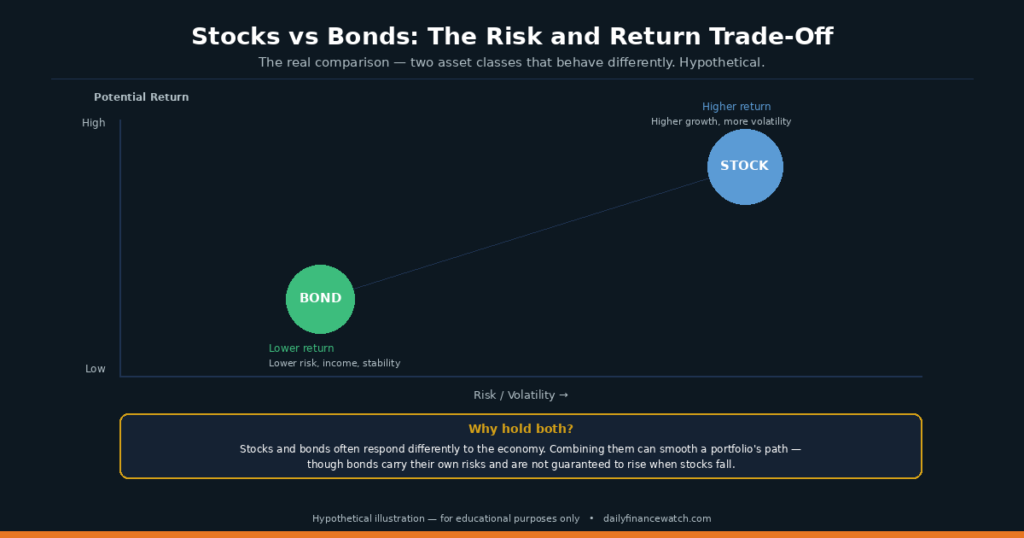
Caption: Stocks offer higher growth with more volatility; bonds offer stability and income — combining them balances a portfolio.
The U.S. government issues some of the most widely held bonds, and the SEC’s investor education resources at Investor.gov explain how bonds work and the risks they carry, including interest-rate and credit risk. Because stocks and bonds often respond differently to economic conditions, holding both can smooth a portfolio’s overall path. When stocks decline, the stability of bonds can cushion the fall, though bonds carry their own risks and are not guaranteed to rise when stocks drop.
Why Mutual Funds Exist
Mutual funds solve a practical problem: diversification is hard to achieve with individual securities. Buying enough individual stocks and bonds to diversify properly requires significant money and effort. A mutual fund pools many investors’ money to buy a broad portfolio, giving each investor instant diversification with a single purchase. This is the wrapper’s value — not a different kind of return, but an easier way to hold a diversified mix of the underlying asset classes.
How Beginners Should Think About the Choice
The clearer mental model replaces the three-way question with two simpler ones. First, decide your asset allocation: what mix of stocks and bonds fits your time horizon and risk tolerance. Second, decide how to hold that mix: through individual securities, which require research and capital, or through funds, which provide diversification automatically. For most beginners, funds answer the second question easily.
Most guides advise beginners to “diversify across stocks, bonds, and mutual funds.” This phrasing is muddled because it treats a wrapper as if it were an asset class. The accurate guidance is to diversify across asset classes — stocks and bonds — and to use funds as the practical vehicle for doing so. Institutional investors think in terms of asset-class exposure first and implementation vehicle second, never confusing the container with its contents. A mutual fund holding only one stock would not be diversified; a fund holding 500 would be — the diversification comes from the holdings, not the wrapper.
For investors building this foundation, what is an index fund explains the most efficient low-cost fund type, and how to build your first portfolio covers the asset allocation decision in detail.
Common Mistakes in Comparing These
The most frequent error is treating a mutual fund as inherently safer or better than stocks. A stock mutual fund holding volatile stocks carries the volatility of those stocks; the wrapper does not remove it. The fund’s risk comes entirely from what it holds. Believing the wrapper itself provides safety leads to misjudged risk.
A second mistake is overlooking bonds entirely. Beginners drawn to stocks’ higher returns sometimes ignore bonds, leaving a portfolio more volatile than their temperament can handle. This often reflects recency bias after a long stock rally, when stability feels unnecessary — until a decline arrives and the absence of bonds is felt sharply.
What Disciplined Investors Understand
Smart money practice separates the asset-class decision from the vehicle decision cleanly. Disciplined investors first determine how much to allocate to stocks versus bonds based on goals and risk tolerance, then choose efficient vehicles — often low-cost funds — to implement that allocation. They never confuse owning a mutual fund with having diversified, because they look through the wrapper to what it actually holds.
A disciplined investor also evaluates a fund by its underlying holdings, costs, and what asset classes it covers, rather than treating “mutual fund” as a category of safety. They understand that the same dollar can be held as an individual stock, inside a stock fund, or inside a mixed fund, with the risk determined by the assets, not the format. This does not guarantee returns, but it prevents the category confusion that distorts beginner decisions.
What you should now understand differently is the question itself. There is no three-way contest among stocks, bonds, and mutual funds. There are two asset classes — stocks and bonds — that determine your risk and return, and there are vehicles like mutual funds that determine how conveniently you hold them. Decide your stock-and-bond mix first, then pick the vehicle to hold it. Once you stop comparing a fruit basket to fruit, the choices become clear.
FAQ
What is the difference between stocks, bonds, and mutual funds?
Stocks and bonds are asset classes, while mutual funds are containers that hold them. A stock is ownership in a company; a bond is a loan to a company or government that pays interest. A mutual fund pools money from many investors to buy a portfolio of stocks, bonds, or both. So stocks and bonds are what you own, while a mutual fund is one way to hold them — not a separate type of investment competing with the other two.
Are mutual funds safer than stocks?
Not inherently. A mutual fund’s risk depends entirely on what it holds. A mutual fund made up of volatile stocks carries that volatility; the wrapper does not remove it. What mutual funds reliably provide is diversification — spreading money across many securities in a single purchase — which can reduce company-specific risk. But a stock fund is still exposed to overall stock-market declines. Safety comes from the underlying holdings and diversification, not from the mutual fund format itself.
Should a beginner invest in stocks, bonds, or mutual funds?
The clearer approach is to decide an asset-class mix first, then a vehicle. Determine how much to hold in stocks versus bonds based on your time horizon and risk tolerance. Then choose how to hold that mix — most beginners use low-cost funds for instant diversification. So it is rarely an either-or among the three. A typical beginner portfolio holds both stocks and bonds through funds, combining the asset classes with a convenient, diversified vehicle.
This content is for educational purposes only and does not constitute personalized financial advice. All investing involves risk, including the possible loss of principal.