Last updated: July 3, 2026
Most people know high-yield savings accounts pay more than traditional ones. Fewer understand why — and that gap in understanding is what leads to decisions based on rate-chasing rather than the underlying structure of how these accounts work.
What a High-Yield Savings Account Is
A high-yield savings account is a federally insured deposit account that pays a significantly higher annual percentage yield than the national average for standard savings products. These accounts function like ordinary savings accounts in almost every respect: deposits earn interest, funds remain accessible, and balances stay protected up to federal insurance limits. The primary difference is the interest rate.
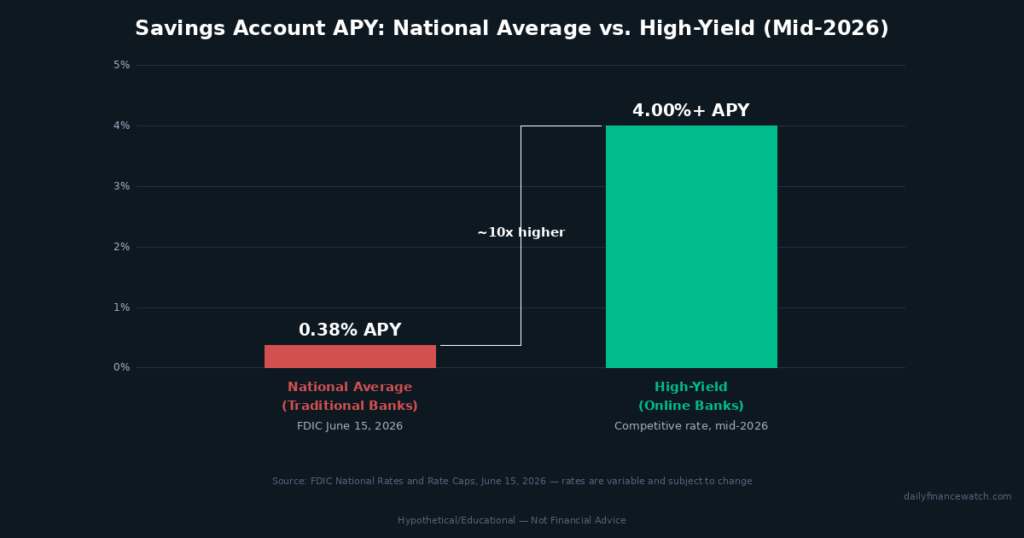
A bar chart comparing the national average savings APY against competitive high-yield savings account rates as of mid-2026.
According to the FDIC’s National Rates and Rate Caps published June 15, 2026, the national average APY for savings deposit products was 0.38%. Competitive high-yield savings accounts offered by online institutions were paying 4% or higher at the same time. That gap — more than tenfold — is not a temporary anomaly. Rather, it reflects a structural difference in how these institutions operate. You can verify the current national average directly at fdic.gov/national-rates-and-rate-caps.
Why the Rate Gap Exists
Traditional brick-and-mortar banks carry higher overhead costs. Branch networks, in-person staff, and physical infrastructure all require revenue to sustain. Banks partially offset those costs by paying depositors lower interest rates. Online-only banks — which typically have no branch networks and lower staffing requirements — operate with a lower cost structure. Consequently, they can pass a larger share of the interest earned on customer deposits back to those customers in the form of higher APYs. This structural cost advantage is the reason the gap between a national average savings rate and a competitive HYSA rate can stay wide even when the Federal Reserve holds benchmark rates steady.
How APY Differs from Interest Rate
APY stands for annual percentage yield. Unlike a simple interest rate, APY accounts for the effect of compounding — the process by which interest earned also earns interest in subsequent periods. Most savings accounts compound interest daily or monthly. Because APY reflects compounding, it gives a more accurate picture of what a deposit actually earns over a full year than a simple annualized rate does. Two accounts with identical stated interest rates but different compounding frequencies will produce different APYs. Federal law requires banks to disclose APY on savings products, which makes it the correct figure to use when comparing accounts.
The Federal Reserve Connection
High-yield savings account rates are variable, not fixed. Banks adjust their offered APYs in response to changes in the federal funds rate set by the Federal Reserve. When the Fed raises rates — as it did aggressively between 2022 and 2023 — savings account rates at competitive online institutions rose sharply, in some cases exceeding 5%. After the Fed cut its benchmark rate six times in 2024 and 2025, HYSA rates declined accordingly, though they remained well above the national average. As of mid-2026, the federal funds rate target range held at 3.50–3.75%, and competitive savings rates had stabilized in the 3.5–4.5% range. This rate sensitivity means that the APY earned today can change without advance notice.
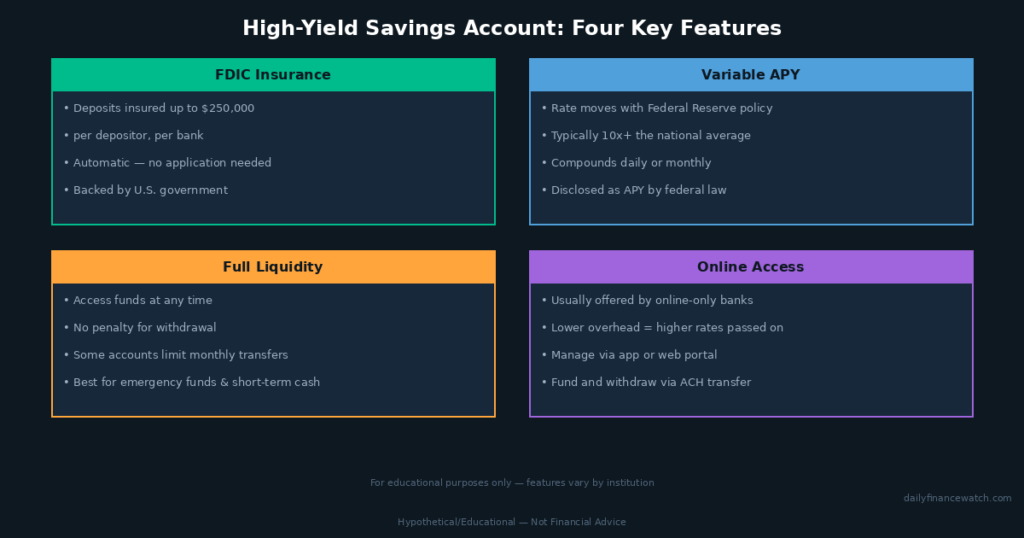
A diagram showing four key features of a high-yield savings account: FDIC insurance, variable APY, liquidity, and online access.
FDIC Insurance and What It Covers
A high-yield savings account at an FDIC-insured bank carries the same deposit protection as any other savings product at that institution. The FDIC insures deposits up to $250,000 per depositor, per insured bank, per account ownership category. This coverage extends to principal and any accrued interest up to the date of a bank failure. Coverage is automatic — depositors do not apply for it. Credit union equivalents use NCUA insurance at the same $250,000 threshold. You can review the full coverage framework at fdic.gov/resources/deposit-insurance.
One distinction worth noting: FDIC insurance covers deposit accounts, not investment products. Stocks, bonds, and mutual funds held at a bank’s brokerage division are not covered, even when purchased at the same institution that holds the insured savings account.
Rate Variability and Introductory Offers
Some institutions advertise elevated introductory APYs that revert to lower ongoing rates after a set period. Others offer higher rates only on balances up to a specific tier, with lower rates applying above that threshold. Reading the account disclosure — specifically the terms governing rate changes and tiered balances — clarifies what a quoted APY actually applies to. The advertised rate and the rate that applies to a depositor’s specific situation may differ.
What HYSAs Are Best Suited For
A high-yield savings account serves best as a home for liquid cash: emergency funds, short-term savings goals, or cash awaiting deployment elsewhere. The combination of FDIC insurance, daily liquidity, and a competitive yield makes this type of account a practical tool for money that should not take on market risk. Building a solid cash reserve connects directly to broader financial health — discussed in our guide on what is net worth.
High-yield savings accounts are not optimal for long-term wealth building. Over extended periods, inflation may outpace savings rates, especially if the Fed is cutting. For money not needed within a few years, other vehicles — including investment accounts and retirement savings — typically offer better long-run return potential. The decision of how much to keep in savings versus investing is covered separately. [PENDING: saving-vs-investing article]
The Anti-Advice Reminder
A higher APY is not the only factor worth evaluating when selecting a savings account. Minimum deposit requirements, monthly fee structures, transfer restrictions, and the quality of the bank’s digital tools all affect the actual experience of holding funds there. Some accounts with top-tier APYs impose limits on monthly withdrawals or require minimum monthly deposits to earn the advertised rate. Others pair high rates with limited customer support options. Evaluating the total picture — not only the rate — is how a savings account choice holds up over time. Rate comparisons should use APY, not simple interest rates, to reflect what deposits actually earn after compounding.
The cost advantage of online banks explains why a savings account at one institution can pay more than ten times what another pays — not because the higher-rate bank takes more risk with deposits, but because its lower overhead leaves more room to reward savers. That structural reality is the more useful piece of information than any single APY figure that changes with the next Fed decision.
This article is for educational purposes only and does not constitute financial or banking advice. APY rates are variable and subject to change at any time.
© 2026 Daily Finance Watch. All rights reserved.