Last updated: July 4, 2026
Headlines often warn that Social Security is running out of money. That framing skips a crucial detail buried in the government’s own numbers. Even in the worst-case scenario, benefits do not drop to zero.
What Social Security Actually Provides in Retirement
Social Security retirement benefits replace a portion of your pre-retirement income based on your lifetime earnings history. The Social Security Administration calculates your benefit using your 35 highest-earning years, adjusted for wage growth over time. Most financial advisers suggest that retirees need roughly 70% to 80% of pre-retirement income, with Social Security covering only part of that target. The program was never designed to fully replace a paycheck. Instead, it functions as a floor beneath other retirement savings.
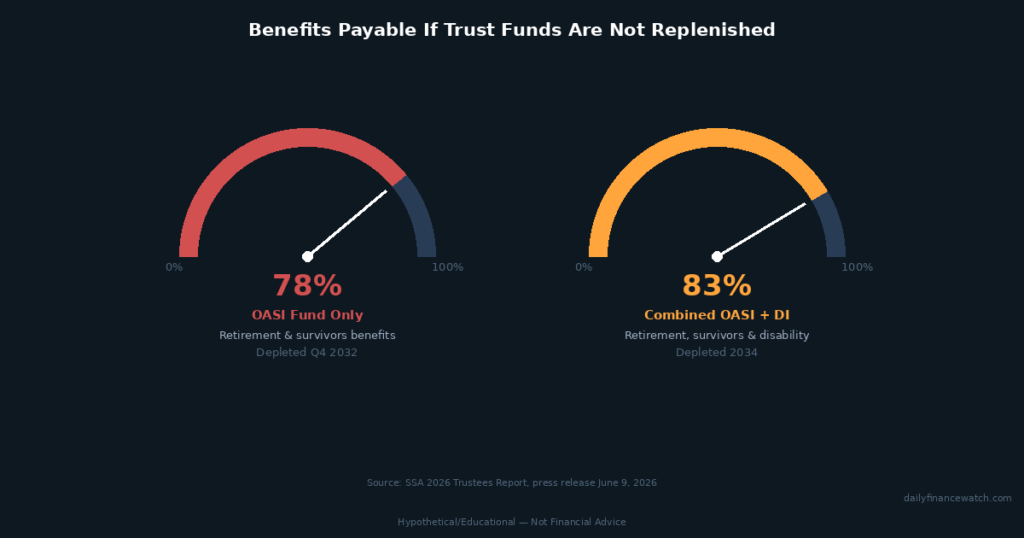
A gauge chart showing scheduled Social Security benefits still payable after trust fund depletion.
The Trust Fund Depletion Myth
Here is the mechanism behind the thesis. Social Security is funded primarily through payroll taxes collected from current workers. Since 2021, the program’s total cost has exceeded its non-interest income. This gap gets covered by trust fund reserves built up over prior decades. Those reserves are projected to run out eventually, and this is the fact that drives the “bankruptcy” headlines.
However, trust fund depletion does not mean benefit payments stop. According to the SSA’s 2026 Trustees Report, released June 9, 2026, the OASI Trust Fund is projected to become depleted in the fourth quarter of 2032. At that point, ongoing payroll tax revenue would still cover 78 percent of scheduled benefits. If Congress takes no action, the combined OASI and DI trust funds are projected to last until 2034, with 83 percent of benefits still payable at that time. You can review the full report at ssa.gov.
Why the Gap Exists
The underlying driver is demographic, not a spending problem in the usual sense. In 1966, there were 3.9 workers paying into the system for every beneficiary receiving payments. That ratio has fallen to roughly 2.6 workers per beneficiary today. Fewer workers per retiree means less payroll tax revenue relative to the benefits owed, which is why the trust funds have been drawing down reserves since 2010.
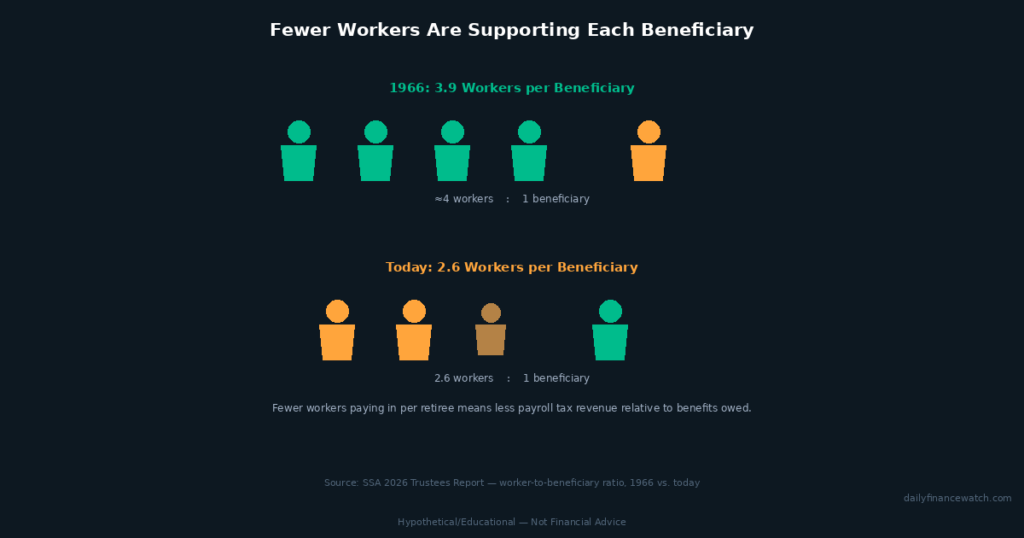
A pictogram showing how the ratio of workers paying into Social Security per beneficiary has declined over time.
How Claiming Age Changes Your Benefit
Separate from the funding question, your own claiming decision has a major effect on what you personally receive. You can start retirement benefits as early as age 62, but your full retirement age (FRA) determines your unreduced benefit amount. For anyone born in 1960 or later, full retirement age is 67. Claiming at 62 instead of 67 permanently reduces your benefit by 30 percent, according to the SSA’s official benefit reduction chart. A $1,000 full benefit drops to $700 if claimed at the earliest possible age.
Delayed Retirement Credits Work in the Opposite Direction
Waiting past your full retirement age increases your benefit through delayed retirement credits. These credits add about 8 percent per year for each year you delay, up to age 70. Someone who waits until 70 instead of claiming at 67 receives roughly 24 percent more per month for the rest of their life. This increase is permanent and continues even after cost-of-living adjustments are applied.
Social Security’s Role Alongside Other Retirement Income
Social Security works best as one part of a broader retirement plan, not as a standalone income source. Our guide on traditional IRA vs Roth IRA covers two of the most common tax-advantaged accounts that typically supplement Social Security income in retirement. Combining predictable Social Security income with savings that offer more flexibility gives most retirees a more resilient overall plan than relying on any single source alone.
The Windfall Elimination Provision Repeal
Legislation passed in January 2025 repealed the Windfall Elimination Provision and Government Pension Offset, two rules that had previously reduced benefits for certain public-sector workers with pensions from non-Social-Security-covered employment. This change increased program outlays, according to the SSA’s own analysis, and is one factor contributing to the accelerated depletion timeline in recent Trustees Reports.
The Anti-Advice Reminder
Deciding when to claim Social Security depends on your health, other income sources, marital status, and how long you expect to live, among other factors. The 78 to 83 percent figure describes what happens under current law if Congress takes no action at all, not a certain future outcome — lawmakers have adjusted the program multiple times before reserves ran out. Before making a claiming decision, reviewing your specific situation with a financial professional or using the SSA’s own benefit calculators can help clarify which approach fits your circumstances.
Social Security is not disappearing, even under the most commonly cited worst-case projections. Understanding the actual 78 to 83 percent figure — rather than assuming benefits vanish entirely — changes how much weight this factor should carry in your broader retirement planning.
This article is for educational purposes only and does not constitute financial or retirement planning advice. Social Security projections are subject to change based on future legislation and economic conditions.
© 2026 Daily Finance Watch. All rights reserved.