Last updated: July 2, 2026
Buying stocks on margin means borrowing money from your broker to purchase more securities than your cash alone would allow. The arrangement works well when prices rise. However, when prices fall, the math turns against the borrower in a very specific way. In other words, a margin call is the broker’s formal demand to restore the minimum equity ratio in your account. Understanding exactly what triggers it changes how you think about leverage broadly.
In brief, a margin account lets you borrow up to 50% of the purchase price of eligible equity securities. Most guides describe the call as what happens when your stocks drop too far. In reality, the trigger is a ratio, not a price. Your broker does not watch a stock’s price. It watches your equity as a percentage of your account’s total securities value. Therefore, this article covers how margin accounts work and what triggers the call. It also covers what brokers can do before you have time to react.
What a Margin Call Is and How It Gets Triggered
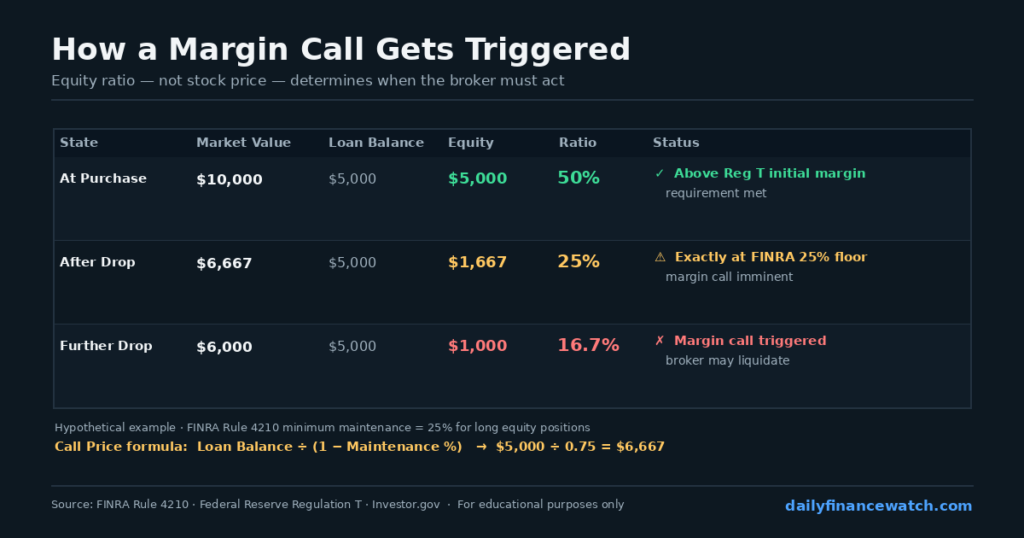
The trigger is your equity ratio, not the stock price itself.
In brief, a margin account lets you borrow up to 50% of the purchase price of eligible equity securities. This 50% rule comes from Federal Reserve Board Regulation T, which sets the initial margin requirement.
For example, to buy $10,000 of stock, you must put up at least $5,000 in cash. You can borrow the remaining $5,000 from your broker.
The Maintenance Margin Formula
After purchase, however, the rules change. FINRA Rule 4210 requires at least 25% equity relative to the current market value of all margin securities held long.
In this formula, equity means the market value of your holdings minus what you owe the broker. Specifically: Equity ÷ Market Value ≥ 25%. When that ratio falls below 25%, your broker must issue a margin call. Many firms set their own maintenance requirement higher — commonly 30% to 40%. Consequently, a call can arrive before the regulatory floor.
How a Margin Call Unfolds in Practice
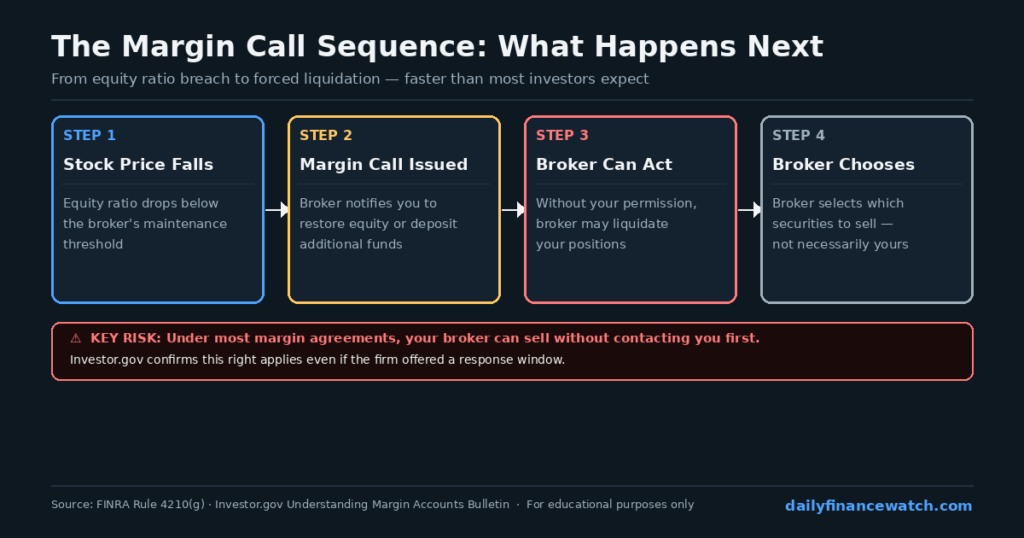
The sequence from trigger to forced sale can move faster than a phone notification.
Continuing the earlier example: you buy $10,000 of stock with $5,000 cash and a $5,000 loan. Your equity is $5,000, and your equity ratio is 50%. Now the stock declines. At a market value of $6,667, your equity is $6,667 minus $5,000, which equals $1,667.
Consequently, your equity ratio hits exactly 25%, the FINRA floor.
Any further decline triggers the call. In contrast, a cash account holding the same stock simply falls in value — no call, no forced sale.
Broker Rights: The Liquidation You Didn’t Authorize
This demand requires that you deposit additional cash or securities. Alternatively, you allow positions to be sold to bring the account back into compliance.
However, the Investor.gov margin account bulletin notes that brokers may sell your securities without consulting you first. This holds even if your firm offered a window to respond. Furthermore, brokers can choose which securities to sell. Moreover, they are not required to wait for you to respond.
| Account state | Market value | Loan balance | Equity | Equity ratio | Status |
|---|---|---|---|---|---|
| At purchase | $10,000 | $5,000 | $5,000 | 50% | Fine (Reg T met) |
| After decline | $6,667 | $5,000 | $1,667 | 25% | At FINRA floor |
| Further decline | $6,000 | $5,000 | $1,000 | 16.7% | Margin call triggered |
All values are hypothetical illustrations based on FINRA Rule 4210 parameters. Actual margin call thresholds vary by broker.
Why Leverage Amplifies Small Price Drops
At first glance, a common assumption says a margin call requires a large price drop. In reality, the math amplifies small moves because the loan balance stays fixed while the asset value falls.
Specifically, when a stock drops 10% in a cash account, your holding falls 10%. In a 2:1 margin account — meaning you borrowed 50% of the purchase — the same 10% drop cuts your equity by roughly 20%. The loss falls entirely on your contributed capital. As a result, a relatively modest market move can reduce the equity ratio enough to trigger the call.
The Math Behind the Margin Call Trigger
The exact price at which a 25% maintenance call fires follows a simple formula. For a margin account: Call Price = Loan Balance ÷ (1 − Maintenance %). Using the earlier example: Call Price = $5,000 ÷ (1 − 0.25) = $5,000 ÷ 0.75 = $6,667. If the broker uses a 30% maintenance requirement instead, the call fires earlier: $5,000 ÷ 0.70 = $7,143.
Consequently, a broker with 30% maintenance sends the call at a higher stock price than one using the FINRA minimum.
In practice, investors need to know their broker’s specific threshold, not just the regulatory floor.
How to Manage Margin Risk Before a Margin Call Arrives
Understanding this mechanism starts with knowing your break-even equity ratio at every position size.
Before using a margin account, calculate the exact price at which your broker would issue a call for each position. Use the Call Price formula above. Disciplined investors typically keep equity well above the maintenance floor. They treat 35% to 40% as a personal buffer rather than waiting for the 25% regulatory minimum. Furthermore, a call during fast-moving sessions can force sales at prices well below what the account needed. A margin call under market orders in a volatile session rarely resolves at favorable prices.
Common Misconceptions About Margin Accounts
A common belief says that responding quickly to the call avoids forced liquidation. However, the SEC’s investor materials make clear that brokers can act before a customer responds. They may liquidate without any advance notice. A second misconception holds that margin calls only occur during market crashes.
In practice, a broker raising its maintenance requirement from 25% to 40% can trigger a call in an account that was compliant the day before. Firms can change requirements at their discretion. Furthermore, interest on the margin loan accrues daily, quietly eroding equity even when stock prices stay flat. Margin borrowing involves a daily cost that begins the moment you borrow.
The call is not a punishment; it is the mathematical outcome of a ratio that crossed a threshold. The ratio itself — not the headline price drop — matters most. In reality, this makes leverage a ratio problem, not a price problem. Disciplined investors who understand the maintenance formula can calculate their own threshold before any volatility arrives. Those who wait to learn the formula from experience may have fewer options than they expected.
Related articles:
What is a margin call in simple terms?
The call is a broker’s demand that you restore your account’s minimum equity ratio. It occurs when your equity — what you own minus what you owe — drops below the maintenance requirement. That threshold is typically 25% of market value under FINRA Rule 4210. At that point, you must deposit more funds, add securities, or allow the broker to sell positions on your behalf.
Can a broker sell my stocks without permission during a margin call?
Yes. Under most margin agreements, your broker has the legal right to sell your securities without contacting you first. This applies whenever your account falls below the maintenance margin. Specifically, the Investor.gov bulletin confirms that brokers can sell securities without consulting you, even if the firm offered a window to respond. Signing a margin account agreement grants this authority to the broker.
How do I calculate when a margin call will happen?
Use the formula: Call Price = Loan Balance ÷ (1 − Maintenance Percentage). For a $5,000 loan at 25% maintenance, the trigger fires at $5,000 ÷ 0.75 = $6,667 in total account value. If your broker uses 30% maintenance instead, the trigger arrives earlier: $5,000 ÷ 0.70 = $7,143. Always confirm your broker’s specific maintenance requirement, since many firms set levels above the FINRA minimum of 25%.
This content is for educational purposes only and is not personalized financial advice. Investing involves risk, including possible loss of principal.
© 2026 Daily Finance Watch. Excerpts under 50 words with attribution and a link back are permitted. Full-article reproduction requires written permission.