Last updated: June 30, 2026
An investor sees a downturn coming, sells to protect their savings, and waits to buy back once things calm down. The market falls further, confirming the decision felt right. Then it rebounds sharply over a handful of days — and the investor, still waiting for clearer skies, misses them. Most beginner guides explain market timing’s failure by saying tops and bottoms are impossible to predict. That is true, but the deeper reason cuts harder: the market’s best days tend to cluster right next to its worst days, so stepping out to dodge the declines usually means missing the rebounds that drive most long-term returns.
What “Timing the Market” Really Means
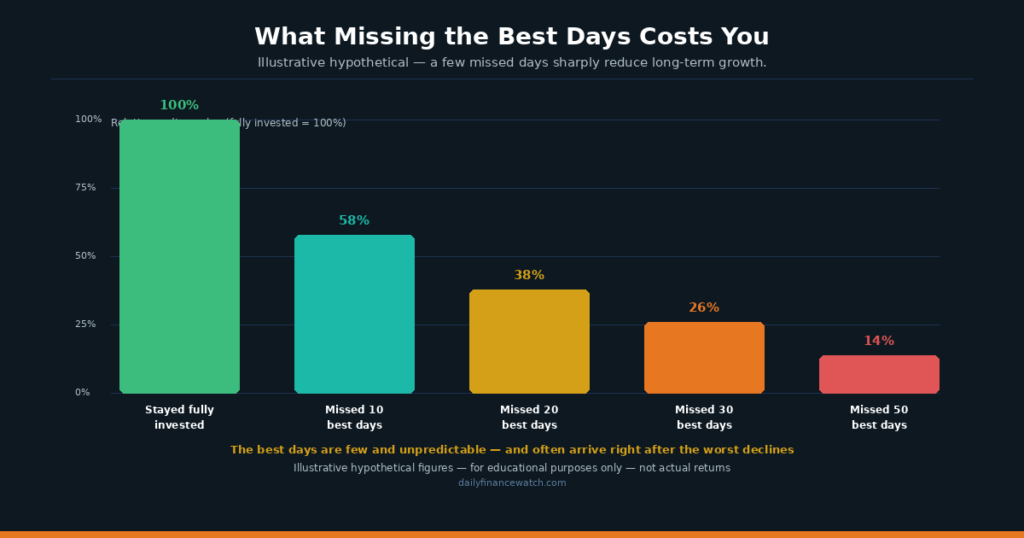
Caption: A handful of the market’s best days drive a large share of long-term returns — and they often arrive during volatile periods.
Market timing is the attempt to buy and sell based on predictions of short-term price direction. A timer tries to exit before declines and re-enter before rallies. The appeal is obvious: avoid the pain of downturns while capturing the gains. The problem is that doing this successfully requires being right twice — once on the way out, once on the way back in — repeatedly, over decades.
Time in the market is the opposite approach. It means staying invested through both rises and declines, accepting volatility as the price of long-term growth. This investor makes no prediction about short-term direction. They rely instead on the market’s long-term upward tendency and the compounding that uninterrupted investment allows.
Why Timing Fails Even When It Feels Smart
Most guides stop at “you can’t predict the market.” The sharper point is about where returns actually come from. Stock market gains are not spread evenly across time — a large share of long-term returns arrives in a small number of exceptional days. According to analyses of historical market data, including widely cited studies by firms such as J.P. Morgan Asset Management, missing just the ten best trading days over a multi-decade period can cut an investor’s final return dramatically compared to staying fully invested. Crucially, those best days frequently occur close to the worst days, often during volatile, frightening stretches. Therefore, the investor who sells to escape a downturn is precisely the one most likely to miss the rebound.
| Approach | What It Requires | Main Risk |
|---|---|---|
| Market timing | Correctly predicting exits and entries, repeatedly | Missing the best days during volatility |
| Time in the market | Staying invested through volatility | Enduring temporary declines |
| Selling in a panic | Predicting the bottom to re-enter | Locking in losses, missing rebounds |
| Waiting for “clarity” | Recognizing safety before the crowd | Re-entering after the recovery already happened |
The Data Behind Missing the Best Days
The mechanism that makes timing so costly is the clustering of the best and worst days. During calm bull markets, daily moves are small. During volatile crashes and recoveries, daily moves are enormous — in both directions. The largest single-day gains in market history have often landed within days or weeks of the largest single-day losses.
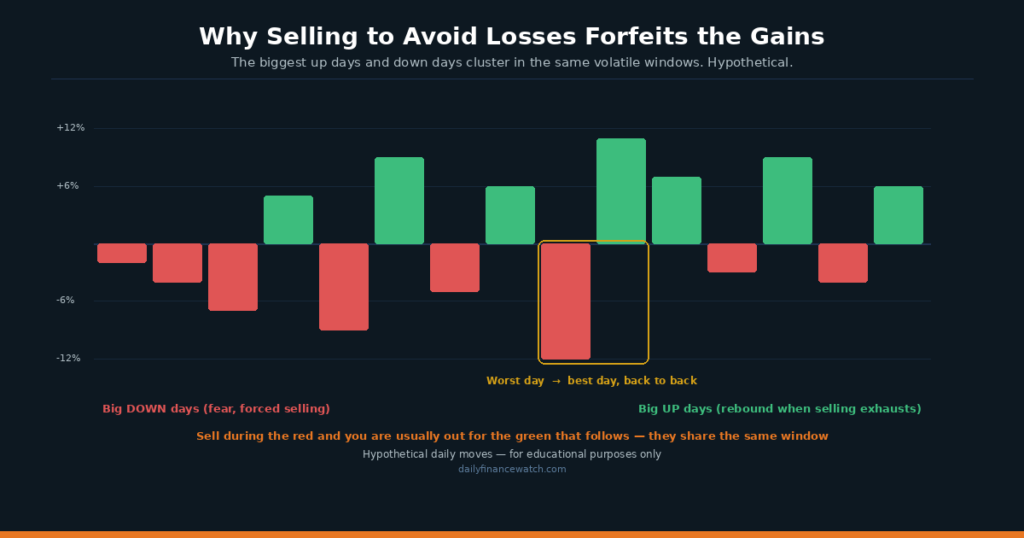
Caption: The biggest up days and biggest down days tend to arrive close together, which is why selling to avoid losses often forfeits the gains.
Consider the period around March 2020. The market fell sharply as the pandemic spread, then staged some of its largest single-day gains in history within the same weeks. An investor who sold during the steep decline to “wait it out” risked missing rebound days that recovered a substantial portion of the losses almost as quickly as they occurred. This is the trap in concrete form: the safety of selling and the cost of missing the rebound are two sides of the same volatile period. You cannot reliably capture one while avoiding the other.
Why This Happens
The clustering is not random. Sharp declines are driven by fear and forced selling, which overshoots. Sharp rebounds follow when that selling exhausts itself and buyers return, often abruptly and without warning. Because the rebound is a reaction to the decline, the two live in the same window of time. An investor waiting for a clear “all clear” signal before re-entering almost always receives that signal after the largest rebound days have already passed, because confidence returns only once prices have recovered.
How Beginners Should Apply This
For a beginner, the practical conclusion is to stop trying to avoid downturns and instead focus on staying invested through them. This feels counterintuitive, because avoiding losses seems prudent. The data reframes it: avoiding losses by selling usually means avoiding the recovery too, which costs more over time than simply enduring the decline. The SEC’s investor education resource at Investor.gov emphasizes long-term investing over reacting to short-term market movements.
Most guides advise beginners to “stay invested for the long term.” This is correct but often presented as a platitude about patience. The accurate mechanism is sharper: staying invested matters because the rebound days that drive returns are unpredictable and clustered near the declines, so any exit risks forfeiting them. Institutional frameworks build around continuous participation precisely because the cost of missing a handful of days is so disproportionate. Patience is not a virtue here — it is a mathematical necessity.
For investors building this foundation, how to start investing in stocks covers continuous, automated participation, and the power of compound interest in investing explains why uninterrupted time in the market compounds so powerfully.
Common Mistakes That Stem From Timing
Panic selling during declines is the most damaging, and it directly causes the missed-rebound problem. An investor sells at the bottom of fear, then waits for safety, and re-enters only after the recovery. This converts a temporary paper loss into a permanent realized one. It reflects loss aversion — the tendency to feel losses more intensely than gains — which makes holding through a decline feel unbearable precisely when holding matters most.
Waiting for “the right time” to invest is a quieter version of the same error. An investor holds cash, waiting for a dip or for conditions to feel safe. In a rising market, this delay costs returns, and the “safe” moment rarely arrives with a clear signal. Recency bias reinforces it: after a decline, the recent pain makes investing feel dangerous; after a rally, the recent gains make it feel too late.
What Disciplined Investors Understand About Timing
Smart money practice accepts volatility as the unavoidable cost of long-term returns rather than something to be dodged. Disciplined investors stay invested through declines, not because they enjoy losses, but because they understand that exiting risks missing the clustered rebound days that produce most gains. They automate contributions so participation continues regardless of market mood, removing the temptation to time entries and exits.
A disciplined investor also reframes downturns. Rather than seeing a decline as a signal to sell, they recognize it as a normal, recurring feature of markets and often a period when continued investing buys at lower prices. They do not predict the rebound — they simply ensure they are present when it arrives. This does not guarantee returns, and markets can decline for extended periods, but it avoids the self-inflicted damage of selling low and re-entering high.
What you should now understand differently is why “time in the market beats timing the market” is more than a slogan. It is not merely that predicting tops and bottoms is hard. It is that the gains and the losses share the same volatile windows, so any attempt to escape the losses forfeits the gains clustered beside them. The investor who stays put through the fear is not being passive — they are positioned to capture the rebounds that the market timer, waiting for clarity, will almost always miss.
FAQ
Why does missing just a few days hurt long-term returns so much?
A large share of long-term stock market gains comes from a small number of exceptional days. Analyses of historical data show that missing only the ten best days over decades can sharply reduce final returns versus staying fully invested. Because these best days are few and unpredictable, being out of the market for even a brief period risks missing them. This concentration of returns in rare days is why continuous participation matters more than avoiding declines.
Why can’t I just sell before a crash and buy back at the bottom?
Doing this successfully requires being right twice — exiting before the decline and re-entering before the rebound — repeatedly over decades. The deeper problem is that the best days cluster near the worst days, often within the same volatile weeks. An investor who sells to avoid a downturn typically waits for clear signs of safety, which arrive only after the largest rebound days have passed. The result is usually selling low and re-entering high.
Is it ever smart to wait for a better time to invest?
Waiting for a “better time” usually costs returns, because markets rise more often than they fall and the safe moment rarely arrives with a clear signal. Holding cash while waiting for a dip means missing growth in the meantime, and re-entry often happens after prices have already recovered. For long-term investors, staying invested and contributing consistently has historically outperformed waiting for ideal conditions, because time in the market compounds while cash on the sidelines does not.
This content is for educational purposes only and does not constitute personalized financial advice. All investing involves risk, including the possible loss of principal.