Last updated: July 4, 2026
Ask someone why they hesitate to open a 529 college savings plan, and a common answer involves fear of overfunding it. That fear was fully justified for decades. As of 2024, it is only partially justified.
What a 529 College Savings Plan Is
A 529 plan, formally called a qualified tuition program, is a state-sponsored account designed to help families save for education costs. According to the IRS, contributions grow tax-free, and withdrawals avoid federal tax entirely when used for qualified education expenses. You can review the official rules at irs.gov. Anyone can open a 529 account, name any beneficiary, and there are no income restrictions on contributors.
Qualified expenses include tuition, fees, books, and required equipment at eligible postsecondary institutions. They also cover up to $20,000 per year in K-12 tuition expenses, an amount that increased from the prior $10,000 annual limit for expenses incurred after December 31, 2025.
The Old Objection: What Happens to Unused Funds
Historically, the biggest hesitation around 529 plans centered on one scenario. What if the beneficiary gets a scholarship, chooses a cheaper school, or skips college entirely? Non-qualified withdrawals face income tax on the earnings portion, plus a 10% penalty on top of that. This risk discouraged many families from contributing as much as they otherwise would have.
The Thesis: A Partial Fix Arrived in 2024
Here is the mechanism behind the thesis. SECURE 2.0 Act Section 126 created a new option for leftover funds. Effective for distributions made after December 31, 2023, a 529 beneficiary can roll unused money directly into their own Roth IRA, tax-free and penalty-free, up to a lifetime limit of $35,000.
The Experience Anchor: How the Rollover Actually Works
According to the IRS, several conditions apply simultaneously. The 529 account must have been open for at least 15 years as of the distribution date. The rolled-over amount cannot exceed contributions (and their earnings) made more than five years before the rollover. Additionally, each year’s rollover is capped at that year’s Roth IRA contribution limit, which is $7,500 for 2026. The Roth IRA must belong to the beneficiary, not the person who owns the 529 account.
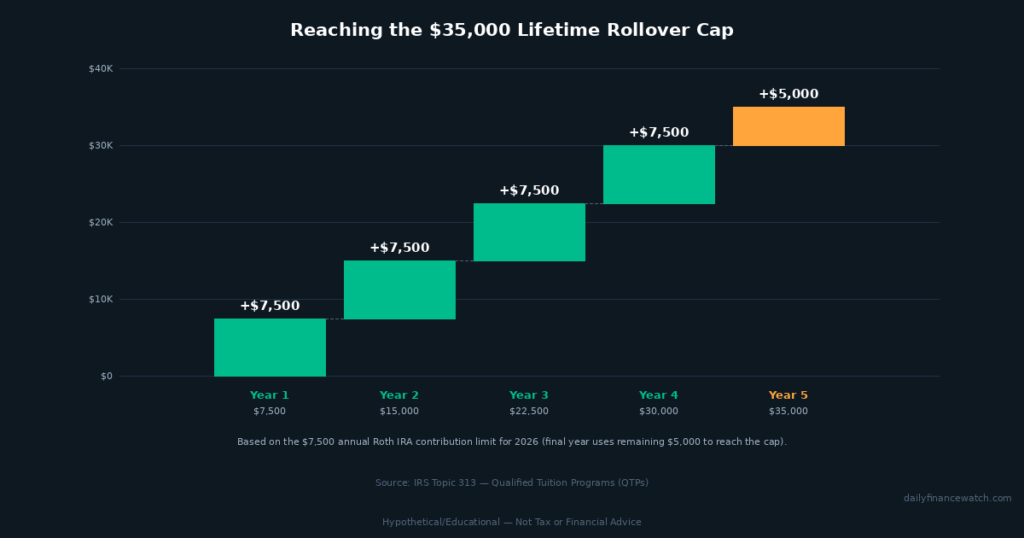
A waterfall chart showing how a $35,000 lifetime 529-to-Roth IRA rollover accumulates through annual contribution-limited transfers over several years.
Reaching the full $35,000 lifetime cap using only the $7,500 annual limit takes roughly five years of consistent rollovers. This structure prevents families from “superfunding” a 529 account and immediately shifting it into a Roth IRA. The rollover also requires the beneficiary to have earned income for the year equal to or greater than the amount transferred, matching the standard rule for any Roth IRA contribution.
Four Conditions Must Line Up Together
Meeting just one or two of these requirements is not enough. The account age, the contribution-aging rule, the annual Roth limit, and the beneficiary’s earned income must all align in the same year for a rollover to proceed. Families who opened a 529 shortly before college started, for example, will not meet the 15-year account age requirement until well after the beneficiary’s traditional college years have passed.
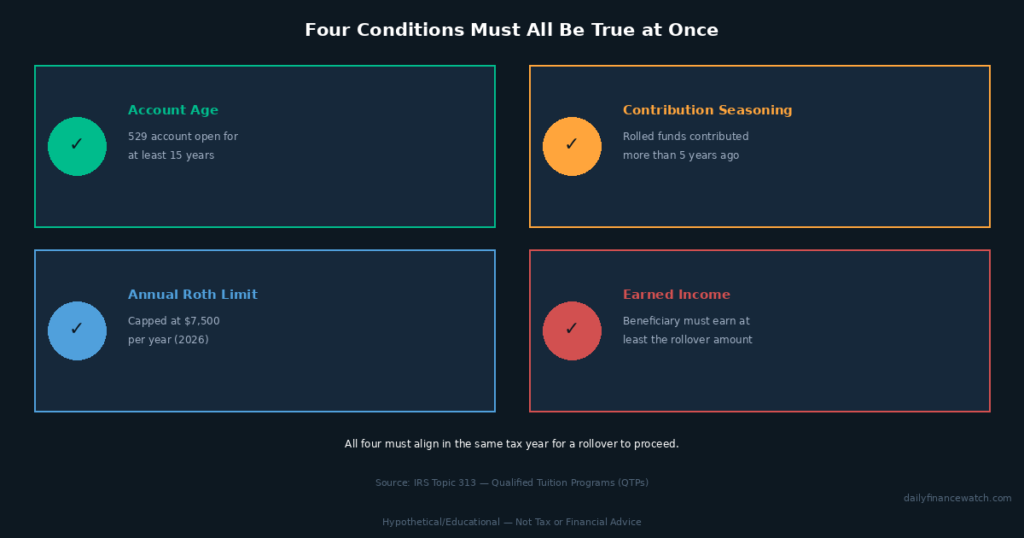
A checklist diagram showing the four conditions that must all be satisfied for a 529-to-Roth IRA rollover: account age, contribution seasoning, annual limit, and earned income.
Notably, No Income Limits Apply to This Rollover
Direct Roth IRA contributions phase out for high earners, as covered in our guide on traditional IRA vs Roth IRA. However, the 529-to-Roth rollover bypasses those income restrictions entirely. This makes the provision particularly useful for higher-income families who would otherwise be shut out of funding a Roth IRA for an adult child or grandchild.
State Tax Treatment Varies
Federal tax treatment is only part of the picture. Some states that offer a state income tax deduction for 529 contributions may claw back that deduction if funds later leave the plan for a Roth rollover instead of qualified education expenses. Checking your specific state’s treatment before initiating a rollover can prevent an unexpected state tax bill.
The Anti-Advice Reminder
Whether the Roth rollover option changes your 529 funding strategy depends on your specific timeline, your state’s tax treatment, and whether you can realistically meet the 15-year and 5-year requirements. This provision helps address genuine overfunding concerns, but it is a narrow escape valve, not a general-purpose backdoor Roth strategy. Before adjusting your 529 contribution levels based on this option, reviewing your full situation with a tax professional or financial planner is a reasonable step, since state-specific rules and family circumstances vary considerably.
For decades, the fear of overfunding a 529 account was a fully rational reason to under-contribute. That fear is now only partially rational. Understanding the real constraints behind the $35,000 Roth rollover option — not just its existence — determines whether it meaningfully changes how much to save.
This article is for educational purposes only and does not constitute tax or financial advice. 529 plan and Roth IRA rollover rules are subject to change by Congress and the IRS.
© 2026 Daily Finance Watch. All rights reserved.