Last updated: July 4, 2026
A robo advisor sounds like financial technology operating in its own space. Actually, regulators oversee it exactly like the human advisors it competes with.
What a Robo Advisor Actually Is
A robo advisor is an automated digital investment program. It builds and manages a portfolio using computer algorithms. Specifically, the process typically starts with an online questionnaire. This covers your goals, time horizon, income, and risk tolerance. Then, the algorithm selects a mix of investments based on those answers. Usually, this means low-cost ETFs. Also, the algorithm rebalances the portfolio over time. You can review the SEC’s official investor guidance at investor.gov.
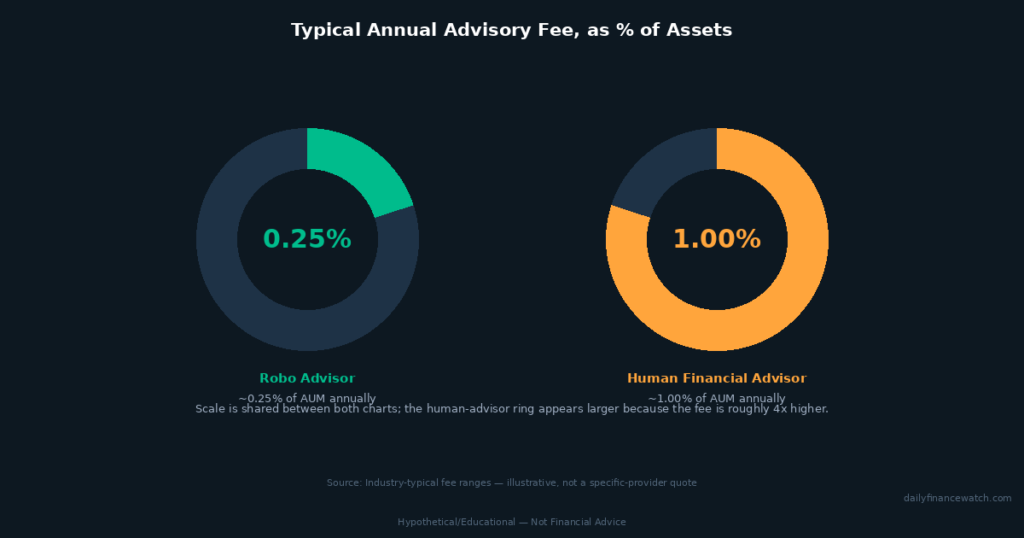
A donut chart comparing typical robo advisor and human advisor fees as a percentage of assets.
Robo advisors typically charge less than traditional advisors. Notably, common robo advisor fees run around 0.25% of assets annually. Traditional human advisors, by contrast, often charge roughly 1%. This fee gap is the main reason robo advisors attracted early adopters. However, the lower cost usually means less person-to-person interaction.
The Thesis: Same Regulatory Category, Different Delivery Method
Here is the mechanism behind the thesis. Many people assume something incorrect about robo advisors. Specifically, they assume software-based delivery means lighter regulation. However, that assumption is wrong. The SEC announced this clearly back in February 2017. Notably, robo advisers are registered investment advisers. As a result, they share the same fiduciary obligations as any other adviser. This comes from the Investment Advisers Act of 1940.
What Fiduciary Duty Actually Requires
A fiduciary duty carries a specific meaning. Specifically, the advisor must act in the client’s best interest. This goes beyond merely recommending broadly suitable investments. Notably, this standard applies whether a human or an algorithm generates the recommendation. Ultimately, the same 1940s-era statute governs both delivery methods.
The Experience Anchor: The SEC Actually Enforces This
The SEC treats this fiduciary standard as very real for robo advisors. Specifically, on November 9, 2021, the SEC’s Division of Examinations issued a risk alert. This followed examinations of numerous robo advisory firms. Notably, the findings were significant. Most firms received deficiency letters. Specifically, these covered inadequate disclosures about fees, conflicts of interest, and algorithm function.
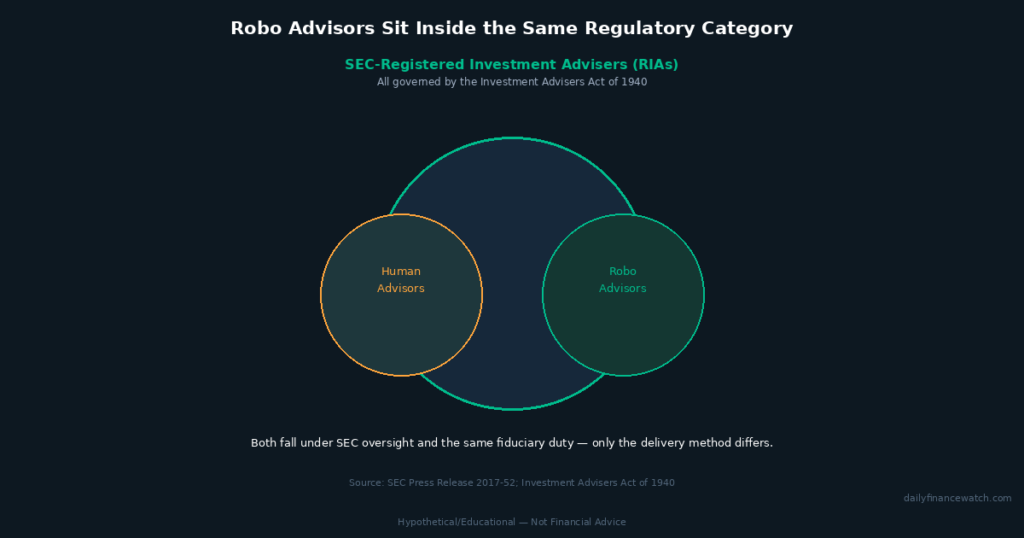
A Venn diagram placing robo advisors inside the same SEC-registered adviser category as human advisors.
This pattern of enforcement has continued. In March 2026, the SEC settled fiduciary duty charges against a robo advisory firm. Specifically, the case involved a “cash-enhanced” account. This account defaulted new clients into a 30% cash allocation. Notably, the firm failed to disclose that structure adequately. However, the specific violation matters less than what it demonstrates. Robo advisors face the same enforcement risk as any registered adviser. This happens because they occupy the same legal category, not a separate one.
How the Algorithm Actually Builds Your Portfolio
Most robo advisors rely on modern portfolio theory. Specifically, they construct a diversified asset mix. This depends on your stated risk tolerance and time horizon. Typically, the algorithm selects broad-based ETFs. These cover domestic stocks, international stocks, and bonds. Then, it adjusts the mix as your goals change. Also, some platforms offer automated tax-loss harvesting. Our guide on tax-loss harvesting covers this strategy in depth. Essentially, it sells losing positions to offset gains elsewhere.
Hybrid Models Blend Both Approaches
Not every robo advisor skips human contact entirely. Instead, many platforms now offer a hybrid or “bionic” tier. Here, clients can consult a human advisor for a fee premium. Meanwhile, the underlying portfolio management stays automated. This blending suggests something important. Ultimately, the earlier “robots versus humans” framing oversimplified how the industry developed.
What to Check Before Choosing One
Here, robo advisors are registered investment advisers. As a result, you can research any specific firm. Also, use the SEC’s Investment Adviser Public Disclosure database through Investor.gov. This tool shows registration status and disciplinary history. Notably, it is the same resource used to vet a traditional human advisor. Also, review a firm’s Form ADV brochure. Every registered adviser must file this document. Specifically, it reveals fee structures and conflicts of interest. This detail often exceeds what marketing materials provide.
The Anti-Advice Reminder
Several factors determine whether a robo advisor fits your situation. These include how much human interaction you value and your financial complexity. Also, consider whether the platform’s investment approach matches your goals. Notably, a lower fee does not automatically mean a better outcome. This especially applies if you need complex tax planning or estate guidance. Before selecting any advisor, robo or human, take one step. Specifically, check their registration and disciplinary history through Investor.gov.
A robo advisor is not a new category outside financial regulation. Instead, it is simply an automated delivery method. Ultimately, the same fiduciary law has governed human advisors for more than eight decades.
This article is for educational purposes only and does not constitute financial advice. Robo advisor fees, features, and regulatory requirements are subject to change.
© 2026 Daily Finance Watch. All rights reserved.