Last updated: July 4, 2026
Ask most people what happens if you skip a required minimum distribution, and many will say the penalty is 50%. That answer was correct for decades. However, it stopped being accurate starting in 2023.
What a Required Minimum Distribution Is
A required minimum distribution is the minimum amount you must withdraw from certain retirement accounts each year. This rule applies to traditional IRAs, SEP IRAs, SIMPLE IRAs, 401(k) plans, and similar employer-sponsored accounts. The IRS requires these withdrawals to ensure it eventually collects tax on money that grew tax-deferred for years. According to the IRS, you generally must begin taking RMDs when you reach age 73. You can review the full rule at irs.gov.
Roth IRAs do not require withdrawals during the original owner’s lifetime. However, once someone inherits any of these accounts, different beneficiary rules apply instead.
Why the RMD Age Keeps Changing
Here is a detail many people miss entirely. The RMD starting age is not fixed. It has moved twice in recent years and is scheduled to move again. Before 2023, the age was 72. SECURE 2.0 raised it to 73, effective January 1, 2023. Then, a further increase to age 75 takes effect January 1, 2033, for anyone born in 1960 or later. Someone still assuming the age is 72 could delay their first withdrawal into a year when a penalty actually applies.
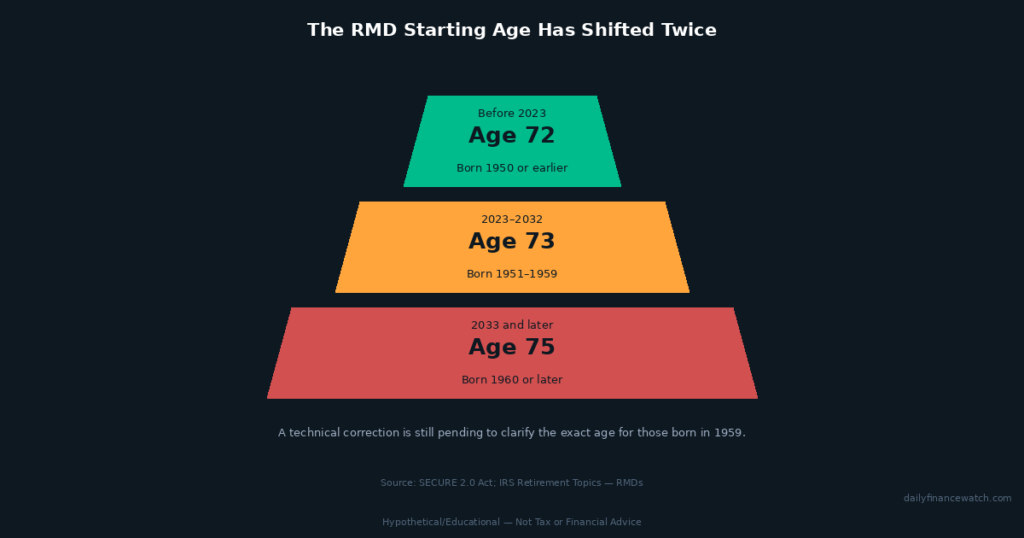
A pyramid diagram showing how the required minimum distribution starting age has shifted from 72 to 73 to 75 based on birth year.
The April 1st Deadline Trap
Your very first RMD carries a special deadline. You can delay it until April 1 of the year after you reach your RMD age, rather than taking it by December 31 of that same year. However, this delay creates a trap. If you wait until the following April, you must then take a second RMD by December 31 of that same year. This stacks two taxable distributions into one tax year, which can push you into a higher tax bracket unexpectedly.
The Experience Anchor: When the 50% Penalty Actually Changed
For decades, missing an RMD triggered what the IRS calls an “excise tax” equal to 50% of the shortfall. This penalty was so severe that many practitioners considered it one of the harshest amounts in the entire tax code. Then, SECURE 2.0 changed this figure. Effective for taxable years beginning in 2023, the penalty dropped to 25% of the amount not withdrawn. If you correct the shortfall within two years, the rate drops further to just 10%. You can confirm these figures directly at the IRS’s RMD FAQ page.
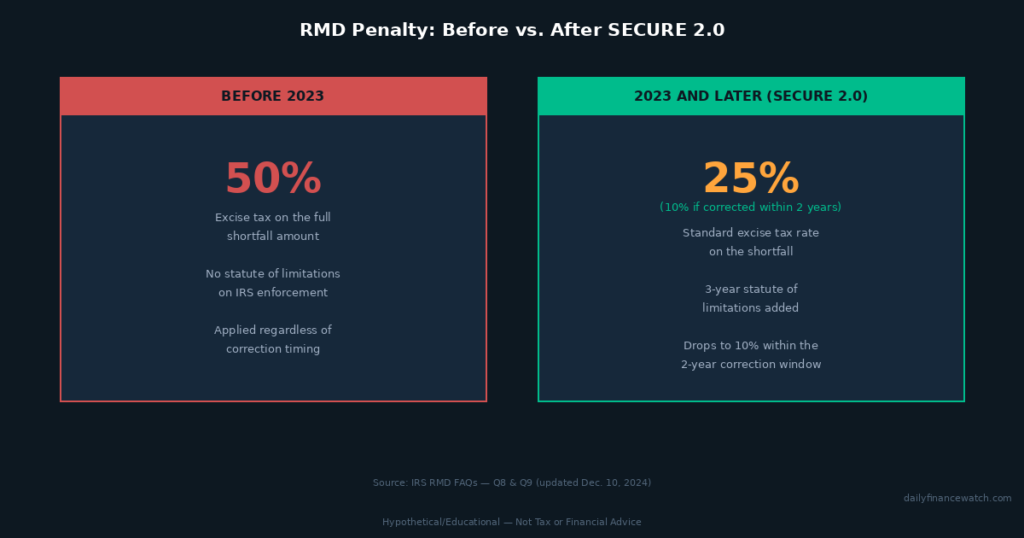
A before-and-after comparison showing how the RMD excise tax penalty changed from 50% to 25%, with a further reduction to 10% for timely corrections.
How to Fix a Missed RMD
If you miss an RMD, take the missed amount out as soon as you discover the error. Then, file Form 5329 with your federal tax return for the year the RMD should have occurred. The IRS may waive the penalty entirely if you can show the shortfall resulted from reasonable error and that you are taking steps to correct it. Attaching a brief letter of explanation to Form 5329 is typically how this waiver request gets made.
How the RMD Amount Gets Calculated
Your RMD is calculated by dividing your account balance as of December 31 of the prior year by a life expectancy factor from IRS tables. Most account holders use the Uniform Lifetime Table. However, if your spouse is your sole beneficiary and more than 10 years younger than you, a different joint life table applies instead, which typically produces a smaller required withdrawal. Each account generally requires its own separate calculation, though IRA owners can withdraw the combined total from any one or more of their IRAs.
RMDs Are Taxed as Ordinary Income
Withdrawals count as taxable income in the year you take them, at your ordinary income tax rate. The only exception applies to any portion representing after-tax contributions, known as your basis, which comes out tax-free. This tax treatment connects directly to the deferral concept discussed in our guide on tax-loss harvesting: retirement accounts postpone tax, they do not eliminate it, and RMDs are the mechanism that eventually collects what was deferred.
RMDs Do Not Apply to Every Account Type
Roth IRAs remain exempt from lifetime RMDs entirely. Additionally, Roth accounts inside 401(k) and 403(b) plans lost their RMD requirement starting January 1, 2024, aligning them with Roth IRA treatment. Traditional accounts, however, still require these annual withdrawals. Our guide on traditional IRA vs Roth IRA covers this distinction in more detail, including how the two account types differ on taxation more broadly.
The Anti-Advice Reminder
Whether an RMD affects your specific tax situation depends on your total income, your account balances, your filing status, and any other distributions you take in the same year. The reduced 25 and 10 percent penalties still represent a meaningful cost for a mistake that is often preventable with basic recordkeeping. Before assuming any specific penalty rate applies to your situation, or before deciding whether to delay a first-year RMD, reviewing your full circumstances with a tax professional can help avoid an expensive and avoidable error.
The 50 percent figure that many people still associate with missed RMDs has been outdated since 2023. Knowing the current 25 and 10 percent rates matters less than understanding that the rules keep changing — the same way the starting age itself is scheduled to shift again in 2033.
This article is for educational purposes only and does not constitute tax or financial advice. RMD rules, ages, and penalties are subject to change by Congress and the IRS.
© 2026 Daily Finance Watch. All rights reserved.