Last updated: June 29, 2026
In June 2022, the U.S. Consumer Price Index rose 9.1% year over year — the highest reading in four decades. Over the following twelve months, the Federal Reserve raised interest rates eleven times in response. The S&P 500 fell more than 25% from its peak before recovering. That sequence illustrates the central challenge inflation poses for investors: it simultaneously erodes purchasing power, forces interest rate increases that compress stock valuations, and reshapes which sectors deliver real returns. Understanding how inflation stocks behave — and why different companies respond so differently to the same inflationary environment — is one of the most practical skills a long-term investor can develop.
What Inflation Is and How It Is Measured
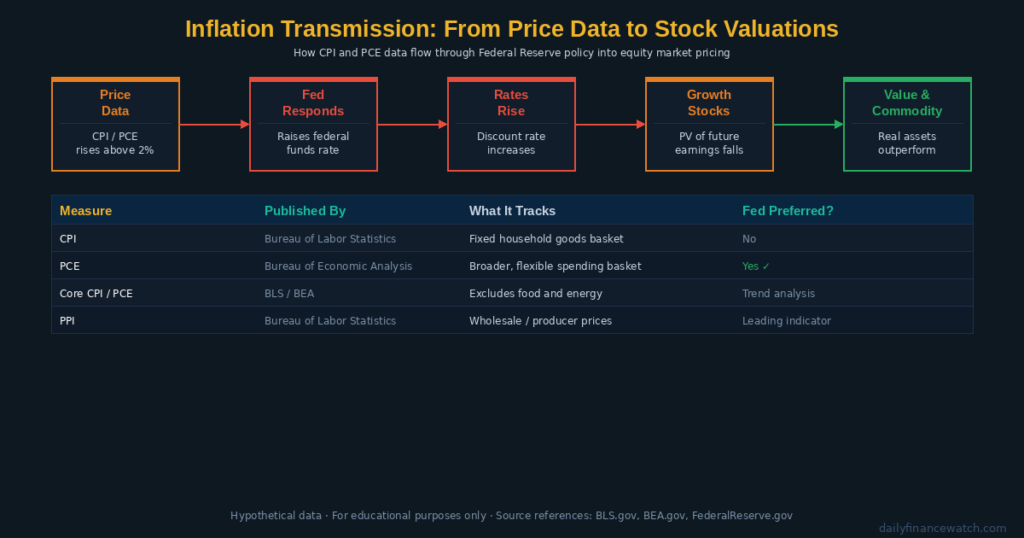
Caption: Inflation flows from price data through Federal Reserve policy into stock valuations — the transmission chain every equity investor needs to understand.
Inflation is the rate at which the general level of prices for goods and services rises over time. As prices rise, each dollar buys less than it did before — a reduction in purchasing power. Mild inflation of approximately 1%–3% per year is considered normal and reflects a healthy, growing economy. Inflation above the Federal Reserve’s long-run target of approximately 2% prompts policy responses that affect every asset class.
The U.S. government measures inflation through two primary indices. The Consumer Price Index, or CPI, tracks the price changes of a fixed basket of goods and services commonly purchased by households — including food, housing, transportation, and medical care. The Personal Consumption Expenditures index, or PCE, tracks a broader and more flexible basket and is the Federal Reserve’s preferred measure for setting monetary policy. According to the U.S. Bureau of Labor Statistics, the CPI is published monthly and serves as the most widely cited inflation indicator in financial media.
| Inflation Measure | Published By | What It Tracks | Fed’s Preferred Tool? |
|---|---|---|---|
| CPI (Consumer Price Index) | Bureau of Labor Statistics | Fixed household goods basket | No |
| PCE (Personal Consumption Expenditures) | Bureau of Economic Analysis | Broader, flexible spending basket | Yes |
| Core CPI / Core PCE | BLS / BEA | Excludes food and energy | Used for trend analysis |
| PPI (Producer Price Index) | Bureau of Labor Statistics | Wholesale / producer prices | Leading indicator for CPI |
Core inflation — which excludes food and energy prices — receives particular attention because food and energy prices are volatile and can distort the underlying inflation trend. A single month of high gasoline prices can push headline CPI sharply higher without reflecting a genuine, broad-based price increase across the economy.
Why Mild Inflation Differs From High Inflation
Mild inflation benefits corporate earnings in a specific way. When the general price level rises gradually, companies can raise their own prices slightly — increasing revenue even if the volume of goods sold stays constant. This nominal revenue growth tends to support stock valuations. Furthermore, mild inflation often accompanies strong economic growth and rising consumer spending, which expands corporate profit margins.
High inflation operates very differently. When prices rise rapidly — particularly above 5%–6% — companies face input cost increases that outpace their ability to raise prices. Labor costs, raw material costs, and energy costs all rise simultaneously. Profit margins compress. Consumer purchasing power falls, reducing demand for discretionary goods. The Federal Reserve responds by raising interest rates aggressively, which adds a second pressure on stock valuations through the discount rate mechanism described in why tech stocks fall when interest rates rise.
How Inflation Affects Different Categories of Stocks
Inflation does not move all stocks in the same direction or by the same magnitude. The impact depends on three factors: pricing power, input cost sensitivity, and earnings duration. Disciplined investors assess all three before deciding how inflation changes the risk profile of individual holdings.
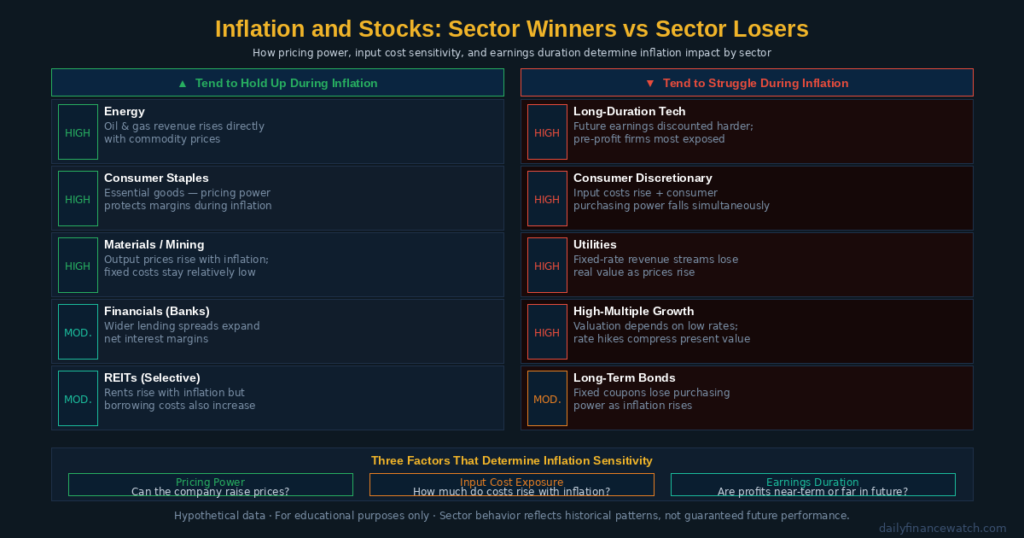
Caption: Inflation creates clear winners and losers across sectors — pricing power and real asset ownership determine which companies maintain real returns.
Pricing power is the most important variable. A company with strong pricing power can raise its prices in line with or above inflation, passing input cost increases to customers without losing significant volume. Consumer staples companies — producers of food, household products, and beverages — often possess this characteristic because their products are essential purchases regardless of price. A hypothetical example: if Procter & Gamble raises detergent prices by 6% during a period of 7% input cost inflation, it partially protects its margins while consumers continue purchasing a necessary product.
Input cost sensitivity determines how much inflation squeezes the cost side of the income statement. Energy-intensive manufacturers, shipping companies, and construction firms face direct exposure to raw material and fuel price increases. When their input costs rise faster than they can raise output prices, profit margins compress — which reduces earnings and depresses stock valuations.
Earnings duration matters because inflation raises interest rates, which raises discount rates. As described earlier, companies whose value rests on earnings far into the future experience greater valuation compression than companies generating strong near-term cash flows. This is why high-growth technology companies — long-duration assets — typically underperform during inflationary periods, while value stocks and dividend-paying companies with near-term earnings tend to show relative resilience.
Sectors That Tend to Perform Well During Inflation
Energy companies benefit directly because oil, natural gas, and related commodity prices typically rise with or ahead of general inflation. Their revenue increases naturally as energy prices climb, which expands margins and supports share prices. The S&P 500 energy sector gained more than 60% in 2022 — a year of high inflation — while the broader index fell more than 18%. These figures are historical and cited for educational context only.
Real estate investment trusts, or REITs, that own physical properties can increase rents in line with inflation, providing a natural revenue hedge. However, rising interest rates — which accompany inflation — increase REITs’ borrowing costs and compress their valuations. Therefore, the net effect on REITs during inflationary periods depends on whether the revenue benefit from rising rents outpaces the cost increase from higher financing rates.
Materials and commodity producers — companies that mine metals, produce agricultural commodities, or supply industrial inputs — benefit from rising commodity prices during inflationary periods, as their output prices increase while their fixed operating costs remain relatively stable.
Financial companies, particularly banks, often benefit from rising interest rates because wider spreads between deposit rates and lending rates expand net interest margins. However, the benefit is tempered if inflation leads to economic slowdown that increases loan defaults.
Sectors That Tend to Struggle During Inflation
Consumer discretionary companies — retailers, restaurant chains, entertainment providers, and automobile manufacturers — face a difficult combination during high inflation: rising input costs on one side and reduced consumer purchasing power on the other. Consumers prioritize essential spending during inflationary periods and cut back on discretionary purchases, which compresses both volume and margin simultaneously.
Long-duration growth stocks, as discussed, face mathematical valuation compression as discount rates rise with interest rates. Technology companies with high price-to-earnings ratios — particularly pre-profit firms — experience the sharpest price declines during inflationary periods, even when their underlying businesses remain sound.
Utilities and bond-like instruments face similar compression because their value is often modeled as a stream of relatively fixed future payments, which becomes less attractive in real terms as inflation erodes purchasing power.
How Disciplined Investors Respond to Inflationary Environments
An inflationary period does not require a complete portfolio overhaul. However, it does create a specific set of risks that warrant review and, in some cases, measured adjustment. Disciplined investors approach inflation through three lenses: protecting real returns, reviewing holdings for pricing power, and avoiding reactive decisions driven by short-term headline data.
Protecting Real Returns Through Asset Selection
The most important concept during inflationary periods is the distinction between nominal returns and real returns. A nominal return is the percentage gain or loss in dollar terms. A real return is the nominal return minus inflation. If a stock gains 5% in a year when inflation runs at 7%, the investor has lost 2% in real purchasing power — even though the account balance shows a gain.
Investors often evaluate Treasury Inflation-Protected Securities, or TIPS, as a benchmark for real returns. TIPS are U.S. government bonds whose principal adjusts with CPI inflation. According to the U.S. Treasury’s official TreasuryDirect resource, TIPS provide a guaranteed real return above inflation — making them a useful reference point for evaluating whether equity holdings are outpacing inflation sufficiently to justify their risk.
A disciplined investor may use the real return framework when reviewing each holding: is this company’s revenue growing fast enough to outpace inflation? Is its margin structure resilient enough to withstand input cost pressure? If the answer is no, that holding may carry more inflation risk than it initially appeared to.
Reviewing Pricing Power Before Inflation Peaks
The optimal time to assess inflation sensitivity is before inflation reaches its peak — not after. Once inflation is already elevated and the Federal Reserve is aggressively hiking rates, many of the repricing effects have already occurred. Disciplined investors monitor leading indicators: the Producer Price Index, which tracks wholesale prices paid by businesses and often leads consumer price increases by several months, and commodity price trends, which signal input cost pressure before it appears in corporate earnings reports.
A hypothetical investor reviewing a portfolio during early signs of rising inflation would ask, for each holding: Does this company have demonstrated pricing power? Has it maintained or expanded margins in prior inflationary periods? Does its revenue grow in nominal terms as prices rise, or does it depend on unit volume that inflation may reduce? These questions do not require macroeconomic expertise — they require careful reading of the company’s own financial history.
Recency Bias and Inflation Cycles
Investor psychology often misreads inflation cycles in a predictable way. Recency bias — the tendency to assume current conditions will persist — causes investors to overreact to inflation data in both directions. When inflation is rising sharply, many investors assume it will remain elevated indefinitely, leading them to sell growth assets at exactly the moment that peak inflation may be approaching. When inflation falls back toward target, the same investors often re-enter growth positions after much of the recovery has already occurred.
Herd behavior amplifies this pattern. When CPI prints above expectations, broad market selling occurs regardless of whether individual holdings are actually inflation-sensitive. A disciplined investor distinguishes between market-wide selling driven by macro fear and genuine deterioration in the earnings quality of specific holdings — and acts on the latter, not the former.
For more context on how the Federal Reserve responds to inflation through rate policy, see what the Federal Reserve is and how it moves markets.
What is the difference between CPI and PCE inflation measures?
The CPI tracks a fixed basket of goods and services purchased by urban households and is published monthly by the Bureau of Labor Statistics. The PCE tracks a broader, more flexible basket that adjusts as consumer spending patterns change, and is published by the Bureau of Economic Analysis. The Federal Reserve uses the PCE as its preferred inflation gauge because it captures a wider range of spending and adjusts for substitution behavior — when consumers switch from expensive items to cheaper alternatives. Both measures are widely cited, but PCE is the benchmark for monetary policy decisions.
Why do some stocks rise during inflation while others fall?
Stocks with strong pricing power and real asset ownership tend to rise during inflation because their revenues increase naturally as prices climb. Energy producers, commodity companies, and businesses selling essential goods can pass higher costs to customers without losing significant volume. In contrast, long-duration growth stocks fall because rising inflation forces interest rates higher, which compresses the present value of their distant future earnings. Consumer discretionary companies fall because reduced purchasing power cuts demand while input costs rise simultaneously.
Should investors buy gold or commodities to protect against inflation?
Gold and commodities have historically served as partial inflation hedges, though their performance during specific inflationary periods varies significantly. Gold tends to preserve purchasing power over very long time horizons but can be highly volatile over shorter periods. Commodity producers — energy and materials companies — often provide more direct inflation protection through growing revenues and earnings. Most long-term equity investors find that holding a diversified portfolio that includes energy, materials, and consumer staples companies provides meaningful inflation resilience without the volatility or storage considerations that physical commodities involve. This is educational context, not personalized investment advice.
This article is for educational purposes only and does not constitute personalized financial or investment advice. All investing involves risk, including the possible loss of principal.