Last updated: July 6, 2026
On March 15, 2020, the Federal Reserve cut its benchmark interest rate to near zero and announced a $700 billion asset purchase program — all before U.S. markets opened on a Monday morning. The S&P 500 had already fallen more than 30% in three weeks. Within five months, it had recovered to new all-time highs. No single institution influences U.S. financial markets more directly than the Federal Reserve, and every investor who holds stocks, bonds, or cash is affected by its decisions whether they realize it or not.
What the Federal Reserve Is and How It Was Created
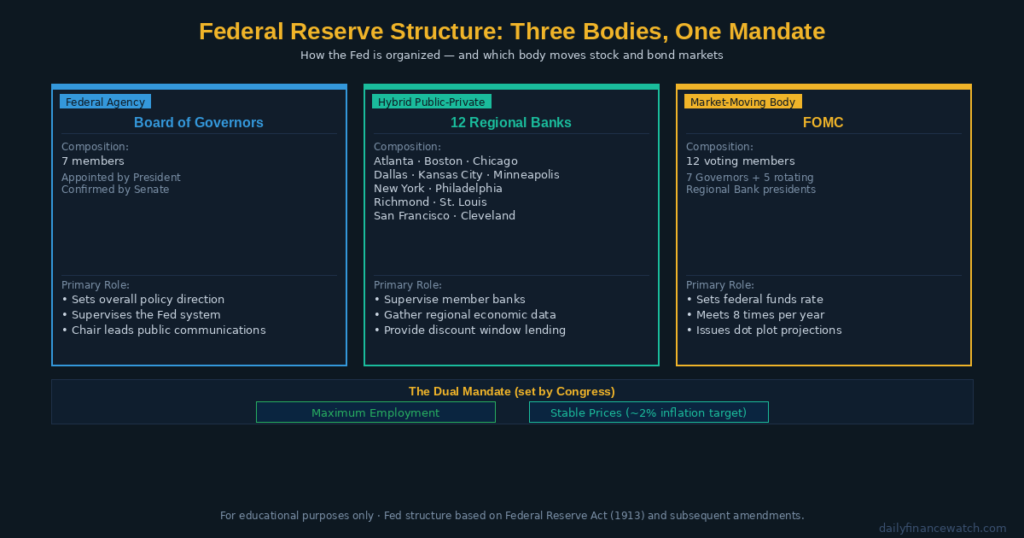
Caption: The Federal Reserve operates through three interconnected bodies — the Board of Governors, twelve regional banks, and the FOMC, which sets interest rate policy.
The Federal Reserve is the central bank of the United States. Congress created it in 1913 through the Federal Reserve Act, following a series of banking panics that exposed the fragility of a financial system without a central lender of last resort. Before the Fed existed, bank runs could collapse the entire financial system because no institution had the authority or capacity to inject liquidity during a crisis.
The Fed operates as a hybrid public-private institution. Its Board of Governors is a federal government agency whose seven members are appointed by the President and confirmed by the Senate. Its twelve regional Federal Reserve Banks — located in cities including New York, Chicago, and San Francisco — are technically owned by member commercial banks. According to the Federal Reserve’s official website, this structure was designed to balance national policy authority with regional representation across the U.S. economy.
| Federal Reserve Body | Members | Primary Role |
|---|---|---|
| Board of Governors | 7 (appointed by President) | Sets overall policy direction |
| Regional Reserve Banks | 12 banks across the U.S. | Supervise banks, gather economic data |
| FOMC | 12 voting members | Sets the federal funds rate |
The Fed’s Dual Mandate
Congress gave the Federal Reserve two primary objectives, known as the dual mandate: maximum employment and stable prices. These two goals sometimes work in opposite directions. Cutting rates to support employment can fuel inflation. Raising rates to control inflation can slow hiring and push unemployment higher. The Fed must balance these competing pressures using the data available at each point in time, which means its decisions always involve judgment under uncertainty — not mechanical rule-following.
The Fed’s long-run inflation target is approximately 2%, measured by the Personal Consumption Expenditures (PCE) price index. When inflation runs persistently above this target, the Fed typically raises rates. When unemployment rises and growth slows, the Fed typically cuts rates. These responses are deliberate and well-telegraphed — the Fed communicates its intentions through speeches, meeting minutes, and quarterly economic projections to reduce the surprise effect of its decisions on markets.
The Fed’s Three Primary Policy Tools
The Federal Reserve uses three main tools to influence financial conditions across the U.S. economy. Each tool operates through a different mechanism, and disciplined investors understand all three to interpret Fed communications accurately.
The federal funds rate is the interest rate at which banks lend reserves to each other overnight. The Federal Open Market Committee — the FOMC — sets a target range for this rate at each of its eight scheduled meetings per year. This rate does not directly control consumer loan rates or mortgage rates, but it anchors the entire U.S. interest rate structure. When the federal funds rate rises, borrowing costs rise across the economy. When it falls, borrowing becomes cheaper throughout the system. For more on how this rate transmits through the economy to stock valuations, see how interest rates affect stocks and investor portfolios.
Open market operations involve the Fed buying or selling U.S. Treasury securities and other assets in the open market. When the Fed buys bonds, it injects money into the financial system, which lowers interest rates and increases liquidity. When it sells bonds, it withdraws money from the system, which raises rates and tightens liquidity. This tool is the Fed’s most frequently used mechanism for implementing its rate targets on a day-to-day basis.
The discount rate is the interest rate the Fed charges commercial banks that borrow directly from the Federal Reserve’s discount window — an emergency lending facility that prevents solvent banks from failing due to short-term liquidity shortfalls. The discount rate is set above the federal funds rate to encourage banks to borrow from each other first and use the Fed’s facility only when necessary.
Quantitative Easing: The Fourth Tool
During the 2008 financial crisis, the Fed cut the federal funds rate to near zero but found that was insufficient to support the economy. Therefore, it introduced quantitative easing — a program of large-scale asset purchases that expanded the Fed’s balance sheet by buying Treasury bonds and mortgage-backed securities directly. This injected liquidity into the financial system beyond what traditional rate cuts could achieve.
The Fed used quantitative easing again in 2020 during the COVID-19 crisis. Conversely, quantitative tightening — reducing the Fed’s balance sheet by allowing purchased assets to mature without reinvestment — is the tool the Fed uses to withdraw that liquidity when economic conditions improve. Both programs directly affect long-term interest rates, credit availability, and investor risk appetite across financial markets.
How the Federal Reserve Moves Stock and Bond Markets
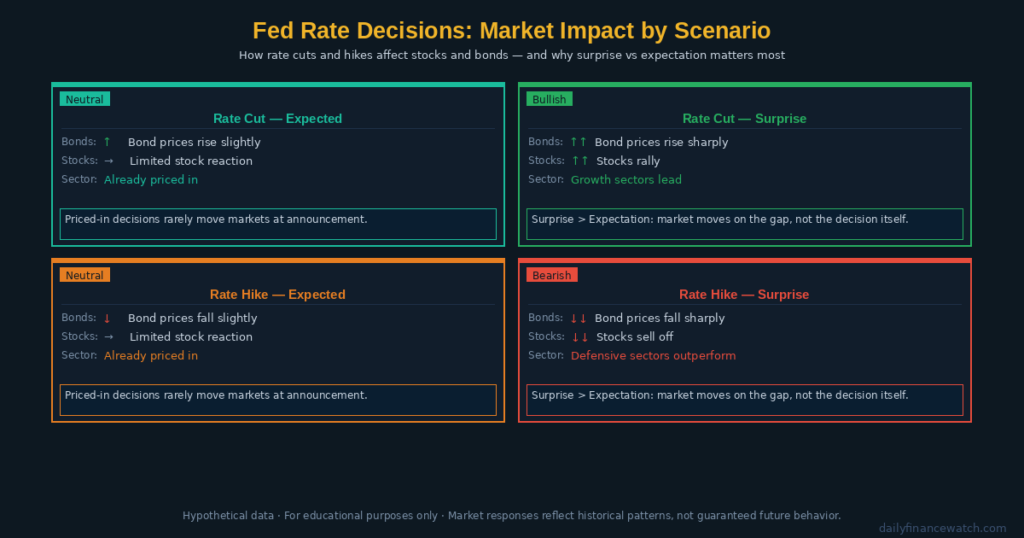
Caption: Fed rate decisions create opposite effects on stocks and bonds — understanding both helps investors position across changing rate environments.
The Fed’s most market-moving decisions are its federal funds rate changes. However, by the time a decision is officially announced, markets have typically already priced in the expected outcome. The actual price movement depends on whether the decision matches, exceeds, or falls short of what the market anticipated.
| Fed Action | Bond Market Effect | Stock Market Effect | Typical Sector Response |
|---|---|---|---|
| Rate cut (expected) | Prices rise, yields fall | Often limited reaction | Already priced in |
| Rate cut (surprise) | Prices rise sharply | Stocks rally | Growth sectors lead |
| Rate hike (expected) | Prices fall, yields rise | Often limited reaction | Already priced in |
| Rate hike (surprise) | Prices fall sharply | Stocks sell off | Defensive sectors outperform |
These responses reflect historical patterns and do not guarantee future market behavior. Every rate cycle operates in a different economic context.
Why Bond Prices and Interest Rates Move in Opposite Directions
When the Fed raises rates, newly issued bonds pay higher yields. Existing bonds with lower yields become less attractive by comparison, so their prices fall in the secondary market. When the Fed cuts rates, existing bonds with higher yields become more attractive, so their prices rise. This inverse relationship between interest rates and bond prices is a fundamental concept for any investor who holds fixed-income assets. According to FINRA’s investor education resources, understanding this relationship is essential for managing portfolio risk across different rate environments.
The FOMC Meeting Cycle and Investor Attention
The FOMC meets eight times per year, roughly every six to eight weeks. Each meeting produces a rate decision, a policy statement, and — four times per year — an updated Summary of Economic Projections, commonly called the dot plot. The dot plot shows each FOMC member’s anonymous projection for the future path of interest rates, and markets use it to gauge the committee’s collective view on where rates are headed.
Disciplined investors track the federal funds futures market — a market where participants bet on future rate levels — to understand what outcome is already priced in before each meeting. A decision that matches the futures market pricing typically produces little market movement. A decision that diverges from expectations — a larger cut, a smaller hike, or an unexpected change in language — produces the sharpest reactions.
How Disciplined Investors Use Fed Policy as Market Context
The Fed does not operate in isolation. Its decisions reflect the state of the economy, and the economy reflects conditions that affect corporate earnings, consumer spending, and business investment — all of which drive stock valuations. Therefore, disciplined investors treat Fed policy as important context for portfolio decisions, not as a trigger for reactive trading.
Reading the Fed’s Forward Guidance
The Fed communicates its intentions before it acts. Chair press conferences, member speeches, and meeting minutes all provide signals about the likely direction of future rate decisions. This forward guidance is deliberate: the Fed wants markets to adjust gradually rather than react violently to surprises. An investor who reads these communications carefully — rather than waiting for official decisions — often has more time to assess the implications for individual holdings.
For example, when Fed officials began signaling in late 2021 that rate hikes were likely in response to rising inflation, growth stocks began declining months before the first actual rate increase in March 2022. Investors who understood the discount rate mechanism — and why higher rates compress the present value of future earnings — were better positioned to assess the risk in their growth-heavy portfolios. This does not mean they could predict the bottom, but it means the direction of risk was readable from the Fed’s own communications.
Recency Bias and the Fed Policy Cycle
Investor psychology often distorts the interpretation of Fed decisions. Recency bias — the tendency to expect recent conditions to continue — causes investors to assume that a rate-hiking cycle will last indefinitely during tightening, and that rate cuts will continue indefinitely during easing. Both assumptions produce poor decisions at turning points. A disciplined investor distinguishes between the current rate level and the direction of rate change — two variables that carry different implications for asset prices. A high but falling rate environment is fundamentally different from a low but rising one, even if the absolute rate level at any given moment is identical.
Furthermore, herd behavior — following the crowd’s interpretation of Fed decisions rather than forming independent analysis — amplifies market reactions in both directions. When the market interprets a Fed statement as hawkish, even a minor language shift can trigger sharp selling driven by collective fear rather than genuine deterioration in economic fundamentals.
For more on how Federal Reserve rate decisions specifically affect technology companies and growth stocks, see why tech stocks fall when interest rates rise.
What is the FOMC and when does it meet?
The Federal Open Market Committee is the body within the Federal Reserve responsible for setting the federal funds rate. It consists of twelve voting members — the seven Board of Governors plus five of the twelve regional Reserve Bank presidents, who rotate annually. The FOMC meets eight times per year, roughly every six to eight weeks. Each meeting produces a rate decision and policy statement. Four meetings per year also include updated economic projections and a press conference by the Fed Chair.
How does the Federal Reserve control inflation?
The Fed controls inflation primarily by raising the federal funds rate, which increases borrowing costs across the economy. Higher borrowing costs reduce consumer spending and business investment, which slows demand for goods and services and reduces upward pressure on prices. This process takes time — rate changes typically take six to eighteen months to work fully through the economy. The Fed also uses quantitative tightening to withdraw liquidity from the financial system, which further tightens financial conditions and supports the inflation-reduction goal.
Does the Federal Reserve print money to fund government spending?
The Federal Reserve does not directly fund U.S. government spending. The government raises money by issuing Treasury bonds, which are sold to investors in the open market. The Fed may purchase some of those bonds through its open market operations or quantitative easing programs, which increases the money supply indirectly — but this is separate from directly financing government budgets. The Fed’s mandate is monetary policy, not fiscal policy. Fiscal decisions — government spending and taxation — are controlled by Congress and the executive branch, not the Federal Reserve.
This article is for educational purposes only and does not constitute personalized financial or investment advice. All investing involves risk, including the possible loss of principal.