Last updated: July 6, 2026
Between January and October 2022, the Nasdaq Composite fell more than 36% as the Federal Reserve raised interest rates from near zero to over 3%. Meanwhile, the S&P 500 energy sector gained more than 60% over the same period. The divergence was not random. Tech stocks — companies whose value depends heavily on earnings projected years into the future — are mathematically the most sensitive asset class to rising interest rates. Understanding exactly why this happens, and how the effect plays out across different types of companies, gives investors a clearer framework for managing growth-stock exposure across changing rate environments.
Why Tech Stocks Are Uniquely Sensitive to Interest Rates
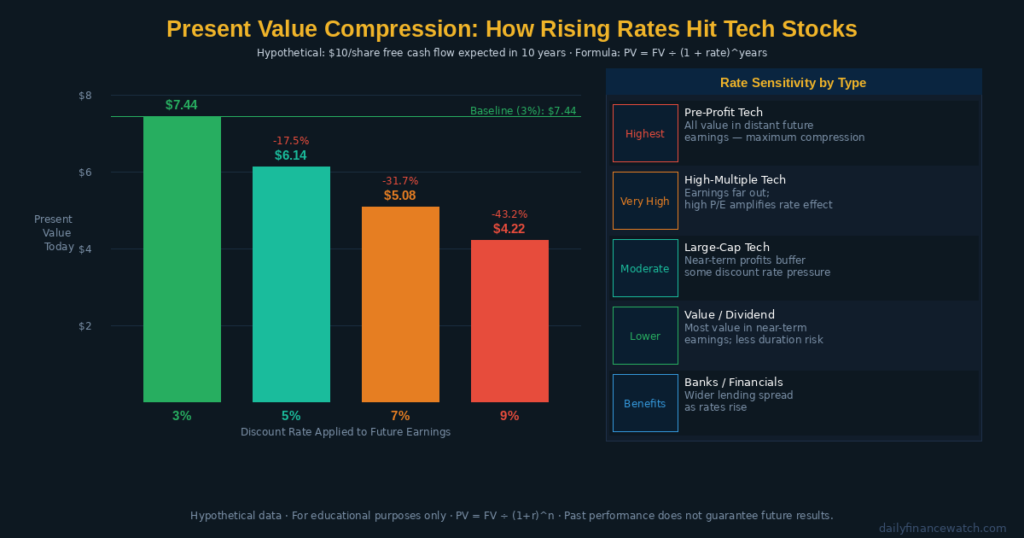
Caption: Higher discount rates reduce the present value of distant future earnings — the core reason tech stocks fall harder than other sectors when rates rise.
Tech stocks are growth stocks. Their current market valuations reflect not just today’s earnings, but earnings expected five, ten, or even twenty years from now. To determine what those future earnings are worth today, investors use a discount rate — a percentage that converts future cash flows into present value. When interest rates rise, that discount rate rises with them. Higher discount rates make future earnings worth less in today’s dollars, which lowers the fair value of the stock — even if the underlying business has not changed at all.
This is the discount rate mechanism, and it affects every stock. However, it hits tech and growth companies hardest because their value is concentrated furthest in the future. A mature dividend-paying company that earns $5 per share this year is relatively unaffected by a change in the discount rate — most of its value is in near-term, already-visible earnings. A high-growth technology company that expects to earn $5 per share in twelve years faces a dramatic compression in present value when the discount rate rises.
The Math Behind the Sensitivity
Consider a hypothetical growth company expected to generate $10 per share in free cash flow ten years from now. At a 3% discount rate, that future cash flow is worth approximately $7.44 today. At a 7% discount rate — the kind of shift that occurred during the 2022 rate-hiking cycle — the same $10 of future cash flow is worth approximately $5.08 today. That is a 32% reduction in present value with no change in the underlying business performance.
| Discount Rate | Future Cash Flow | Present Value Today | Change vs 3% |
|---|---|---|---|
| 3% | $10 / share (yr 10) | $7.44 | — |
| 5% | $10 / share (yr 10) | $6.14 | −17.5% |
| 7% | $10 / share (yr 10) | $5.08 | −31.7% |
| 9% | $10 / share (yr 10) | $4.22 | −43.3% |
Formula: PV = FV ÷ (1 + rate)^years. All figures are hypothetical and for educational purposes only.
The higher the growth rate priced into a stock, the longer the duration of its expected cash flows, and therefore the more sensitive its valuation becomes to discount rate changes. This is why companies like NVIDIA, which traded at extremely high earnings multiples during the low-rate environment of 2020 and 2021, experienced severe valuation compression when the Federal Reserve began hiking rates in 2022. The business did not deteriorate — the math of valuation did.
How the Rate Hike Transmission Affects Tech Valuations
Rising interest rates affect tech stocks through two distinct channels. Both reduce valuations, but they operate differently and on different timescales.
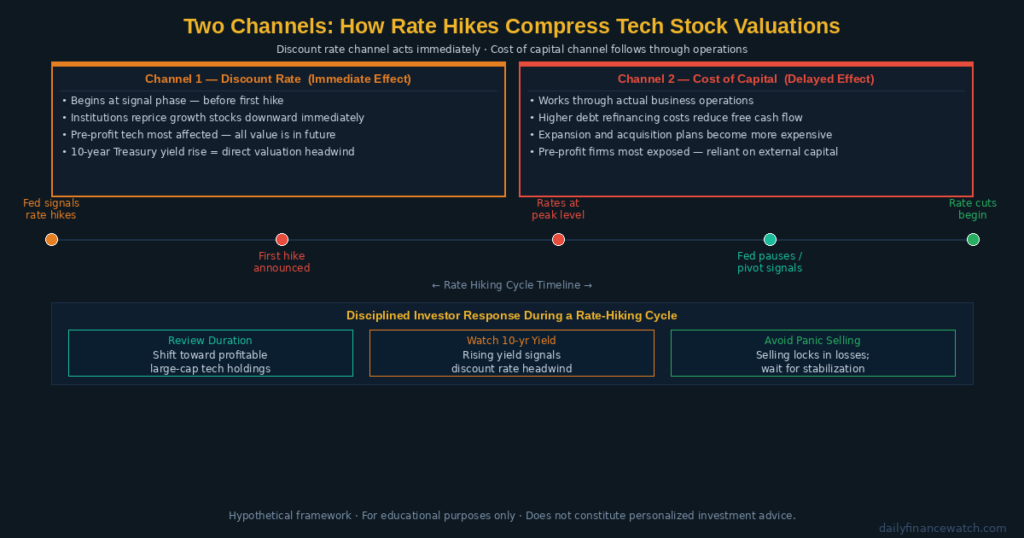
Caption: Rate hikes compress tech valuations through two channels simultaneously — higher discount rates and higher borrowing costs both work against growth companies.
The discount rate channel operates immediately through investor behavior. As soon as the Federal Reserve signals higher rates — often weeks or months before the actual hike — institutional investors and algorithmic trading systems reprice growth stocks downward. This is why tech stocks often begin falling before rates actually rise. Markets are forward-looking, and rate expectations are priced in as soon as they shift. According to the Federal Reserve’s official communications on monetary policy, the Fed deliberately telegraphs its intentions to allow markets to adjust gradually — but this forward pricing means that growth stocks often decline during the signaling phase, not just during the actual rate-hiking cycle.
The cost of capital channel operates more slowly, through actual business operations. Many technology companies — particularly younger, pre-profit firms — rely on external financing to fund research, development, and expansion. When interest rates rise, the cost of that financing increases. Companies that issued bonds at low rates face higher refinancing costs when those bonds mature. Companies planning to issue new debt to fund acquisitions or capital expenditure face a materially higher cost of capital than they anticipated in their original growth plans. This reduces projected free cash flow, which further lowers the fair value estimate.
Why Pre-Profit Tech Companies Are Most Vulnerable
Within the technology sector, the most rate-sensitive companies are those with no current earnings — pre-profit growth firms that trade entirely on future revenue expectations. These companies have no near-term cash flows to anchor their valuation. Their entire market price reflects a discounted projection of earnings that may be five to fifteen years away. When discount rates rise, that projection collapses faster and more severely than any other category of equity.
For context, the ARK Innovation ETF — which concentrated heavily in pre-profit, high-growth technology companies — fell more than 75% between its February 2021 peak and its trough in December 2022, a period that coincided almost exactly with the shift from ultra-low rates to aggressive rate hikes. These figures are historical and cited for educational context only. They do not predict future behavior.
How Disciplined Investors Manage Tech Exposure During Rate Hikes
A rate-hiking cycle does not automatically mean investors should sell all technology holdings. However, it does create a different risk environment for growth stocks — one that rewards careful position sizing, valuation discipline, and sector awareness.
Distinguishing Duration Risk Within Tech
Not all tech companies carry the same rate sensitivity. A disciplined investor separates technology holdings into two categories based on earnings duration.
Near-term earners — large-cap technology companies with significant current profitability, strong free cash flow, and dominant market positions — carry lower duration risk. Companies like Apple or Microsoft generate enormous quantities of near-term earnings. Their valuations still compress when rates rise, but the compression is more moderate because a larger share of their value resides in visible, near-term cash flows rather than distant projections.
Long-duration growth stocks — pre-profit companies or those trading at very high price-to-earnings ratios relative to near-term earnings — carry extreme duration risk in a rising rate environment. Their valuations depend almost entirely on the discount rate assumption. A disciplined investor may reduce exposure to this category before or during a rate-hiking cycle, not because the businesses are necessarily bad, but because the mathematical headwind is severe.
A hypothetical investor holding a 30% tech allocation during a low-rate environment may review whether that allocation contains primarily near-term earners or long-duration growth stocks when the Federal Reserve signals a rate-hiking cycle. Adjusting the balance within the tech allocation — toward profitable, cash-generating companies — reduces duration risk without requiring a complete exit from the sector. This does not guarantee protection from losses.
Watching the 10-Year Treasury Yield as a Signal
Disciplined investors track the 10-year U.S. Treasury yield as a real-time proxy for the discount rate applied to long-duration growth assets. When the 10-year yield rises rapidly — as it did from approximately 1.5% in early 2022 to over 4% by October 2022 — growth stock valuations face immediate mathematical pressure. When the 10-year yield stabilizes or falls, that pressure eases.
According to FINRA’s investor education resources, the 10-year Treasury yield serves as a benchmark rate that influences pricing across many asset classes, including equity valuations for long-duration growth stocks. Monitoring this yield does not provide a precise trading signal, but it gives investors context for assessing the macro environment before making allocation decisions.
Recency Bias and the Growth Stock Trap
Investor psychology plays a significant role in amplifying rate-driven tech sell-offs. Recency bias — the tendency to assume that recent conditions will continue — caused many investors to assume in 2020 and 2021 that ultra-low interest rates were permanent. This assumption drove aggressive buying of high-multiple growth stocks at prices that were only justifiable at extremely low discount rates. When rates rose, not only did the mathematical valuation compress — but investors who had anchored their expectations to low-rate valuations experienced an additional psychological shock.
Anchoring — the behavioral finance concept describing the tendency to fixate on a prior reference price — caused many investors to hold falling tech stocks far longer than their revised fair value justified, expecting a return to prior highs that were themselves only achievable at rates that no longer existed. Recognizing these patterns does not eliminate the risk, but it creates the pause needed for more deliberate decision-making during rate transitions.
For a broader view of how rate decisions flow through the economy to all asset classes, see how interest rates affect stocks and investor portfolios.
For context on how the Federal Reserve signals rate changes before it acts, see what the Federal Reserve is and how it moves markets.
Why do tech stocks fall before interest rates actually rise?
Markets are forward-looking. Institutional investors and algorithmic systems begin repricing growth stocks as soon as the Federal Reserve signals that rate hikes are coming — often weeks or months before the first actual increase. Because tech stock valuations depend on discounting future earnings, any shift in expected future rates immediately changes the present value calculation. The Federal Reserve deliberately telegraphs its intentions to allow gradual market adjustment, which means the valuation compression often occurs during the signaling phase rather than the hiking phase itself.
Do all technology companies fall equally when rates rise?
No. Companies with strong current profitability and large near-term free cash flows — such as established large-cap technology firms — are less sensitive to rate increases than pre-profit growth companies whose entire valuation rests on distant future earnings. The further into the future a company’s expected earnings are, the larger the mathematical impact of a higher discount rate on its present value. Pre-profit technology companies and those trading at very high earnings multiples face the most severe valuation compression during rate-hiking cycles.
Should investors avoid tech stocks entirely when rates are rising?
Avoiding all technology stocks during a rate-hiking cycle is rarely necessary for long-term investors. A more disciplined approach is to review the earnings duration of each tech holding — distinguishing between profitable, cash-generating companies and pre-profit, high-multiple growth stocks. Reducing exposure to the highest-duration names while maintaining positions in profitable large-cap tech companies addresses the rate sensitivity without abandoning an entire sector that may recover strongly when rate expectations stabilize or reverse.
This article is for educational purposes only and does not constitute personalized financial or investment advice. All investing involves risk, including the possible loss of principal.