Last updated: June 30, 2026
Two friends each invest for retirement. One invests $200 a month from age 25 to 35, then stops completely — ten years, $24,000 total. The other waits, then invests $200 a month from 35 to 65 — thirty years, $72,000 total. The second person contributes three times as much money for three times as long. Yet at 65, under common long-term return assumptions, the early starter who invested less often ends up with more. This is the part of compound interest most beginner guides miss: time matters far more than the amount you invest.
What Compound Interest Actually Is
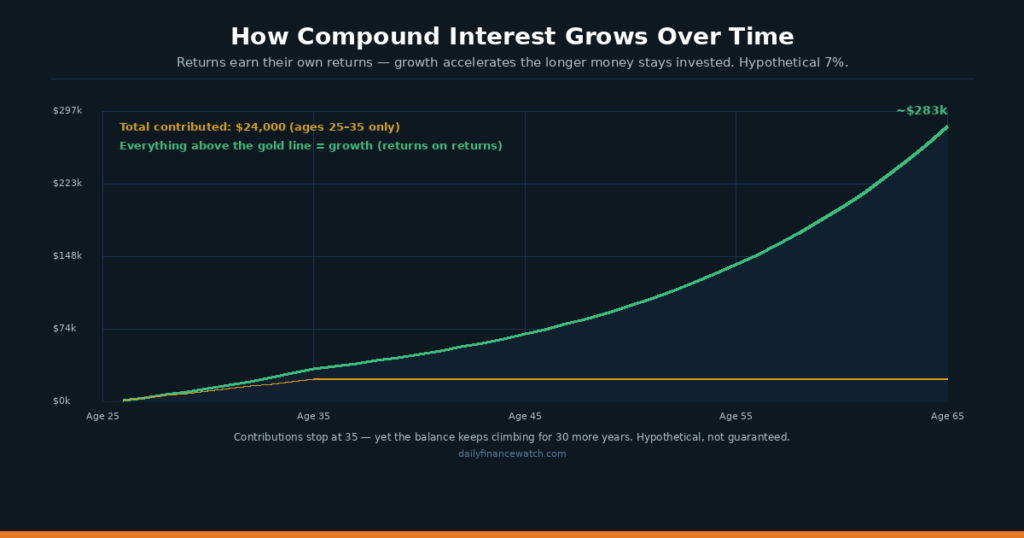
Caption: Compounding means returns earn their own returns, producing growth that accelerates the longer money stays invested.
Compound interest is the process of earning returns on both your original investment and the returns it has already generated. In the first year, you earn a return on your contribution. In the second year, you earn a return on your contribution plus the first year’s gain. Each year, the base that generates returns grows larger, so the gains grow larger too. This is why compounding produces a curve that bends upward over time rather than a straight line.
The distinction from simple interest is the engine of the effect. Simple interest pays only on the original amount. Compound interest pays on an ever-growing balance. Over short periods, the difference is small. Over decades, it becomes the dominant force in building wealth — larger than the contributions themselves.
Why Time Matters More Than Amount
Most beginner guides present compounding as a reason to invest more money. That advice is not wrong, but it buries the more powerful lever: time. Because compounding multiplies returns on returns, each additional year does more work than the last. The earliest dollars invested have the longest runway to compound, which makes them disproportionately valuable. A dollar invested at 25 can grow for 40 years; a dollar invested at 45 has only 20 years to work. Therefore, starting early can beat investing more later, because the math rewards duration above contribution size.
| Factor | Effect on Final Balance | Common Beginner Focus |
|---|---|---|
| Time invested | Largest driver — exponential | Underestimated |
| Rate of return | Significant — compounds over time | Sometimes considered |
| Amount contributed | Linear — helps, but less than time | Most attention |
| Starting early | Multiplies all of the above | Often delayed |
The Math That Proves Time Wins
The early-starter example deserves real numbers, because the result feels counterintuitive until the math is visible. The principle traces back to the time value of money, a foundational concept the SEC’s investor education resource at Investor.gov illustrates with its compound interest calculator.
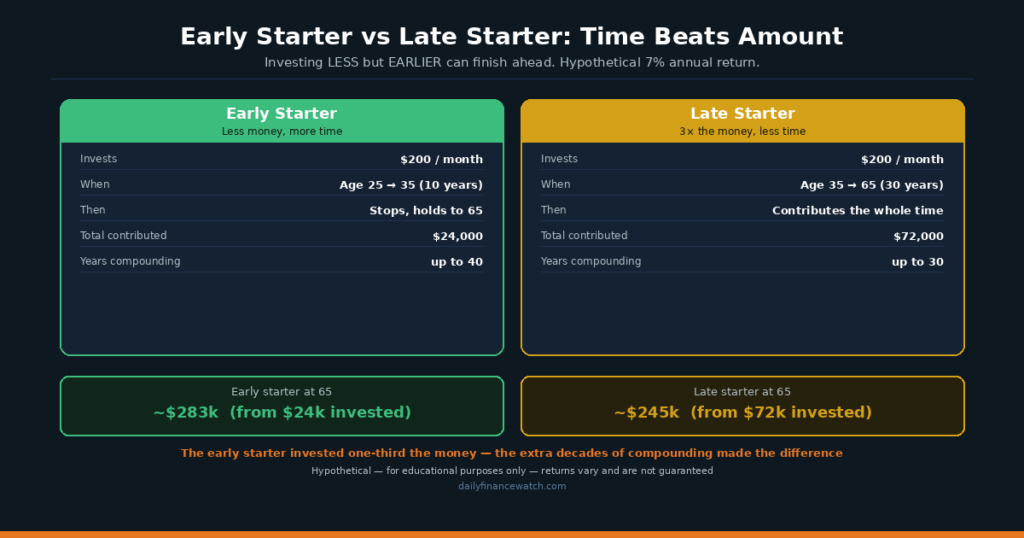
Caption: The early starter contributes far less yet can finish ahead, because the early dollars compound for decades longer.
Assume a hypothetical 7% average annual return, a figure often used to approximate long-term stock market returns after inflation, though actual returns vary widely and are never guaranteed. The early starter invests $200 monthly for ten years (ages 25–35), contributing $24,000, then leaves it untouched until 65. The late starter invests $200 monthly for thirty years (ages 35–65), contributing $72,000. Under these assumptions, the early starter finishes with roughly $283,000 while the late starter finishes with roughly $245,000 — despite the early starter investing only one-third as much money. The variable that overwhelms the contribution gap is time.
Why This Happens
The reason lies in where the growth comes from. In a long compounding period, the majority of the final balance is not the money contributed — it is the accumulated returns on returns. The early starter’s contributions spend decades generating those layered returns. The late starter’s contributions, though larger, never get enough time to build the same compounding base. This is why financial educators stress starting early even with small amounts: the first years of compounding are the hardest to replace later with bigger contributions.
How Beginners Can Harness Compounding
For a beginner, the practical takeaway reorders the usual priorities. The instinct is to wait until you can invest a meaningful amount. The math says the opposite: start now with whatever you can, because time is the input you can never recover. A small, consistent contribution begun today often outperforms a larger contribution begun in five years, simply because those five years of compounding are gone forever.
Most guides describe compounding as “your money grows faster over time.” This framing is true but vague, and it leads beginners to focus on the amount. The accurate mental model is that compounding rewards duration exponentially, so the single most valuable action is extending the time your money stays invested. Institutional and retirement-planning frameworks build entire strategies around this — automatic early contributions and long, uninterrupted holding periods, precisely because interrupting compounding resets its most powerful years.
For investors building this foundation, how to start investing in stocks covers how to begin immediately, and why time in the market beats timing the market extends this principle into how compounding interacts with market participation.
Common Mistakes That Interrupt Compounding
Waiting to start is the most costly error, and it is invisible because the loss never appears on a statement. An investor who delays five years to “have more to invest” forfeits the five most leveraged years of compounding. No later contribution fully replaces them. This delay often reflects a misunderstanding that compounding needs large sums to matter, when in fact it needs time more than size.
Withdrawing early is a second compounding killer. Pulling money out, even temporarily, removes it from the compounding base and resets part of the growth engine. Each interruption costs not just the withdrawn amount but all the future returns that amount would have generated. Frequent buying and selling has a similar effect, as it can trigger taxes and break the uninterrupted holding that compounding rewards.
What Disciplined Investors Understand About Compounding
Smart money practice treats time in the market as the scarcest and most valuable resource. Disciplined investors prioritize starting early and staying invested over timing the perfect entry or waiting for a larger contribution. They automate contributions so compounding begins immediately and continues without interruption, understanding that consistency over decades matters more than the size of any single investment.
A disciplined investor also resists interrupting the process. They avoid withdrawing from long-term accounts and avoid frequent trading that breaks compounding and triggers taxes. They understand that the unremarkable act of leaving money invested for decades is, mathematically, one of the most powerful financial moves available. This does not guarantee any specific return, and market values fluctuate, but the structural advantage of long uninterrupted compounding is well established.
What you should now understand differently is which lever to pull first. The beginner instinct is to wait until you can invest more. The math says start now, even small, because the earliest years of compounding do the heaviest lifting and can never be recovered later. Amount helps, and a higher return helps, but time is the input that multiplies everything else. The most valuable day to begin compounding was years ago; the second most valuable day is today.
FAQ
Why is starting early more important than investing more?
Compounding earns returns on previous returns, so each year of growth builds on a larger base than the year before. The earliest dollars invested have the longest time to compound, making them disproportionately valuable. A smaller sum invested early can finish ahead of a larger sum invested late, because the early money spends more years generating layered returns. Time is the one input you cannot recover later, which is why starting early often beats contributing more.
How does compound interest actually build wealth over decades?
Over long periods, most of a portfolio’s final value comes not from contributions but from accumulated returns earning their own returns. Early on, growth is modest. As the balance grows, each year’s return is calculated on a larger total, so the gains accelerate. This produces an upward-bending curve rather than steady linear growth. The effect is small over a few years but becomes the dominant force over decades, often exceeding the total amount contributed.
What is the biggest mistake people make with compounding?
The most damaging mistake is waiting to start, because the lost years of compounding never appear on a statement yet cannot be replaced. Delaying to “invest more later” forfeits the most leveraged early years. Withdrawing money early or trading frequently also interrupts compounding, removing funds from the growing base and resetting part of the growth engine. Compounding rewards starting early and leaving money invested without interruption for as long as possible.
This content is for educational purposes only and does not constitute personalized financial advice. All investing involves risk, including the possible loss of principal.