Last updated: July 3, 2026
Most guides describe an initial public offering as the moment a company goes public.
However, that framing stops one step short of the most important detail. The IPO process is a price-discovery mechanism. Investment banks hired by the company — called underwriters — set the offering price before any public trading begins. That distinction changes how investors should interpret first-day market behavior. When a stock opens 112% above its offering price, that gap represents money the company did not collect. It is not a windfall available to every investor.
The offering price and the market price are two separate numbers, set by two separate processes. Therefore, this article covers how the IPO process unfolds and why underwriters set the price the night before trading. It also explains what retail investors can realistically access compared to institutional buyers.
What the IPO Process Actually Involves
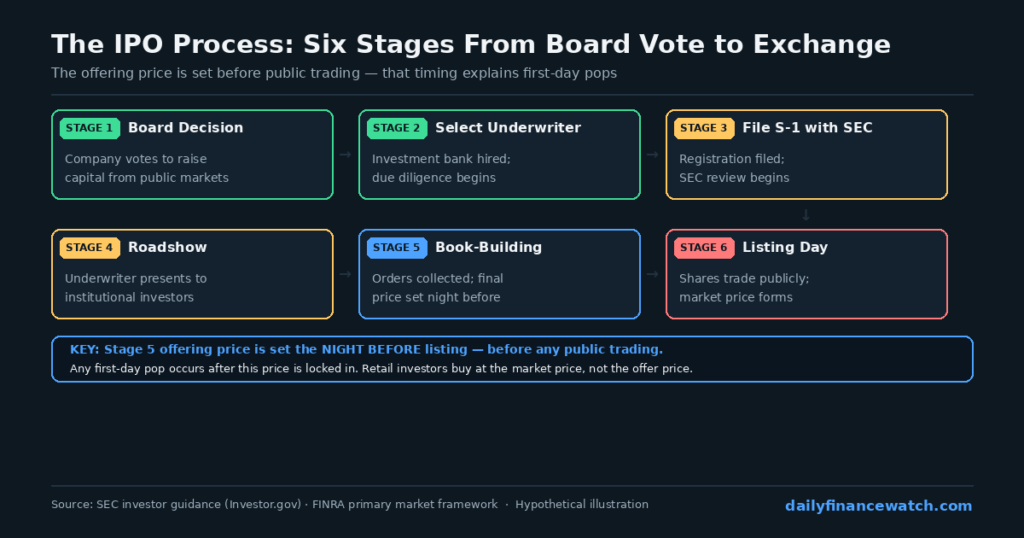
Six sequential stages take a private company from board vote to exchange listing.
In practice, the IPO process begins when a company’s board votes to raise capital from public investors. Management then selects one or more investment banks — the underwriters — to manage the transaction. Specifically, this decision starts a process that can take three to six months. The underwriter’s role involves verifying the company’s financial history and drafting legal disclosures required by the SEC. The underwriter also builds a preliminary offering price range based on comparable company valuations.
From Private Company to Public Market
Specifically, the company files a Form S-1 registration statement with the SEC. This document discloses the company’s business model, financial history, risk factors, and an initial price range.
The SEC then reviews the S-1 and sends comment letters requesting clarification. Consequently, the company files amended versions — labeled S-1/A — until the SEC declares the registration effective. Furthermore, the underwriter schedules a roadshow. This series of presentations reaches institutional investors, fund managers, and analysts. In turn, it gathers non-binding indications of interest before the offering price is set.
How Underwriters Set the Offering Price
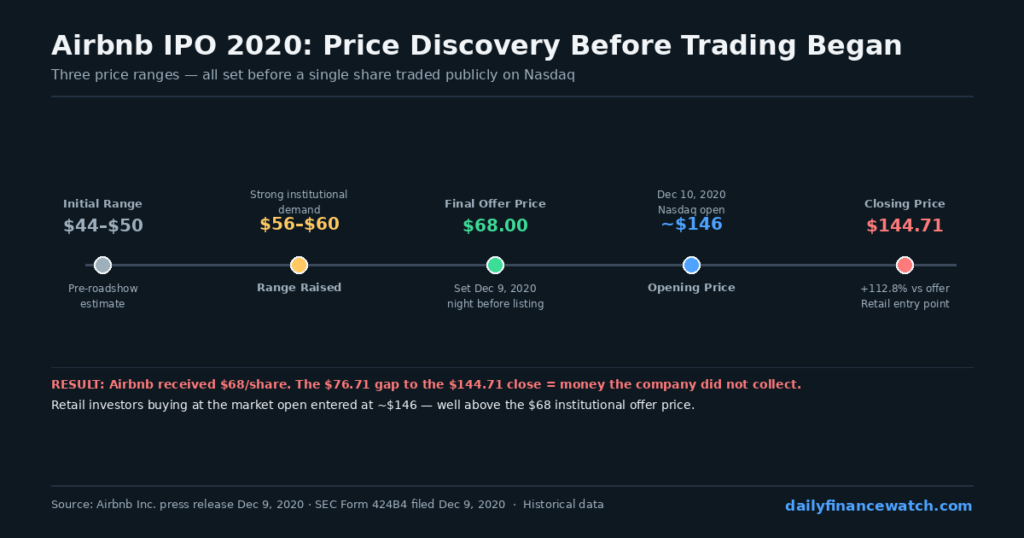
Airbnb’s price climbed through three ranges before public trading opened.
Book-building is the process underwriters use to collect orders from institutional investors at various price levels.
Consequently, the underwriter maps demand across price points and adjusts the range when demand clusters above the initial estimate. According to the SEC’s Investor.gov bulletin on IPO investing, underwriters use order-book data to recommend a final price to the company. The company, in turn, makes the final pricing decision. The company and its underwriters set this price the night before trading opens. They base it on institutional orders collected during the roadshow, not on live market demand.
Book-Building and the First-Day IPO Pop
The first-day IPO pop is the gap between the offering price and the stock’s price on its first trading day. Underwriters set the offering price the night before listing. Underwriters typically price the offering below the level where institutional demand would fully clear. This deliberate discount rewards book-building participants and ensures all shares sell. For the company, every dollar of first-day pop represents revenue it did not receive.
A stock opening at $140 on a $68 offering means the company sold shares at roughly half the market price. In practice, the market assigned that higher value the moment trading opened.
Airbnb’s 2020 IPO: Money Left on the Table
Specifically, Airbnb’s December 2020 IPO illustrates the pricing sequence precisely. The company entered the process with an initial range of $44 to $50 per share. However, institutional demand was strong enough that underwriters raised the range twice. First they moved to $56–$60 per share, then beyond that.
How Pricing Decisions Affect Company Proceeds
On December 9, 2020, Airbnb confirmed a final offering price of $68.00 per share. The offering covered 51,323,531 shares of Class A common stock, of which 50,000,000 came from Airbnb itself.
According to the company’s official press release filed the same day, gross proceeds to Airbnb reached approximately $3.4 billion. Lead book-running managers included Morgan Stanley, Goldman Sachs & Co. LLC, and Allen & Company LLC. On December 10, 2020, shares began trading on Nasdaq under the ticker ABNB. Consequently, shares closed at approximately $144.71 — a 112.8% gain over the $68 offering price.
In total, Airbnb received $68 per share. It did not participate in any subsequent market-driven price increase.
A common piece of guidance tells investors to buy IPO shares on the first day to capture the pop.
In reality, the pop that institutional buyers capture runs from the offering price to the market open. For Airbnb, the move from $68 to approximately $146 at the open occurred entirely within institutional accounts. Retail buy orders had not yet executed. In reality, an investor purchasing ABNB at the market open on December 10 did not buy at $68. Instead, whether that price represented fair value depended on Airbnb’s fundamentals, not the size of the pop.
What Retail Investors Can Access
Notably, retail investors enter the IPO process at a different stage than institutional buyers. Some broker platforms offer directed share programs that include retail allocations. However, these typically go to the platform’s highest-value clients first and represent a small fraction of total shares. Consequently, most retail investors buy in the open market on the first trading day. In other words, they pay the prevailing market price, not the institutional offering price.
Reading the Prospectus Before Participating
In practice, the prospectus provides the most complete public information about a company entering the IPO process.
According to SEC investor guidance, the final prospectus — filed as a Form 424B4 — includes the final offering price, use of proceeds, and underwriting discount. It also discloses insider lockup terms. Lockup periods — typically 90 to 180 days — prevent founders and early investors from selling immediately after the IPO. Consequently, when lockup periods expire, additional supply enters the market and can affect the stock price. Investors who track SEC filings can monitor both the S-1 filing date and the lockup expiration through SEC EDGAR.
In other words, understanding the IPO process means distinguishing three separate events. These are the offering, the listing, and the lockup expiration. In turn, each event carries different implications for price behavior. The common framing — company goes public, stock pops — describes only the second event. It misses the first and third entirely.
Related articles:
What is an IPO and how does it work?
An IPO, or initial public offering, is the first time a company sells shares to public investors through a formally registered process.
The company files a Form S-1 registration statement with the SEC, selects underwriters, and sets an offering price through a book-building process with institutional investors. Once the SEC declares the registration effective, the company confirms a final price and shares begin trading on a stock exchange. The full IPO process typically takes several months from the initial filing to the first trading day.
What causes the first-day IPO pop?
The first-day pop occurs because underwriters typically set the offering price below where full market demand would clear.
Institutional investors receive shares at the offering price set the night before listing. Consequently, when shares begin trading, broader market demand pushes the price above that level. The difference between the offering price and the first trading day’s closing price is money the company did not collect. Airbnb’s 2020 IPO illustrates this directly — shares offered at $68 closed at approximately $144.71 on the first day of trading.
Can retail investors buy shares at the IPO offering price?
Retail investors rarely receive shares at the institutional offering price.
Most IPO share allocations go to institutional investors — hedge funds, mutual funds, and large accounts — who participated in the book-building process. Some broker platforms offer directed share programs that include retail allocations, but these typically go to the platform’s highest-value clients first. Most retail investors buy in the open market on the first trading day at the market price, which in cases like Airbnb’s is already well above the institutional offering price.
This content is for educational purposes only and is not personalized financial advice. Investing involves risk, including possible loss of principal.
© 2026 Daily Finance Watch. Excerpts under 50 words with attribution and a link back are permitted. Full-article reproduction requires written permission.