Last updated: July 3, 2026
Short selling is typically described as one of the riskiest strategies in stock investing. However, that framing tells only half the story.
In practice, this strategy can add risk to a portfolio, but it can also reduce it — the outcome depends entirely on how and why a position is opened. For instance, a speculative short bet on a rising stock carries unlimited loss potential. In contrast, a short position used to hedge an existing long holding can reduce total exposure. It does not necessarily increase it. Understanding the mechanism — not just the label — is the key distinction.
At first glance, most beginners encounter short selling through cautionary examples — a trader betting against a company and losing badly. Therefore, this article covers how this strategy works, what the risk profile looks like in concrete terms, and what the GameStop squeeze of 2021 reveals about what happens when short positions unwind at scale.
What Short Selling Actually Involves
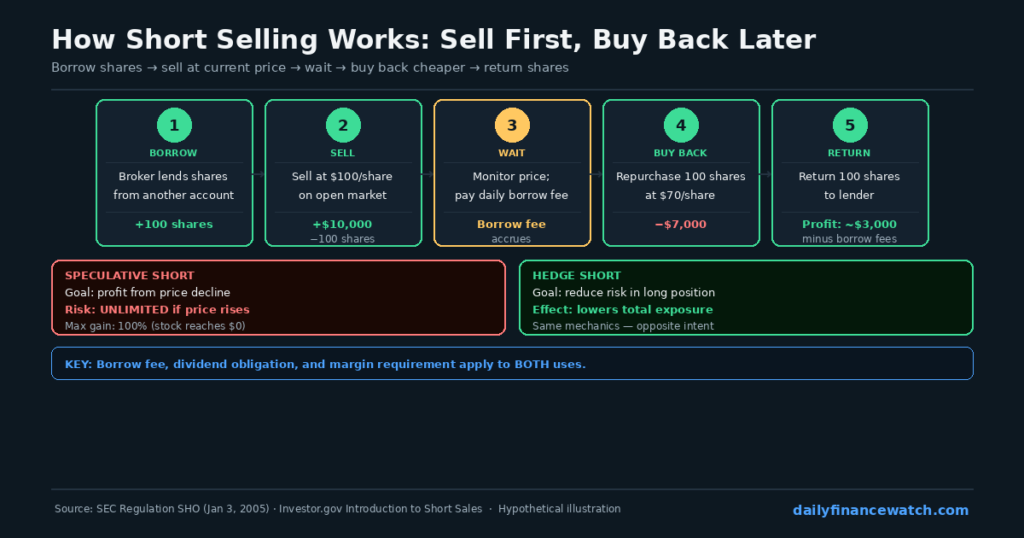
Short selling reverses the typical sequence — you sell first, then buy back later.
In a standard stock purchase, an investor buys first and sells later. In contrast, short selling reverses that sequence. Specifically, the short seller borrows shares from a broker, sells them immediately at the current market price, and waits. If the price falls, the short seller buys the shares back at the lower price and returns them to the lender. The difference becomes profit. If the price rises, the short seller must buy the shares back at a higher price. The result is a loss.
Borrowing Shares and the Short Selling Mechanics
The broker charges a borrow fee for the duration of the loan, which varies by how heavily shorted a stock is. Consequently, a stock with very high short interest may carry an annualized borrow fee of 10% or more. This fee reduces profitability even if the price moves in the expected direction.
Furthermore, according to the SEC’s Investor.gov bulletin on short sales, the borrower must pay any dividend to the lender during the loan period. The short seller does not receive it.
Regulation SHO, effective January 3, 2005, requires short sellers to locate shares available to borrow before executing a sale. In practice, the locate requirement prevents most forms of “naked” short selling — selling shares without arranging to borrow them first.
How Short Sellers Profit — and Face Unlimited Loss
The profit calculation for short selling has a hard ceiling and no floor. A short seller who sells a stock at $100 earns a maximum of $100 per share. That ceiling only exists if the stock falls to zero.
However, the loss side has no equivalent ceiling. A stock can rise from $100 to $200, $400, or $1,000. The short seller must cover at whatever price the market sets. Consequently, short selling exposes the trader to losses that grow without limit as the stock price rises.
The Asymmetric Risk Calculation
In contrast, a long position limits the loss to the amount invested. A short position carries no equivalent ceiling. Notably, brokers require short sellers to maintain margin accounts and meet margin calls if a short position moves against them. In practice, a broker may require additional collateral or force closure if the loss exceeds the maintenance margin. This forced closure can happen at the worst possible moment — when the price is rising fastest.
| Comparison | Long position | Short position |
|---|---|---|
| Max profit | Unlimited (stock rises) | Limited (stock falls to $0) |
| Max loss | 100% of investment | Unlimited (stock rises without ceiling) |
| Profit condition | Price rises | Price falls |
| Loss condition | Price falls | Price rises |
| Margin required | Sometimes | Always |
Source: SEC Regulation SHO; Investor.gov — An Introduction to Short Sales.
When Short Selling Becomes a Short Squeeze: GameStop 2021
In January 2021, GameStop (ticker: GME) became the center of a historic short squeeze. GameStop, a struggling video game retailer, had attracted heavy short interest because many analysts expected further decline.
As of January 22, 2021, approximately 140% of GameStop’s public float was sold short. This happened because shorted shares had been re-lent and shorted again.
How 140% Float Creates a Feedback Loop
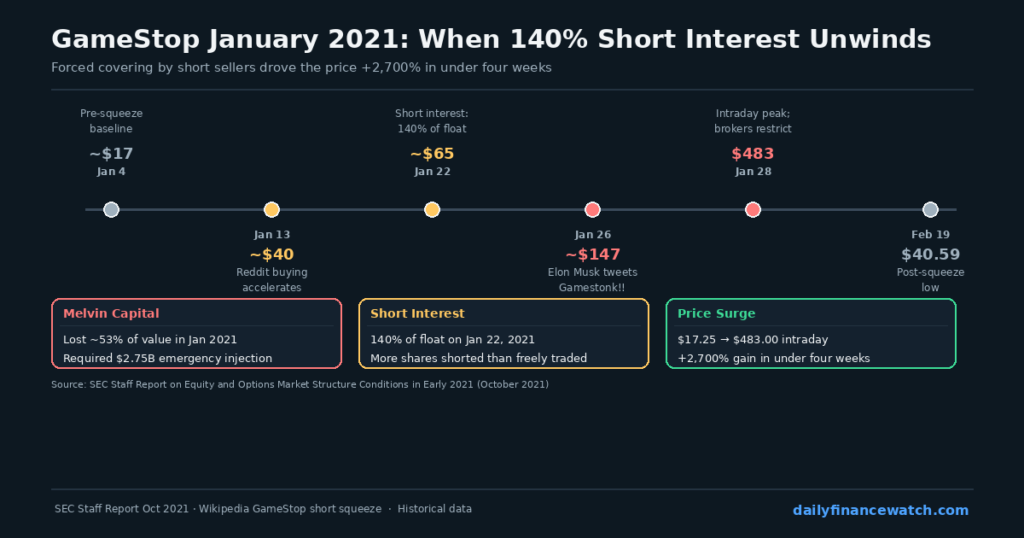
At 140% short float, forced covering drove GameStop’s price to $483 intraday.
Retail investors on Reddit’s r/WallStreetBets began buying GME shares and call options in large numbers. Consequently, GameStop’s stock price rose from approximately $17.25 on January 4 to an intraday high of $483.00 on January 28, 2021. That represents a gain of over 2,700% in less than four weeks, according to the SEC Staff Report on Equity and Options Market Structure Conditions in Early 2021 (October 2021).
As the price rose, consequently, short sellers faced growing margin calls. In turn, many were forced to buy back shares to close positions. This pushed the price higher and triggered additional closures — a self-reinforcing loop.
Melvin Capital, a hedge fund with a significant short position in GameStop, lost approximately 53% of its value in January 2021 alone. The fund required a $2.75 billion emergency injection — $2 billion from Citadel and $750 million from Point72 — to remain solvent. Consequently, Melvin Capital ultimately closed in 2022.
A common piece of guidance frames this strategy as simply the mirror image of buying a stock. Bearish investors go short the same way bullish investors go long — just in reverse.
In practice, that framing misses a critical asymmetry. When a long investor is wrong, the position eventually reaches zero — a defined loss. When a short seller is wrong at GameStop’s scale, covering at 2,700% above entry is the outcome. The two strategies share mechanics but carry structurally different risk profiles.
What Retail Investors Should Know About Short Selling
Retail investors rarely use this strategy directly, but short interest data appears in stock quotes on most brokerage platforms.
Specifically, short interest is the total number of shares currently sold short, expressed as a percentage of the stock’s float. A high short interest ratio — sometimes called “days to cover” — measures how many trading days it would take to close all positions at average volume. It signals that many participants expect the price to fall. However, high short interest can also create conditions for a squeeze if sentiment shifts rapidly.
Reading Short Interest Data Before It Moves a Stock
In practice, FINRA and U.S. exchange rules require brokerage firms to report short interest data twice monthly. This data becomes publicly available through financial data providers and broker platforms. Tracking SEC filings from institutional investors can reveal large short positions. Funds managing over $100 million must disclose certain holdings. Furthermore, the bid-ask spread on a heavily shorted stock tends to widen when borrow demand spikes. This signals rising borrow costs.
Understanding these mechanics — the borrow, the locate requirement, the margin obligation, and the asymmetric loss profile — provides context even for investors who never short a stock. In other words, it explains why certain stocks behave unusually when short interest is elevated.
Related articles:
What is short selling and how does it work?
This strategy involves borrowing shares from a broker and selling them immediately, with the goal of buying them back at a lower price later. The profit equals the sale price minus the repurchase price and borrow fees. If the stock rises, the short seller buys back at a higher price — a loss. The loss potential is theoretically unlimited.
Why is short selling considered high risk?
Long investors can lose at most 100% of the amount invested if a stock falls to zero. A short seller faces no equivalent ceiling. If the stock doubles, triples, or rises 2,700% as GameStop did in January 2021, the short seller must cover at market price. Brokers may force closures if losses exceed maintenance margin.
What is a short squeeze and why does it happen?
A short squeeze occurs when a heavily shorted stock rises sharply, forcing short sellers to buy back shares to limit losses. This buying pushes the price higher and triggers more forced closures — a self-reinforcing cycle. Squeezes are more likely when short interest is high relative to the float and shares are difficult to borrow. GameStop’s January 2021 squeeze is the most cited recent example: short interest at 140% of float meant any forced covering would accelerate the price higher.
This content is for educational purposes only and is not personalized financial advice. Investing involves risk, including possible loss of principal.
© 2026 Daily Finance Watch. Excerpts under 50 words with attribution and a link back are permitted. Full-article reproduction requires written permission.