Last updated: July 5, 2026
A covered call strategy gets marketed as a way to generate steady income with reduced risk. Actually, that “reduced risk” framing overstates what the strategy really does. The premium provides a small cushion, not real protection.
What a Covered Call Actually Is
According to FINRA, a covered call is a situation where an investor sells a call option. Specifically, they do this while owning the underlying stock. Also, the investor generates income from the premium. However, they risk losing upside appreciation if the option gets exercised. You can review the official definition at finra.org. Notably, an investor holding 100 shares can sell one call contract against those shares. This lets them collect the option’s premium immediately as cash.
The Mechanism: What You Actually Trade Away
Here is the mechanism behind the thesis. Selling a call option caps your maximum gain. Specifically, that cap sits at the strike price plus the premium received. If the stock rallies far above that strike, you still only receive the capped amount. Your downside, meanwhile, remains almost fully intact. Notably, you still own the stock. As a result, it can decline just as much as if you never sold the call. The premium only offsets a small portion of any loss.
Why This Trade-Off Gets Misunderstood
Marketing materials for covered call funds often follow a pattern. Specifically, they emphasize the income generated while downplaying the capped upside. Investors sometimes interpret “generates income” incorrectly. They assume it means extra return, layered on top of normal stock ownership. Instead, the premium substitutes for a portion of potential capital appreciation. It does not add to your total return in a rising market.
The Experience Anchor: What the Trade-Off Actually Costs
Specifically, consider the real performance data behind popular covered call funds. In 2023, the JPMorgan Equity Premium Income ETF (JEPI) returned approximately 15%. The S&P 500, by contrast, returned about 24% that same year. In 2021, JEPI returned roughly 24% against the index’s 29%. However, 2022 told a different story. During that bear market, JEPI returned around -5%. The S&P 500, meanwhile, declined roughly -18%. This pattern repeats across covered call funds. Essentially, the strategy trades upside participation for a smoother ride, not for a higher total return.
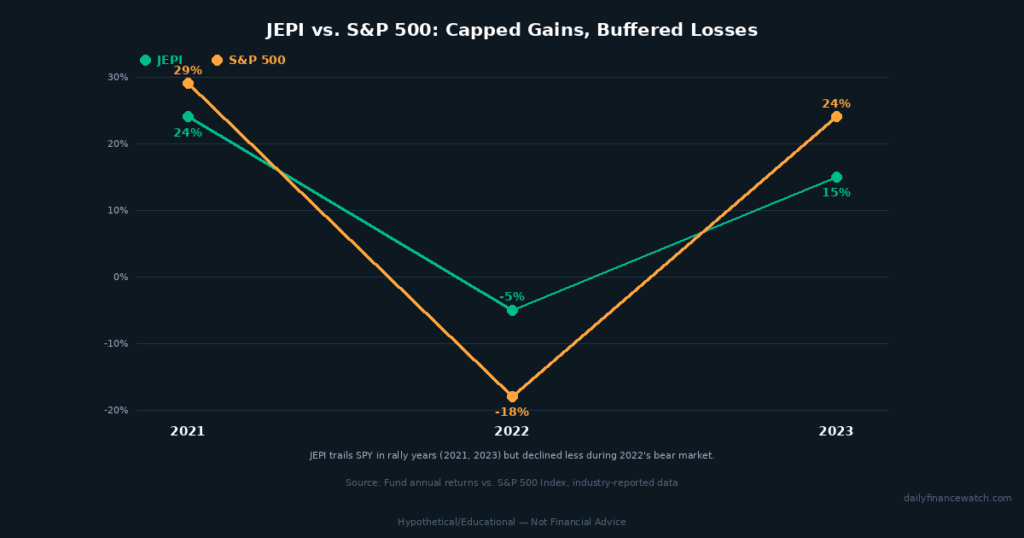
A slope chart comparing JEPI and S&P 500 returns across 2021-2023.
The trade-off shows up even more starkly in funds that write calls aggressively. According to fund industry data, one prominent Nasdaq-100 covered call ETF offers a clear example. Its net asset value has declined an average of 3.72% annually over its lifespan. Notably, this happened even while the fund distributed double-digit yields. This matters for one key reason. A high yield paired with a shrinking NAV is not pure income. Instead, a meaningful portion of that yield reflects capital returning to shareholders, not new wealth being created.
The Balance-Scale View of a Covered Call
Notably, every covered call sits on a trade-off. Specifically, on one side sits the premium income you collect today. On the other side sits the upside participation you give up if the stock rallies. Neither side is inherently better. Ultimately, the right balance depends on your stock outlook and your need for current income versus growth.
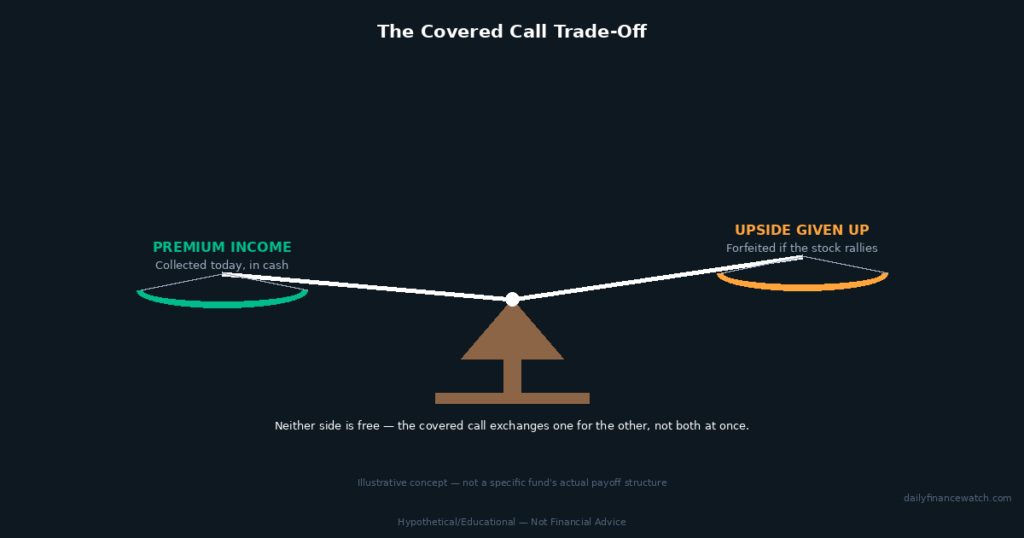
A balance-scale diagram of covered call income versus upside given up.
When a Covered Call Actually Makes Sense
Notably, a covered call tends to work best under specific conditions. Specifically, it fits a stock you already own and expect to trade sideways. If you expect a large rally, selling a call caps your gain. This happens right when you would benefit most. If you expect a sharp decline, the premium provides only minor cushioning. Ultimately, this strategy fits a specific market view, not a universal income solution.
Tax Treatment Adds Another Layer
Notably, option premium income from covered calls faces different tax treatment than qualified dividends generally. Depending on the holding period and strategy structure, different rules apply. Often, this income falls under short-term capital gains rates. Notably, these rates can reach the same level as ordinary income. Our guide on tax-loss harvesting covers a related concept. Specifically, it explains how timing and income character affect your after-tax return.
Covered Calls Connect Back to Options Basics
Notably, a covered call is one of the simplest options strategies available. Specifically, it uses a single call option against stock you already hold. Also, our guide on options trading covers the foundational terms that apply here. These include strike price and premium, both central to how a covered call gets priced.
The Anti-Advice Reminder
Specifically, several factors determine whether a covered call fits your portfolio. These include your stock outlook, your tax situation, and your tolerance for capped gains. Notably, the strategy is not free insurance. Also, the income it generates is not separate from the stock’s own performance. Before selling calls against a position, consider two steps. First, review the specific historical trade-offs involved. Then, consult a financial professional about your own goals.
A covered call strategy does exactly what its name suggests. It covers a call option with stock you own. However, it does not cover you from loss. Ultimately, understanding that the premium compensates for capped upside — not a bonus on top of ordinary returns — determines whether the strategy fits your goals.
This article is for educational purposes only. It does not constitute financial advice. Options strategies carry risk, and past fund performance does not guarantee future results.
© 2026 Daily Finance Watch. All rights reserved.