Last updated: July 5, 2026
Most people think of options trading as a tool for making a directional bet. Actually, the market was built for something else entirely. Today’s fastest-growing segment looks nothing like either version.
What an Options Contract Actually Is
An option is a contract. Specifically, it gives the buyer the right, but not the obligation, to buy or sell a stock at a fixed price by a specific date. According to the SEC, this fixed price is the strike price. The date is the expiration date. You can review the full breakdown at investor.gov. A “call” option gives the right to buy. A “put” option gives the right to sell. Notably, each standard contract typically represents 100 shares of the underlying stock.
Why Options Were Created in the First Place
Here is the mechanism behind the thesis. Before 1973, options traded informally over-the-counter. There were no standardized terms. Then, on April 26, 1973, the Chicago Board Options Exchange opened. This created the first exchange for standardized, listed options. The goal was straightforward. Standardized contracts and centralized clearing would let investors manage risk with precision. This replaced the need to negotiate one-off private agreements.
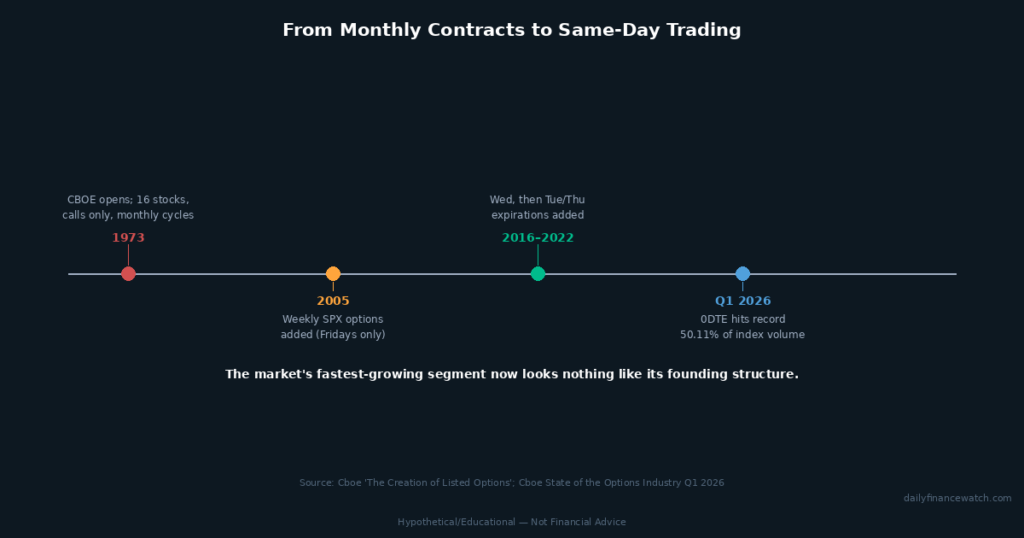
A timeline showing options trading evolving from CBOE’s 1973 founding to today’s daily expirations.
The exchange started small. Specifically, it listed call options on just 16 stocks. Put options were not added until 1977. Expiration cycles were monthly at first. Then, quarterly additions followed as demand grew. For decades, this multi-week structure defined what “trading options” meant in practice.
The Original Purpose: Risk Management, Not Speculation
The founders designed options to solve a real problem. Specifically, investors and institutions needed to hedge existing stock positions. However, they wanted to do this without selling those positions outright. Specifically, a protective put illustrates this. This lets an investor lock in a minimum sale price on shares they already own. Ultimately, this insurance-like function was the primary reason the exchange existed.
The Experience Anchor: Where Options Volume Actually Sits Today
The market has shifted dramatically since 1973. Specifically, total U.S. options volume reached 15.2 billion contracts in 2025. According to Cboe, this marked the sixth consecutive annual record. However, a more telling number involves timing, not total volume. By 2022, Cboe had expanded S&P 500 index options to offer an expiration every weekday. This rollout began with Friday-only expirations back in 2005. As a result, full same-day trading, known as “zero days to expiration” or 0DTE, became possible every session.
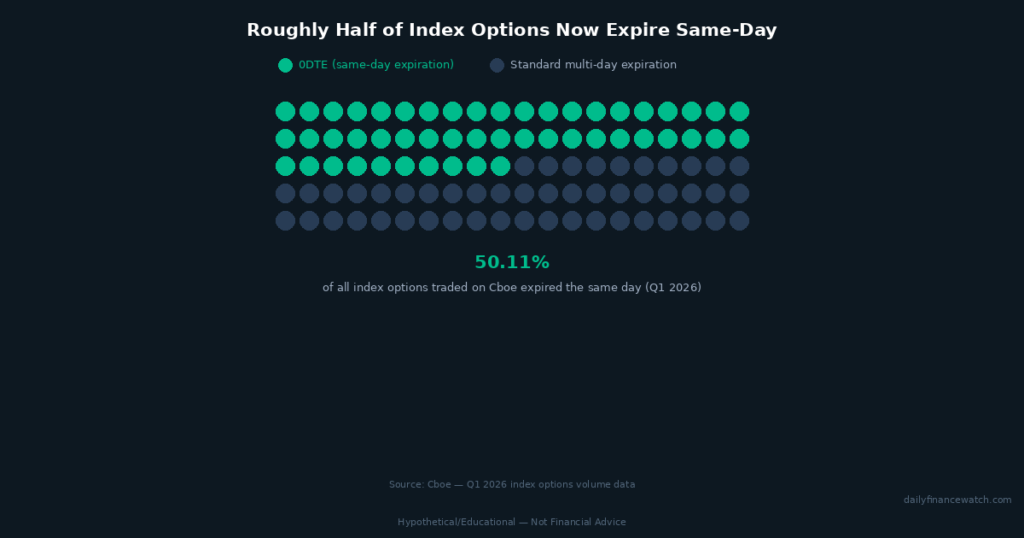
An icon-grid pictogram showing roughly half of all index options trades on Cboe now expire the same day they open.
The result has been striking. Specifically, 0DTE trading represented a record 50.11% of all index options trading on Cboe’s markets in the first quarter of 2026. This means something important. The fastest-growing corner of the options market barely resembles the multi-week hedging structure the exchange was originally built around.
Same-Day Trading Is Not Automatically Reckless
Cboe’s own data tells a different story than media coverage often suggests. Specifically, same-day options activity appears more balanced than commonly assumed. Roughly half of this volume involves spread strategies rather than simple directional bets. Also, a large share of participants use capped-risk structures. Still, the short time horizon matters. These contracts react quickly to price swings. Beginners should understand that speed cuts both ways.
How to Actually Open an Options Account
Notably, trading options is not as simple as clicking “buy” on a stock. First, your broker must approve your account for options trading. This happens through a formal options agreement. Notably, the agreement asks about your investment objectives, trading experience, and financial situation. Based on your answers, brokers typically assign a trading level. Five levels generally exist, with Level 1 representing the most conservative strategies. Level 5, by contrast, permits the highest-risk approaches. Also, regulators require your broker to provide a specific disclosure document. This comes from the Options Clearing Corporation, before you can begin trading. You can review the account-opening process at investor.gov.
Basic Terminology Worth Knowing Before You Start
Specifically, an option is “in-the-money” under one condition. Specifically, exercising it would be profitable based on the current stock price. Otherwise, it is “out-of-the-money.” Notably, the premium is the price you pay to buy the contract. Notably, this amount is never refunded, even if the option later expires worthless. Ultimately, understanding these terms matters more than memorizing strategy names. After all, most complex strategies are simply combinations of basic calls and puts.
Options Trading Connects to Other Strategies
Notably, the covered call is one of the more common income-generating strategies. This involves selling call options against stock you already own. Our upcoming guide on covered call strategy will walk through this approach in more detail. Also, it will explain how this relates to the same fundamental building blocks introduced here. Notably, options interact with tax rules differently than plain stock trades. This is worth understanding before using them regularly in a taxable account.
The Anti-Advice Reminder
Options carry risks that differ meaningfully from simply buying or selling stock. These include the possibility of losing your entire premium. Some strategies can even produce losses that exceed your initial investment. Whether options fit your situation depends on several factors. These include your risk tolerance, experience level, and the specific strategy under consideration. Before trading any option, consider two steps. First, read the Options Clearing Corporation’s required risk disclosure. Then, discuss your plans with a licensed financial professional.
Options were built in 1973 to formalize risk management with monthly and quarterly contracts. However, today’s fastest-growing use case looks almost nothing like that original design. Ultimately, understanding both versions of the market prepares a beginner to approach options responsibly.
This article is for educational purposes only. It does not constitute financial advice. Options trading involves substantial risk and is not suitable for all investors.
© 2026 Daily Finance Watch. All rights reserved.