Last updated: July 6, 2026
When the Federal Reserve raised its benchmark interest rate from near zero to over 5% between March 2022 and July 2023, the S&P 500 fell more than 25% from its peak before recovering. That sequence — rate increases followed by equity market turbulence — repeats across market history. Understanding what an interest rate is, how it is set, and why it moves asset prices gives investors the context to interpret Federal Reserve decisions without reacting to headlines with unnecessary fear or overconfidence.
What an Interest Rate Is and How It Works
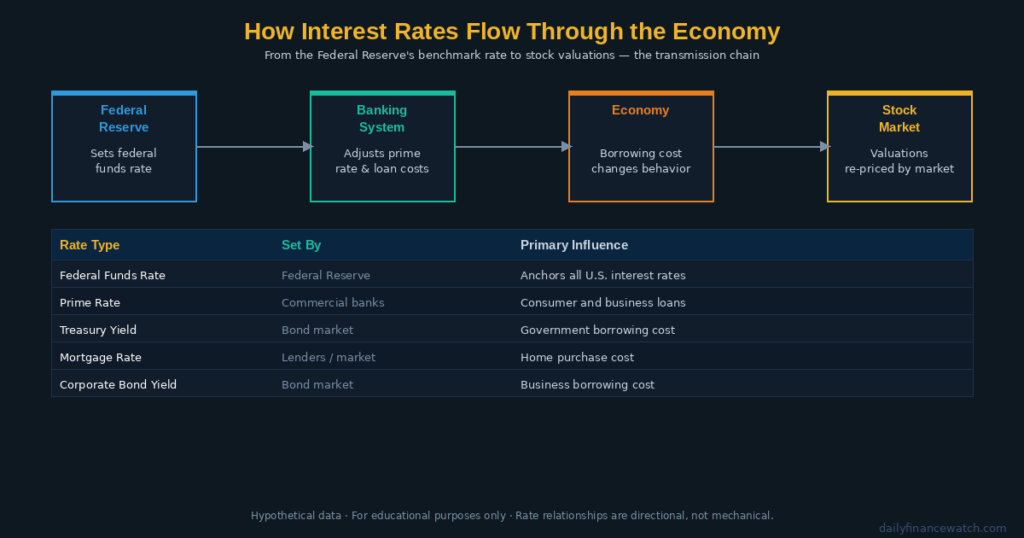
Caption: Interest rates flow from the Federal Reserve through the banking system to consumers, businesses, and ultimately stock valuations.
An interest rate is the cost of borrowing money, expressed as a percentage of the amount borrowed per year. When a bank lends $10,000 at an annual interest rate of 6%, the borrower pays $600 per year in interest. That percentage compensates the lender for three things: the time value of money, the risk that the borrower may not repay, and the expected erosion of purchasing power from inflation.
Interest rates exist across the economy in many forms. Mortgage rates determine the cost of buying a home. Credit card rates determine the cost of carrying consumer debt. Corporate bond yields determine the cost of capital for businesses. All of these rates are influenced — directly or indirectly — by the rate set by the Federal Reserve, the central bank of the United States.
The Federal Funds Rate: The Rate That Moves Markets
The Federal Reserve sets the federal funds rate — the interest rate at which banks lend money to each other overnight. This rate does not directly control mortgage rates or corporate bond yields, but it anchors the entire U.S. interest rate structure. When the federal funds rate rises, borrowing costs rise across the economy. When it falls, borrowing becomes cheaper. According to the Federal Reserve’s official explanation of monetary policy, the Fed adjusts this rate primarily to control inflation and support maximum employment.
| Rate Type | Set By | Primary Influence |
|---|---|---|
| Federal Funds Rate | Federal Reserve | All other U.S. rates |
| Prime Rate | Commercial banks | Consumer and business loans |
| Treasury Yield | Bond market | Government borrowing cost |
| Mortgage Rate | Lenders / bond market | Home purchase cost |
| Corporate Bond Yield | Bond market | Business borrowing cost |
These relationships are directional, not mechanical. Rate changes take time to work through the economy, and the magnitude of the effect varies across loan types and market conditions.
Simple vs Compound Interest
Two types of interest calculation appear throughout investing. Simple interest applies the rate only to the original principal. On a $10,000 loan at 5% simple interest over three years, the borrower pays $1,500 in interest total ($500 per year). Compound interest applies the rate to the growing balance — principal plus accumulated interest. On the same loan with annual compounding, the total interest is slightly higher because each year’s interest earns interest itself. Compound interest works powerfully in both directions: it accelerates wealth accumulation in savings and investment accounts, and it accelerates debt growth when borrowing costs compound against an unpaid balance.
Why Interest Rates Rise and Fall
The Federal Reserve adjusts interest rates in response to two primary economic conditions: inflation and employment. These two goals — price stability and maximum employment — are the Fed’s dual mandate, established by Congress.
When inflation rises above the Fed’s long-run target of approximately 2%, the Fed typically raises the federal funds rate. Higher rates make borrowing more expensive, which reduces consumer spending and business investment, which slows the economy and reduces upward pressure on prices. This is the mechanism the Fed used aggressively between 2022 and 2023 to address inflation that reached historically elevated levels.
When unemployment rises and economic growth slows, the Fed typically cuts the federal funds rate. Lower rates make borrowing cheaper, which encourages spending and investment, which supports job creation and economic activity. The Fed cut rates to near zero during the 2008 financial crisis and again at the onset of the COVID-19 pandemic in 2020 to cushion the economic impact.
What the Yield Curve Signals to Investors
The yield curve plots interest rates on U.S. Treasury bonds across different maturities — from three months to thirty years. Normally, longer-term bonds carry higher yields because investors demand more compensation for lending money over longer periods. This produces an upward-sloping curve.
When short-term rates rise above long-term rates — an inverted yield curve — it historically signals that investors expect economic growth to slow. An inverted yield curve has preceded every U.S. recession since the 1970s, though with variable timing and no guarantee of causation. Disciplined investors watch the yield curve not as a precise prediction tool, but as one data point among many when assessing the macro environment.
How Interest Rates Affect Stock Prices
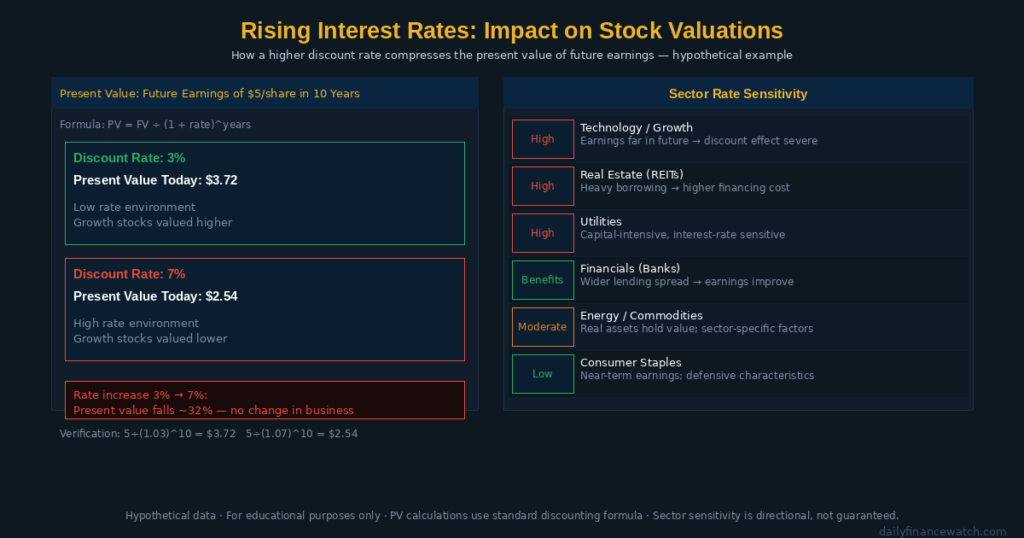
Caption: Rising rates compress the present value of future earnings — growth stocks with distant cash flows are most sensitive to rate increases.
Interest rates affect stock prices through two primary channels: the discount rate and the cost of capital.
The discount rate channel works through valuation math. Every stock’s fair value reflects the present value of its future earnings or cash flows. To calculate present value, investors divide expected future earnings by a discount rate that includes prevailing interest rates. When interest rates rise, the discount rate rises, and the present value of future earnings falls — even if the earnings themselves do not change. Growth stocks, whose value depends heavily on earnings projected years into the future, experience this effect more sharply than value stocks or dividend-paying companies whose earnings are closer in time.
A hypothetical example: a technology company expected to earn $5 per share in ten years has a very different present value at a 3% discount rate than at a 7% discount rate. At 3%, that future $5 is worth approximately $3.72 today. At 7%, it is worth approximately $2.54 today. A rise in interest rates from 3% to 7% reduces the present value of that future earnings stream by roughly 32% — without any change in the underlying business. This illustrates why NVIDIA, Microsoft, and other long-duration growth stocks fell sharply during the 2022 rate-hiking cycle.
The cost of capital channel works through business operations. Higher interest rates increase the cost of corporate borrowing. Companies that carry significant debt face higher interest expenses, which reduces earnings. Companies planning expansion or acquisition activity face higher financing costs, which can delay investment. Sectors with heavy capital requirements — utilities, real estate, and telecommunications — are particularly sensitive to rising rates because their business models depend on affordable long-term borrowing.
Sectors That Benefit When Rates Rise
Not all sectors respond negatively to rising interest rates. Financial companies — banks and insurance firms — often benefit because higher rates widen the spread between what they pay depositors and what they earn on loans. Energy and commodity companies, whose assets maintain value as inflation rises alongside rates, also tend to show relative resilience. Disciplined investors may use sector rotation — shifting capital between sectors as rate expectations change — as one tool to manage rate sensitivity in a portfolio. However, sector rotation requires accurate macroeconomic judgment, which is difficult to sustain consistently. This does not guarantee outperformance.
For more on how rate-driven market phases connect to broader cycle behavior, see what bull and bear market cycles mean for your returns.
How Disciplined Investors Use Interest Rate Context
Interest rate decisions are among the most widely watched macro events in financial markets. Federal Reserve meetings — held eight times per year — routinely move stock and bond markets significantly. However, reacting to individual rate decisions with portfolio changes is rarely a disciplined strategy. By the time a rate decision is announced, markets have typically already priced in the expected outcome. Unexpected decisions — a larger or smaller rate change than anticipated — drive the actual price moves.
Reading Rate Expectations Before the Decision
Disciplined investors watch the federal funds futures market — a market where participants bet on the future level of the federal funds rate — to understand what the market has already priced in. When the market prices in a 0.25% rate cut and the Fed delivers exactly that, stock prices may not move at all. When the market prices in a 0.25% cut and the Fed delivers a 0.50% cut, stocks often rally because the outcome is better than expected. The decision itself matters less than how it compares to prevailing expectations.
Bonds as a Rate Sensitivity Barometer
Bond prices move inversely to interest rates. When rates rise, existing bond prices fall because newly issued bonds pay higher yields, making older lower-yield bonds less attractive. When rates fall, existing bond prices rise. A disciplined investor may monitor the 10-year U.S. Treasury yield as a broad indicator of market rate expectations. A rising 10-year yield generally signals that investors expect stronger economic growth or higher inflation — conditions that often pressure growth stock valuations. According to FINRA’s investor education resources, understanding this inverse relationship between bond prices and yields is fundamental to managing a diversified portfolio across rate environments.
For more on how rate changes specifically affect technology companies, see why tech stocks fall when interest rates rise.
What is the difference between the federal funds rate and a mortgage rate?
The federal funds rate is the overnight rate at which banks lend to each other — set directly by the Federal Reserve. A mortgage rate is determined by lenders based on market conditions, creditworthiness of the borrower, and the yield on long-term Treasury bonds. The federal funds rate influences mortgage rates indirectly. When the Fed raises rates, borrowing costs across the economy tend to rise, including mortgage rates — but the relationship is not one-to-one and varies with market conditions.
Why do growth stocks fall more than value stocks when interest rates rise?
Growth stocks derive most of their value from earnings projected far into the future. When interest rates rise, investors apply a higher discount rate to those future earnings, which reduces their present value today — even if the business itself has not changed. Value stocks and dividend-paying companies generate more of their earnings in the near term, making them less sensitive to the mathematical effect of a higher discount rate. This is why technology and high-growth sectors typically underperform during rate-hiking cycles.
Should investors change their strategy when interest rates rise?
Most long-term investors benefit from maintaining their core strategy rather than making reactive changes when rates rise. Rate environments shift gradually, and the market typically prices in expected changes well before they occur. However, rising rates are a useful time to review the debt levels of individual holdings, assess exposure to interest-rate-sensitive sectors, and confirm that the portfolio’s time horizon matches its risk profile. Investors who hold diversified positions across sectors are generally better positioned than those concentrated in rate-sensitive assets.
This article is for educational purposes only and does not constitute personalized financial or investment advice. All investing involves risk, including the possible loss of principal.