Last updated: July 5, 2026
Most investors assume a money market fund works like a bank account. It does not. Money market funds are SEC-registered mutual funds, not FDIC-insured deposits. Their entire safety structure rests on fund regulation rather than deposit insurance. On July 12, 2023, the SEC adopted the third major overhaul of that regulation since 2010. This article explains what changed, why it changed, and what it means for anyone holding a money market fund today.
What Is a Money Market Fund
A money market fund is a mutual fund that invests in short-term, liquid debt. Typically, its holdings include Treasury bills, commercial paper, and repurchase agreements. According to Investor.gov, funds generally fall into three types: government, prime, and tax-exempt. For instance, government funds hold at least 99.5% of assets in cash and government securities. Prime funds hold taxable corporate and bank debt instead. Tax-exempt funds invest mainly in municipal securities. Each type carries a different risk profile. However, all three are commonly marketed as low-risk, cash-like holdings.
Stable NAV Versus Floating NAV
Most retail and government money market funds try to hold a stable $1.00 net asset value per share. Specifically, special pricing conventions let them round small gains and losses so the price rarely moves. Institutional prime and institutional tax-exempt funds work differently. Since 2016, these funds must use a floating NAV. Instead, their share price moves with the market value of their holdings, just like an ordinary mutual fund. As a result, institutional investors in prime funds can see their share price drift slightly above or below $1.00 on any given day.
Why Fund Regulation Tightened in 2023
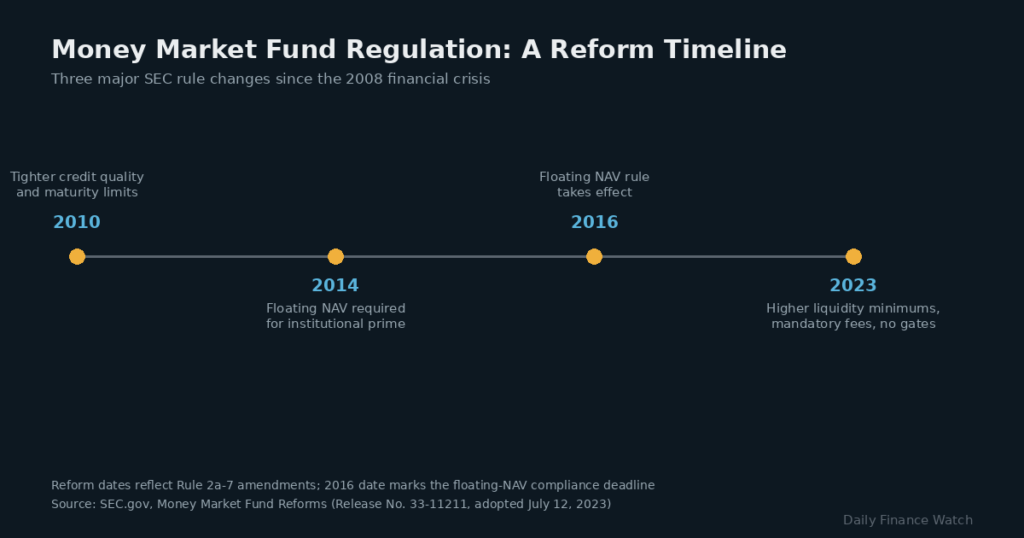
Three SEC rule changes reshaped money market fund liquidity requirements since 2010.
The immediate trigger for the 2023 reform was March 2020. Investor.gov describes how a run on a fund can develop when investors rush to redeem shares. Generally, they redeem because they fear the fund’s value will drop further. During the early days of the pandemic, institutional prime and tax-exempt funds faced exactly that kind of pressure. Consequently, short-term funding markets came under stress as a result. The SEC’s own rule filing states that this episode exposed structural weaknesses in the prior liquidity fee framework. So the Commission moved to rebuild that framework rather than patch it.
What the New Regulatory Rule Changed
The SEC’s July 2023 final rule made several specific changes. First, it raised the minimum daily liquid asset requirement to 25%, up from 10%. Second, it raised the minimum weekly liquid asset requirement to 50%, up from 30%. Third, it eliminated a fund board’s ability to temporarily suspend redemptions. Specifically, that tool was known as a redemption gate. Fourth, it removed the old tie between a fund’s liquidity level and its liquidity fee. Instead, the rule created a clearer trigger. Now, institutional prime and institutional tax-exempt funds generally must charge a liquidity fee once daily net redemptions exceed 5% of net assets.
Redemption Gates Are Gone
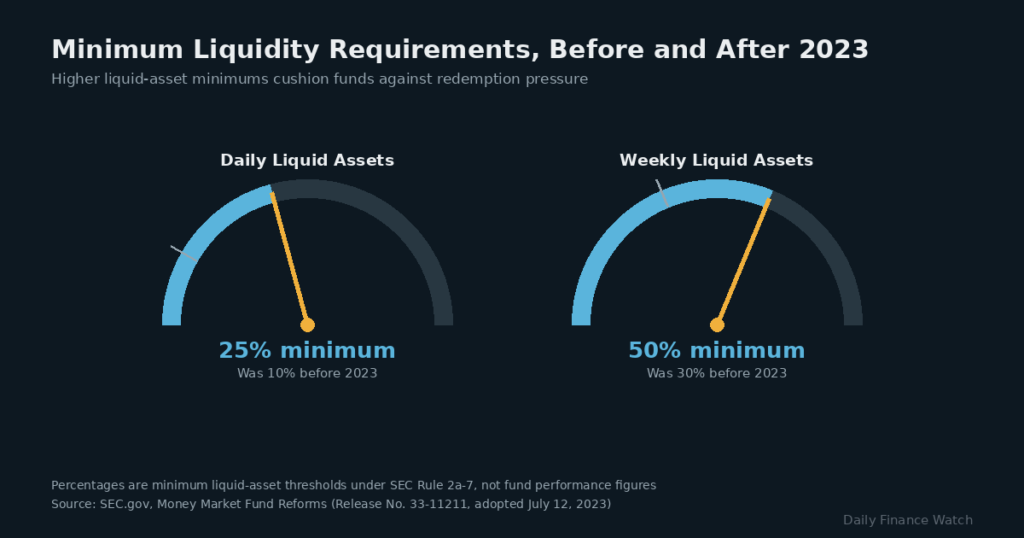
Minimum daily and weekly liquidity requirements both rose sharply under the 2023 rule.
Before 2023, a fund board could suspend redemptions for up to ten business days. Specifically, this applied whenever weekly liquid assets fell below 30%. However, regulators worried that this option actually made runs worse. Investors who feared a coming gate had an incentive to redeem early. That way, the gate could not trap their money inside the fund. Therefore, the 2023 rule removed that incentive entirely by eliminating the gate tool. Liquidity fees now handle the job that gates used to do. Importantly, they do this without encouraging a rush for the exits.
Mandatory Liquidity Fees Explained
Essentially, a liquidity fee reduces the amount a redeeming shareholder receives. Meanwhile, the deducted amount stays inside the fund for remaining shareholders. This structure is meant to make redeeming investors absorb the trading costs their own exit creates. Otherwise, those costs would spread across everyone who stays. Retail prime and retail tax-exempt funds may still charge a fee at their board’s discretion. In contrast, institutional prime and institutional tax-exempt funds must charge one automatically once the 5% threshold is crossed. Overall, government money market funds face no such requirement, since they rarely see this kind of redemption pressure.
Why FDIC Insurance Doesn’t Apply Here
None of these changes turn a money market fund into an insured deposit. Investor.gov is explicit on this point. Money invested in a money market fund is not guaranteed by the FDIC, unlike a bank money market account. A stable NAV fund can still theoretically “break the buck.” This happens if its per-share value drops by more than half a cent from $1.00. That event is rare, and it has happened only a handful of times in the fund industry’s history. Still, the 2023 reforms made that outcome less likely under stress; they did not regulate it out of existence.
Comparing These Cash Options
The names sound almost identical, but the products are not the same thing. Specifically, a money market fund is the SEC-regulated investment covered throughout this article. A money market account is a bank deposit product, and it carries FDIC insurance up to the standard limit. In contrast, a money market fund carries no such guarantee, regardless of how conservative its holdings are. Meanwhile, some savers compare both against a high-yield savings account when deciding where to park cash. Each option trades a bit of yield, liquidity, or protection differently, so the right fit depends on the reason the money is being held in the first place.
How to Check Which Type You Own
Generally, a fund’s prospectus states its category in the first few pages, usually right in the fund’s name or objective section. Specifically, look for the words “government,” “prime,” or “tax-exempt” or “municipal.” Additionally, the prospectus discloses whether the fund uses a stable or floating NAV. For institutional share classes, this detail matters more, since only institutional prime and institutional tax-exempt funds face the floating NAV and mandatory fee requirements. In contrast, retail investors in a retail prime fund still benefit from the stable $1.00 NAV convention. Therefore, checking the exact share class, not just the fund’s general name, is the only reliable way to know which rules actually apply.
This Is Not a Recommendation to Buy or Avoid Any Specific Type
This article describes how money market fund regulation works. It does not recommend using or avoiding any specific fund type. Whether a government, prime, or tax-exempt fund fits your situation depends on several personal factors. These include your tax bracket, your need for same-day liquidity, and your comfort with residual risk. A brokerage’s fund screener can show current yields and fund category. However, it cannot assess your personal risk tolerance or tax situation. Consult a financial or tax professional before choosing among money market fund types.
Overall, the 2023 reforms did not eliminate risk from money market funds. Indeed, they were never designed to. Instead, they targeted a specific, narrow failure mode. That failure mode showed up once, in March 2020, inside institutional prime and tax-exempt funds. Today, fund regulation is built around higher liquidity buffers and a clearer fee trigger. Instead, it replaced a suspension tool that made runs worse. Ultimately, understanding that structure matters more than assuming any money market fund is automatically as safe as a bank deposit.
This article is for educational purposes only and does not constitute financial, investment, or tax advice; consult a licensed financial professional before making decisions about your own portfolio.