Last updated: July 3, 2026
Most beginners frame saving and investing as competing strategies, as if choosing one means rejecting the other. That framing misses the actual mechanism: the right answer depends on what each specific dollar is for, not a single decision applied to all your money at once.
What Saving Actually Means
Saving means setting money aside in a low-risk, easily accessible account — typically a savings account, high-yield savings account, or money market account. The core feature of saving is principal protection. The dollar amount you deposit does not decline in value due to market movement. FDIC or NCUA insurance covers most savings vehicles up to $250,000 per depositor.
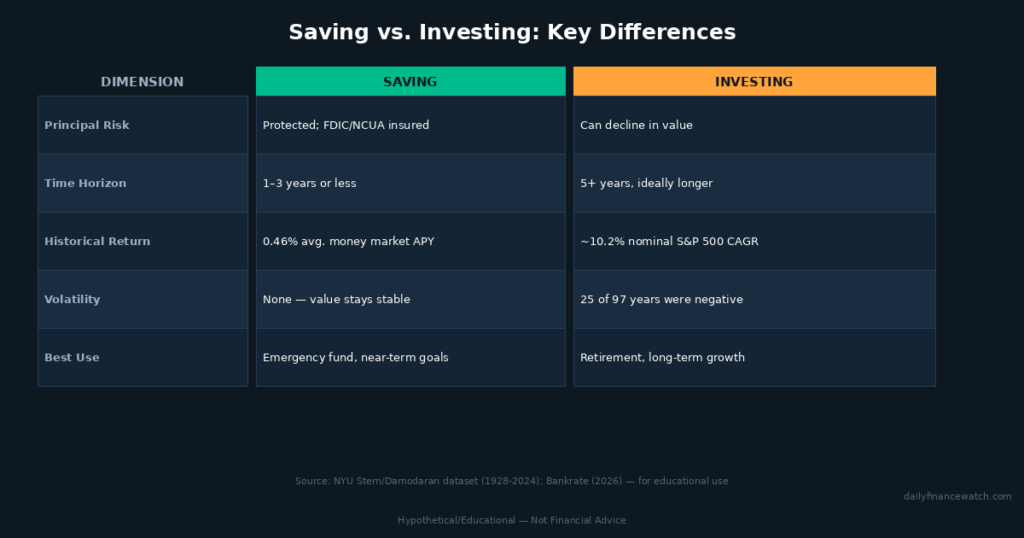
A comparison table showing key differences between saving and investing across risk, return, liquidity, and time horizon.
The trade-off for that safety is limited growth. According to Bankrate’s national data referenced in our guide on high-yield savings accounts, even competitive savings rates have historically lagged behind long-run inflation during high-inflation periods. Saving protects the nominal dollar amount. It does not protect purchasing power over long stretches of time.
What Investing Actually Means
Investing means allocating money into assets — stocks, bonds, mutual funds, or real estate — with the expectation of growth over time. Unlike saving, investing carries the risk of loss. The value of an investment account can decline, sometimes sharply, over any given period. Investor.gov’s guide to asset allocation confirms this directly: investors with a longer time horizon may feel more comfortable taking on riskier, more volatile investments because they have time to recover from downturns.
The trade-off for that risk is higher long-run growth potential. Based on NYU Stern’s historical U.S. equity return dataset, the S&P 500 produced a compound annual growth rate of approximately 10.2% from 1928 through 2024, with dividends reinvested. Adjusted for inflation using average CPI over that period, the real return drops to roughly 7% — still substantially higher than what any savings account has offered over the same span.
The Volatility Investors Actually Live Through
An average return is not what any single year delivers. In the 97 years from 1928 to 2024, the S&P 500 posted a negative annual return in 25 of them — roughly one year in four. Some of those declines were severe: −43.3% in 1931 and −37.0% in 2008. This volatility is the reason investing suits money with a long time horizon and poorly suits money needed soon.
The Experience Anchor: Why the Two Return Figures Matter Together
Comparing a 0.46% national average money market rate — discussed in our guide on money market accounts — against a 10.2% nominal stock market average makes investing look like the obvious winner. That comparison, however, ignores time horizon entirely. Money needed within one to three years faces a real risk of loss if invested in equities during a down year like 2008 or 2022. Money not needed for ten or more years faces a different risk: inflation quietly eroding purchasing power while it sits in a low-yield account.
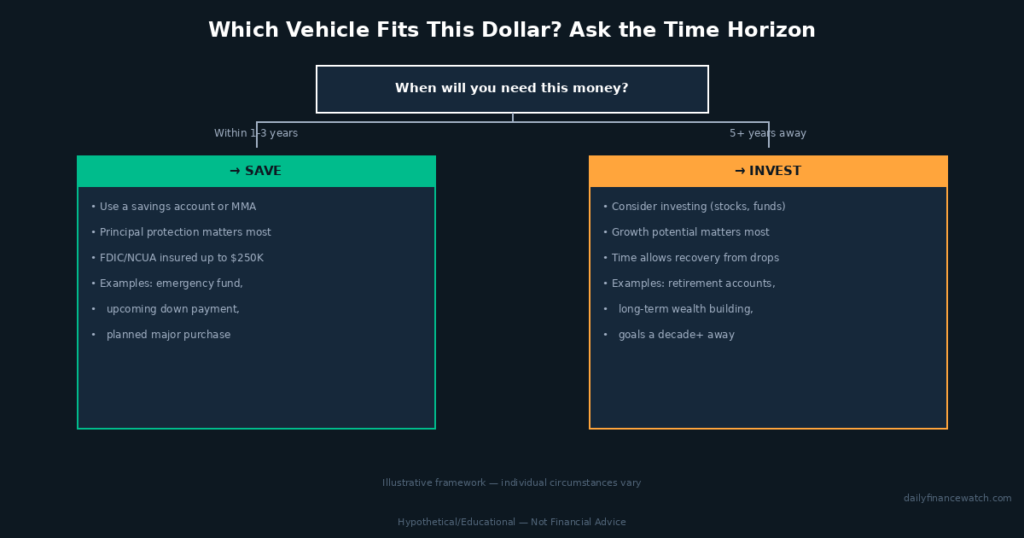
A decision tree diagram showing how time horizon determines whether a specific sum of money should be saved or invested.
Time Horizon Is the Actual Deciding Factor
This is the mechanism behind the thesis. Rather than choosing to be “a saver” or “an investor” as an identity, the more accurate framework treats every dollar according to when it will be needed. Money needed within the next one to three years belongs in savings, because a market downturn at the wrong moment could force a sale at a loss. Money not needed for five, ten, or more years can tolerate the volatility that comes with investing, because time allows for recovery from downturns.
An emergency fund is the clearest example of a short-horizon allocation. The CFPB’s guide to building an emergency fund recommends keeping this money somewhere safe, accessible, and free from the temptation to spend it on non-emergencies — characteristics that describe a savings account, not a brokerage account. Retirement savings decades away represent the opposite case: a long horizon that can absorb short-term volatility in exchange for long-run growth.
Splitting the Same Paycheck Two Ways
In practice, most people do both saving and investing simultaneously, using different portions of the same income. A portion goes to an emergency fund or short-term goal in a savings vehicle. Another portion goes to a retirement account or brokerage account for long-term growth. Neither allocation replaces the other — they solve different problems with different time horizons.
When the Line Blurs
Some financial goals fall in a gray zone — a house down payment three to five years out, for example. Investor.gov’s asset allocation guidance suggests that shorter time horizons generally call for more conservative allocations, even if the exact cutoff varies by individual risk tolerance. There is no universal rule that applies to every three-year goal; the right choice depends on how much flexibility exists if the timeline shifts or the market underperforms.
The Anti-Advice Reminder
Neither saving nor investing is inherently the better financial behavior — each serves a specific purpose tied to time horizon and risk tolerance. A person who invests money needed next year takes on unnecessary risk. A person who saves money not needed for thirty years accepts unnecessary inflation erosion. Before deciding where a specific sum of money belongs, consider when you will need it, how much flexibility you have if the timeline changes, and your comfort with potential short-term losses. A financial professional can help evaluate more complex allocation decisions.
The question “should I save or invest” assumes a single answer exists for all your money at once. It does not. Each dollar has its own time horizon, and matching the vehicle to that horizon — not committing to one identity — is what actually determines whether your money is protected or growing when you need it most.
This article is for educational purposes only and does not constitute financial or investment advice. Past performance does not guarantee future results.
© 2026 Daily Finance Watch. All rights reserved.