Last updated: June 30, 2026
The most useful investing tip a beginner can receive sounds disappointing: automate your contributions and stop watching the market. There is no clever trick, no signal, no edge in it. Yet it outperforms nearly every sophisticated tactic beginners chase, because it removes the human decisions where things go wrong. The best investing tips are not clever maneuvers that produce an advantage. They are boring systems that make good behavior automatic, and their power lies in what they prevent rather than what they add.
What Makes an Investing Tip Actually Useful
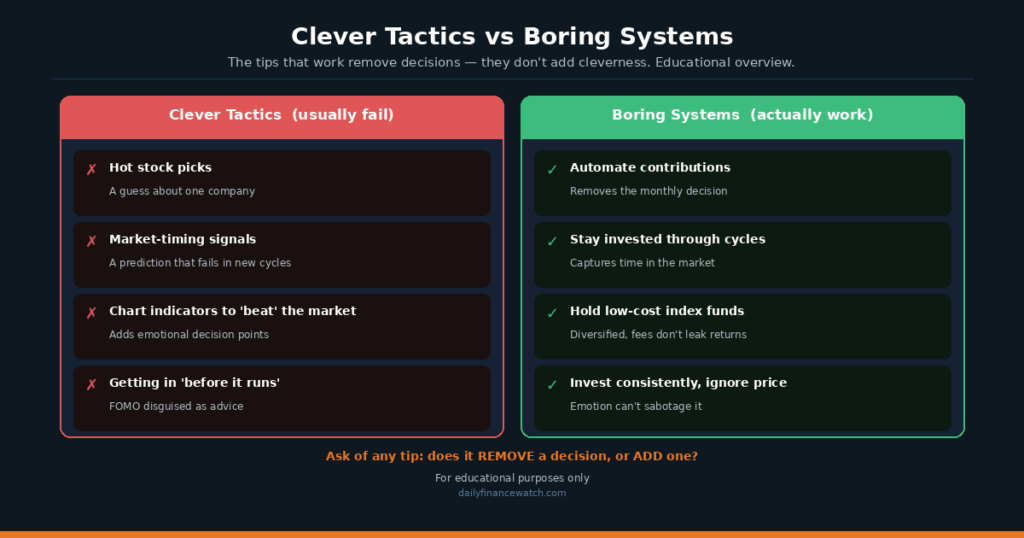
Caption: The most effective investing tips remove decisions and emotion rather than adding complexity or supposed market edges.
A useful investing tip changes behavior in a way that improves long-term results. That sounds obvious, but it rules out most of what gets marketed as tips. A “hot stock pick” is not a tip; it is a guess. A market-timing signal is not a tip; it is a prediction. Real tips are durable principles that work regardless of what the market does next, because they govern your behavior rather than forecasting the market’s.
The distinction matters because beginners are surrounded by tactical noise — patterns to watch, indicators to follow, stocks to buy now. Almost none of it survives contact with a real market cycle. What survives is unglamorous: consistency, low costs, diversification, and patience. These work precisely because they do not depend on being right about the future.
Why Boring Beats Clever
Most beginner guides present tips as ways to gain an edge. This framing misleads, because beginners do not lose to the market by lacking clever tactics — they lose by making predictable behavioral errors. Therefore, the highest-value tips do not add sophistication; they remove the moments where emotion causes damage. A tip that automates a decision is worth more than a tip that sharpens one, because the automated decision cannot be sabotaged by fear or greed. The boring systems win by subtraction.
| Marketed as a “Tip” | Actually a… | Durable Tip Instead |
|---|---|---|
| “Buy this stock now” | Guess about one company | Diversify across many companies |
| “Sell before the dip” | Market-timing prediction | Stay invested through cycles |
| “This indicator signals a top” | Pattern that fails in new cycles | Automate contributions on schedule |
| “Get in before it runs” | FOMO disguised as advice | Invest consistently regardless of price |
The Investing Tips That Actually Work
A small set of habits does most of the work, and each one removes a decision rather than adding a tactic. Automating contributions is the single most powerful, because it makes investing happen on schedule without depending on motivation or market mood. Keeping costs low is second: fees compound against you over decades, so choosing low-cost index funds preserves returns that would otherwise leak away silently.
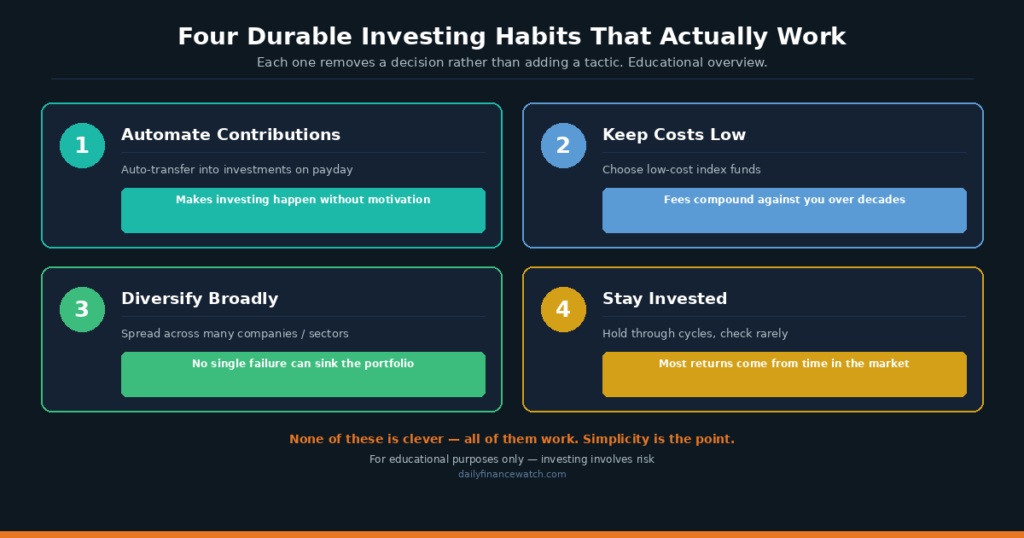
Caption: A handful of durable habits — automate, diversify, minimize costs, stay invested — outperform most tactical strategies over time.
Diversification is third — spreading capital so no single failure can sink the portfolio, which also makes declines easier to hold without panic. Staying invested is fourth and hardest: most long-term returns come from time in the market, and the urge to react to headlines is the main threat to it. None of these is clever. All of them work. The SEC’s investor education resources at Investor.gov emphasize consistent saving and investing over attempts to find shortcuts.
Why These Tips Feel Too Simple to Trust
There is a psychological barrier here worth naming. Simple, boring tips feel inadequate, because beginners assume that good results require sophisticated effort. This assumption is itself a trap. The financial media rewards complexity and novelty, which makes patient simplicity feel like underachievement. In reality, the simplicity is the point — a system you can follow for thirty years without thinking beats a brilliant strategy you abandon in eighteen months.
How to Build These Habits in Practice
Turning tips into reality is a setup problem, not a willpower problem. The goal is to arrange your finances so good behavior happens by default and bad behavior requires effort. Set up automatic transfers into investments on payday, so the decision is made once rather than monthly. Choose broad low-cost index funds so diversification and low fees are built in from the start. Then deliberately reduce how often you check the portfolio, because frequent checking feeds the urge to react.
Most guides tell beginners to “stay disciplined.” This advice quietly assumes discipline is a trait you summon on demand, which is exactly wrong in the moments that matter. The accurate approach is to build systems that do not require discipline in the moment — automation, default settings, and rules decided in advance. Institutional investors rely on written policies and automated processes precisely because they know that depending on in-the-moment willpower is unreliable. Design the system once, and it carries the discipline for you.
For investors building this foundation, common beginner investing mistakes shows the errors these habits prevent, and what is dollar-cost averaging explains the automation principle in detail.
A Realistic Example of a Simple System
Consider a hypothetical beginner who sets up one automatic monthly transfer into a single broad index fund, then checks the account only quarterly. They make no predictions, watch no indicators, and react to no headlines. Over a market cycle that includes a sharp decline, they keep contributing automatically — buying more shares when prices fall — because no decision is required. A more active beginner, by contrast, tinkers constantly, reacts to every scare, and underperforms despite far more effort. The simpler system wins not despite its simplicity but because of it.
What Disciplined Investors Understand About Tips
Smart money behavior treats good investing as a system to be designed, not a series of clever calls to be made. Disciplined investors automate contributions, hold low-cost diversified funds, and rebalance on a schedule. They consciously avoid the tactical noise that fills financial media, recognizing that most of it is designed to encourage activity rather than improve outcomes. Their edge is structural, not predictive.
A disciplined investor also resists the temptation to complicate a working system. When tempted by a new tactic or a hot opportunity, they ask whether it removes a decision or adds one — and treat anything that adds emotional decision points with caution. This does not guarantee returns, but it preserves the behavioral consistency that drives long-term results. The discipline lives in the design, not in daily willpower.
What you should now understand differently is what to look for when you hear an investing tip. Stop searching for the clever tactic that produces an edge — that search is itself one of the most common ways beginners go wrong. Look instead for the boring system that removes a decision: automation, low costs, diversification, patience. The best tips do not make you smarter than the market. They make it impossible for your own emotions to work against you, which for most beginners matters far more.
FAQ
What is the single best investing tip for a beginner?
Automate your contributions. Setting up an automatic transfer into a diversified low-cost index fund on payday is the most powerful step a beginner can take, because it makes investing happen consistently without depending on motivation or market mood. It removes the monthly decision where fear or distraction would otherwise interfere. This single habit captures most of what matters — consistency, time in the market, and protection from emotional timing — with no cleverness required.
Why do simple investing tips work better than advanced strategies?
Because beginners typically lose to the market through behavioral errors, not through a lack of sophisticated tactics. Simple habits like automation, diversification, and low costs work regardless of what the market does next, since they govern behavior rather than predicting prices. Advanced strategies often add emotional decision points where mistakes happen. A simple system you can follow for decades reliably beats a complex one you abandon during the first serious downturn.
How often should a beginner check their investments?
Less often than most expect — quarterly is usually enough for long-term investors. Frequent checking feeds the urge to react to short-term moves, which is where emotional mistakes begin. Because long-term returns come from staying invested through cycles, monitoring daily price swings adds anxiety without improving results. Reducing how often you look is itself a useful tip, since it removes the temptation to tinker with a system that works best when left alone.
This content is for educational purposes only and does not constitute personalized financial advice. All investing involves risk, including the possible loss of principal.