Last updated: June 30, 2026
An investor sells in a panic when their portfolio drops 20%, terrified of losing more. Months later, the same investor pours money into a surging stock at its peak, terrified of missing out. These look like opposite behaviors driven by opposite emotions — fear of loss versus greed for gain. They are not. Loss aversion and FOMO spring from the same psychological root: an asymmetric sensitivity to loss that the human brain carries by default. Understanding that shared wiring explains why fighting each emotion separately rarely works.
What Loss Aversion Actually Is
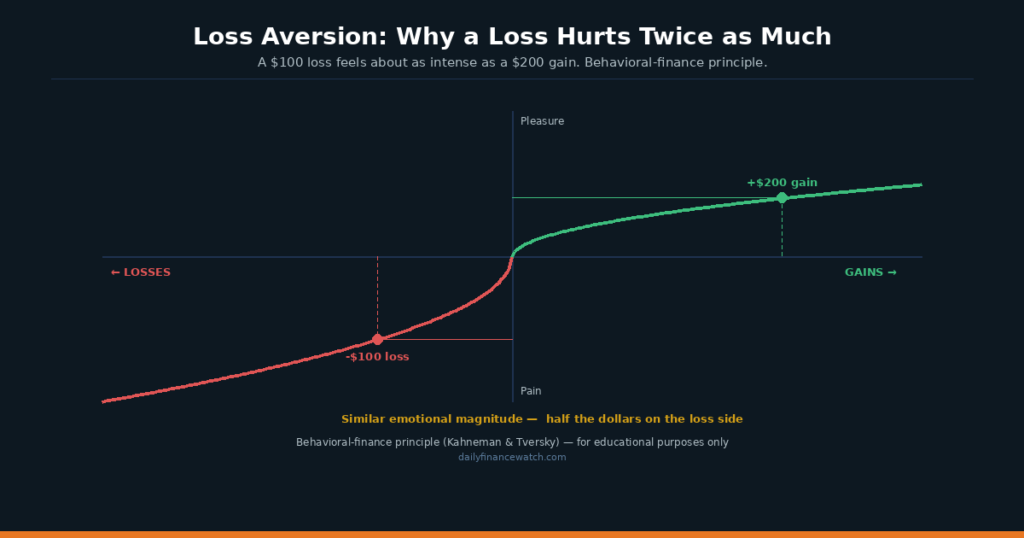
Caption: Loss aversion means a loss hurts roughly twice as much as an equal gain feels good — an asymmetry that distorts investing decisions.
Loss aversion is the tendency to feel the pain of a loss more intensely than the pleasure of an equivalent gain. Research in behavioral economics, pioneered by Daniel Kahneman and Amos Tversky, found that losses feel roughly twice as powerful as gains of the same size. Losing $100 hurts about as much as winning $200 feels good. This is not a character flaw; it is a feature of how human decision-making evolved.
In investing, this asymmetry distorts behavior in predictable ways. Because losses feel so painful, investors take irrational steps to avoid realizing them — even when those steps damage long-term returns. The emotion overrides the math. A decision that would be obvious on a spreadsheet becomes impossible when a real loss triggers the disproportionate pain response.
How Loss Aversion Drives Panic Selling
The most visible effect of loss aversion is panic selling. When a portfolio falls, the pain of the paper loss becomes intense enough that selling — making the pain stop — feels like relief. The investor locks in the loss to escape the discomfort, usually near the bottom, and then misses the recovery. The decision is emotionally driven, not logically chosen. This is why loss aversion is among the most expensive biases a beginner carries: it triggers exactly the wrong action at exactly the wrong moment.
| Behavior | Driven By | What the Investor Feels | The Result |
|---|---|---|---|
| Panic selling in a decline | Loss aversion | “Make the pain stop” | Locks in loss, misses recovery |
| Holding a losing stock too long | Loss aversion (disposition effect) | “It’s not a loss until I sell” | Money trapped in a falling asset |
| Chasing a surging stock | FOMO | “I can’t miss this gain” | Buys near the peak |
| Refusing to invest after a drop | Loss aversion | “It might fall further” | Misses the recovery entirely |
Why FOMO Is Loss Aversion in Disguise
FOMO — the fear of missing out — appears to be the opposite of loss aversion. It looks like greed: chasing gains, buying into rallies, piling into whatever is surging. Most beginner guides treat it as a separate emotion requiring separate willpower. This framing misses the deeper mechanism, and that gap is the core insight of this article.
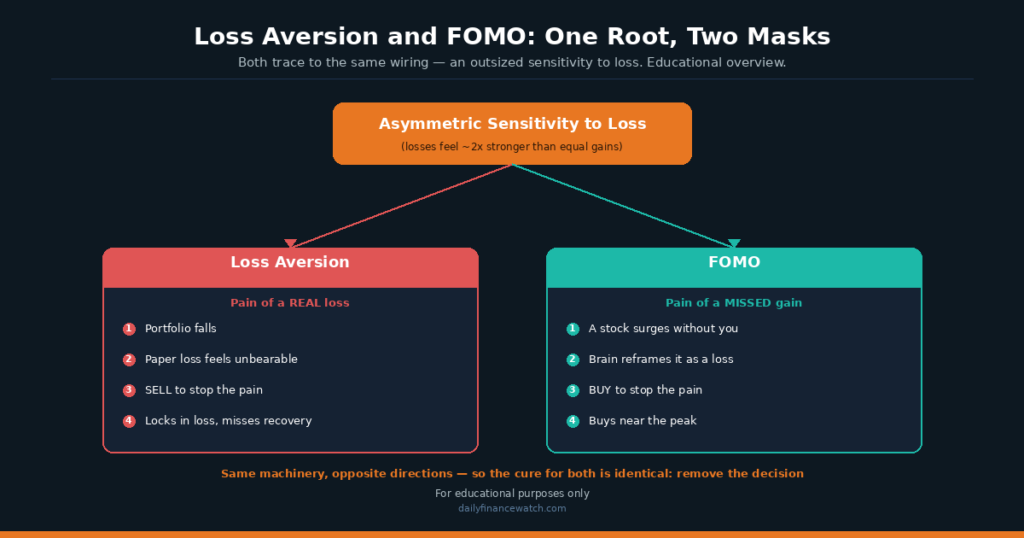
Caption: Loss aversion and FOMO are two expressions of the same wiring — the brain reframes a missed gain as a loss, triggering the same pain response.
FOMO is loss aversion pointed at a different target. When an investor watches a stock surge without them, the brain does not register a neutral non-event. It reframes the missed gain as a loss — the loss of profit they “could have had.” That reframing triggers the same disproportionate pain response that drives panic selling. The investor then buys, often near the peak, to stop the pain of the perceived loss. Therefore, FOMO and panic selling are not opposites; they are the same loss-aversion machinery aimed in opposite directions. This is why willpower aimed at one does little for the other — the root is identical.
The Disposition Effect: A Third Expression
Loss aversion produces a third, quieter distortion called the disposition effect — the tendency to sell winners too early and hold losers too long. Investors rush to realize gains because locking in a profit feels good, while they refuse to realize losses because doing so confirms the painful loss. The result is a portfolio where strong holdings are sold prematurely and weak ones accumulate. The same asymmetric sensitivity to loss explains all three behaviors: panic selling, FOMO, and the disposition effect.
How Beginners Can Work With This Wiring
Because these biases share one root, the defense is shared too — and it is not willpower. You cannot reliably out-feel an emotion that evolved over millions of years, especially in the moment it fires. The effective approach is to remove the in-the-moment decision through structure decided in advance. Automating contributions means FOMO cannot trigger a poorly timed purchase, because buying already happens on schedule. Deciding in advance to hold through declines means loss aversion cannot trigger a panic sale, because the decision was made before the pain arrived.
Most guides advise investors to “master your emotions” or “be rational.” This advice quietly assumes you can override hardwired responses through awareness alone, which fails precisely when the emotion is strongest. The accurate model treats these biases as permanent features to design around, not weaknesses to conquer. Institutional investors build rules and automation specifically because they know awareness does not neutralize loss aversion in a crash or a mania. The SEC’s investor education resources at Investor.gov emphasize long-term, consistent investing over reacting to short-term swings.
For investors building this foundation, common beginner investing mistakes maps how these biases produce specific errors, and why time in the market beats timing the market shows why staying invested defeats both panic selling and FOMO.
A Realistic Example of the Shared Root
Consider a hypothetical beginner during a volatile year. In the spring, their portfolio falls 25%; loss aversion makes the pain unbearable, and they sell near the bottom. By autumn, the market has recovered and a popular stock is surging; FOMO — the reframed pain of a missed gain — pulls them in near its peak. Both decisions felt like responses to different emotions. Both were the same asymmetric loss sensitivity firing twice. Recognizing this, the investor sees that the cure for both is identical: a pre-set system that does not ask them to feel calm in the moment.
What Disciplined Investors Understand About These Biases
Smart money behavior does not rely on being immune to loss aversion or FOMO — disciplined investors feel both. The difference is that they expect these feelings and treat them as signals to follow their pre-set rules rather than to act. When the urge to sell in fear or buy in excitement arises, they recognize it as the predictable firing of a known bias, not as useful information about the market. The feeling becomes a cue to do nothing, not a reason to act.
A disciplined investor also designs their environment to reduce how often these biases fire. They check portfolios less frequently, avoid the constant stream of market alarm and hype that triggers both panic and FOMO, and automate decisions so emotion has fewer openings. This does not eliminate the wiring, and it does not guarantee returns, but it prevents the asymmetric loss response from controlling their actions.
What you should now understand differently is that loss aversion and FOMO are not two enemies to fight separately. They are one mechanism — an outsized sensitivity to loss — wearing two masks. The investor who panic-sells and the investor who chases a bubble are running the same program in opposite directions. Once you see the single root, the solution stops being “more willpower against two emotions” and becomes “one system that removes the decision for both.” That shift, more than any amount of self-control, is what protects a beginner’s returns.
FAQ
What is loss aversion in investing?
Loss aversion is the tendency to feel the pain of a loss roughly twice as intensely as the pleasure of an equal gain. Pioneered in research by Kahneman and Tversky, it explains why investors take irrational steps to avoid realizing losses. In practice, it drives panic selling during declines and a refusal to sell losing positions. The emotion overrides logic, triggering damaging decisions at the worst moments because the pain of loss feels disproportionately large.
Why are loss aversion and FOMO connected?
They share one root: an asymmetric sensitivity to loss. FOMO looks like greed, but the brain reframes a missed gain as a loss — the profit you “could have had” — which triggers the same pain response that drives panic selling. So buying a surging stock to stop the pain of missing out is the same mechanism as selling in a panic to stop the pain of a decline. Because the root is identical, fighting each separately rarely works.
How can investors overcome loss aversion and FOMO?
Not through willpower, which fails when emotions are strongest, but through structure decided in advance. Automating contributions removes FOMO’s chance to trigger a poorly timed purchase, since buying happens on schedule. Deciding ahead of time to hold through declines removes loss aversion’s chance to trigger panic selling. Checking portfolios less often and avoiding constant market hype reduces how frequently both biases fire. The goal is designing around permanent wiring, not conquering it.
This content is for educational purposes only and does not constitute personalized financial advice. All investing involves risk, including the possible loss of principal.