Last updated: June 30, 2026
Here is a fact that should be impossible: the average investor in a fund often earns less than the fund itself returns. The fund goes up 10% for the year, yet the typical investor in it earns noticeably less. Nothing was wrong with the fund. The shortfall comes from when investors bought and sold — pouring money in after gains and pulling it out after losses. This is the behavior gap, and it reveals an uncomfortable truth: most investors underperform not because they choose bad investments, but because of how they behave around good ones.
What the Behavior Gap Actually Is
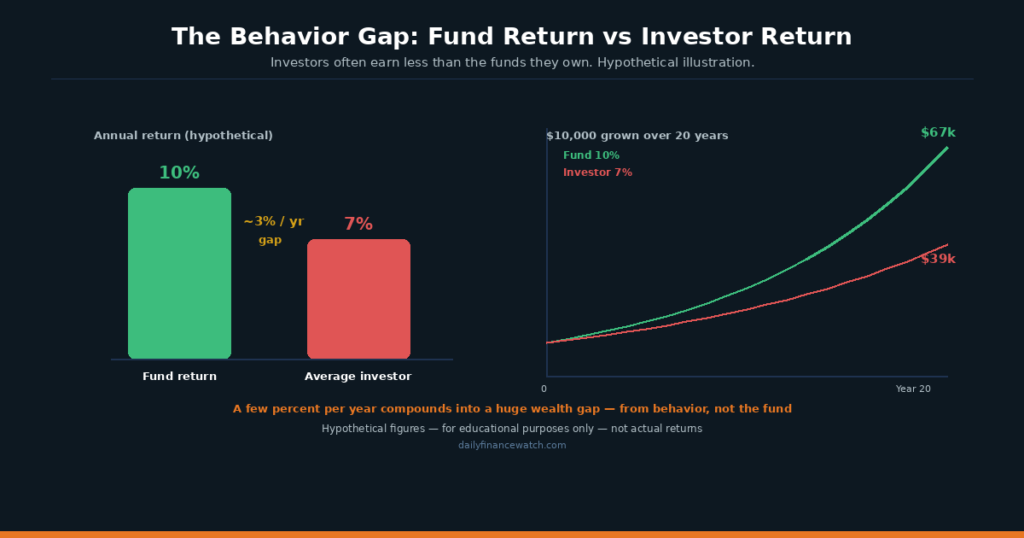
Caption: The behavior gap is the difference between what investments return and what investors actually earn, caused by poorly timed buying and selling.
The behavior gap is the measurable difference between the return an investment produces and the return the average investor in it actually captures. An investment has one return over a period. But investors who move money in and out at different times each earn something different — and on average, they earn less than the investment itself. The gap is the cost of that timing.
The mechanism is straightforward. Investors tend to add money after a period of strong performance, when optimism is high and prices have already risen. They tend to withdraw after declines, when fear peaks and prices have already fallen. Buying high and selling low, repeated across a lifetime of investing, steadily erodes returns below what simply holding the investment would have delivered. The investment did its job; the timing undid part of it.
Why the Cause Is Behavior, Not Bad Funds
Most beginner guides explain underperformance by pointing to investment selection — the wrong stocks, the wrong funds, high fees. Those factors matter, but they miss the larger and better-documented cause. Research firms that study investor returns versus investment returns, most notably DALBAR in its long-running Quantitative Analysis of Investor Behavior, have found for decades that the average investor underperforms broad market indexes by a meaningful margin over the long run. Crucially, this gap persists even among investors holding perfectly good funds. Therefore, the problem is not what they own — it is what they do with it.
| Source of Underperformance | How Much It Matters | Within Investor’s Control? |
|---|---|---|
| Behavior gap (poor timing) | Large and well-documented | Yes — fully |
| High fees and expense ratios | Significant over decades | Yes — fully |
| Poor security selection | Smaller than commonly assumed | Partly |
| Bad luck (unforeseeable events) | Real but random | No |
The Data Behind the Gap
The behavior gap is not a theory; it shows up repeatedly in studies of real investor accounts. The pattern is remarkably consistent across decades and market conditions: the average equity-fund investor captures less than the market’s return, and a large share of the shortfall traces directly to buying and selling at the wrong times rather than to fees alone.
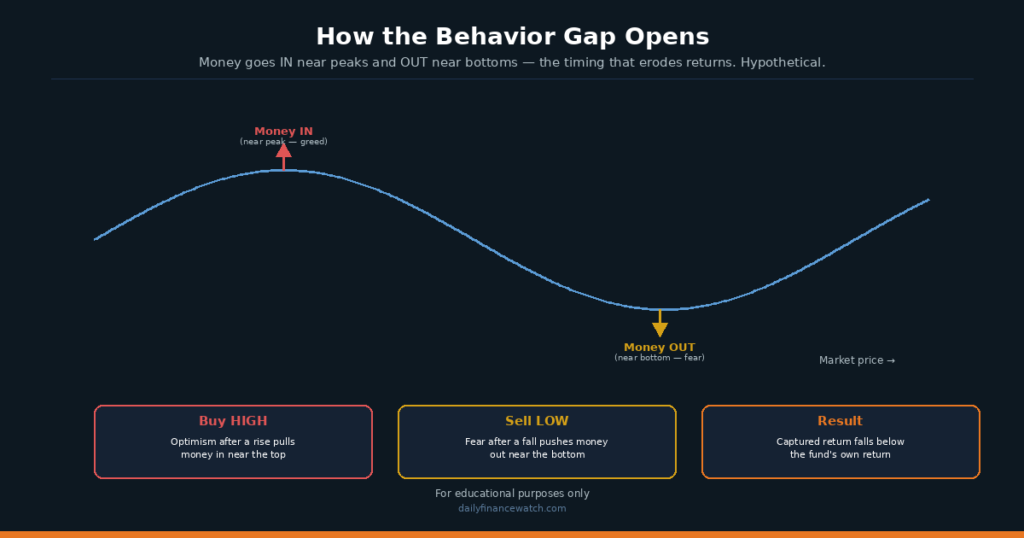
Caption: The gap opens because investors add money near peaks and withdraw near bottoms — the timing pattern that fear and greed produce.
A concrete illustration makes the scale clear. Suppose a broad index returns roughly 10% annually over a long period. Studies of investor behavior have repeatedly found the average investor capturing several percentage points less per year. Over decades, that annual shortfall compounds into an enormous difference in final wealth — not because the investor picked the wrong index, but because they did not stay fully invested through the emotional extremes. The gap is widest precisely during volatile periods, when fear and greed are strongest and the temptation to act is greatest.
Why This Pattern Is So Persistent
The behavior gap endures because it is driven by the emotional wiring discussed throughout this chapter — loss aversion and herd behavior — which do not weaken with experience or education. Knowing about the gap does not close it, because the same emotions that cause it override the knowledge in the moment of fear or excitement. This is why the gap appears across all types of investors, including sophisticated ones. The cause is human, not informational.
How Beginners Can Close Their Own Gap
The encouraging implication is that the largest source of underperformance is the one most within your control. You cannot control what the market returns, but you can control whether you capture that return by staying invested. Closing the behavior gap requires no skill in prediction — only the discipline to not act on emotion, which is best achieved by removing the decision entirely through automation.
Most guides respond to underperformance by urging investors to “pick better investments” or “do more research.” This advice misdiagnoses the problem. For the average investor, switching to better funds while keeping the same emotional timing behavior changes little, because the gap reopens around the new funds. The accurate prescription is behavioral: automate contributions, hold through declines, and stop reacting to short-term moves. The SEC’s investor education resources at Investor.gov emphasize long-term investing over reacting to market swings — precisely the behavior that closes the gap.
For investors building this foundation, common beginner investing mistakes maps the specific errors that create the gap, and investor psychology: loss aversion and FOMO explains the emotional wiring beneath it.
A Realistic Example of Closing the Gap
Consider two hypothetical investors who both buy the same index fund returning 10% annually over twenty years. The first checks constantly, sells during two major declines out of fear, and re-enters after each recovery — capturing perhaps 7% annually after the timing damage. The second automates contributions and never sells, capturing close to the full 10%. Same fund, same market, same two decades. The difference in their final wealth is enormous, and it comes entirely from behavior. The second investor was not smarter; they simply removed the decisions where the first one went wrong.
What Disciplined Investors Understand About Underperformance
Smart money behavior accepts that capturing the market’s return is itself an achievement, not a baseline. Disciplined investors recognize that the behavior gap is the default outcome for those who act on emotion, so they build systems specifically to avoid it. They automate, they hold through volatility, and they measure success by how fully they capture an investment’s return rather than by trying to beat it through timing.
A disciplined investor also reframes their goal. Rather than trying to outperform the market through clever moves — which often widens the gap — they focus on the simpler, more achievable target of not underperforming it through emotional mistakes. This is a lower bar than beating the market, yet most investors fail to clear it. Clearing it reliably requires no genius, only the structural discipline to stay invested. This does not guarantee returns, but it captures what the market offers.
What you should now understand differently is where underperformance actually comes from. It is not primarily a selection problem to be solved with better stock picks or fund choices. It is a behavior problem — the gap between what investments return and what investors earn by mistiming them. The investment was rarely the issue. The investor was. And that is genuinely good news, because behavior is the one variable you can fully control, while the market’s returns are not.
FAQ
What is the behavior gap in investing?
The behavior gap is the difference between the return an investment produces and the return the average investor actually earns from it. It arises because investors tend to buy after prices rise and sell after they fall, capturing less than the investment itself returned. Studies of real investor accounts consistently show this gap across decades. It means many investors earn less than the very funds they own, purely because of poorly timed buying and selling.
Why do most investors underperform the market?
Most investors underperform not because they pick bad investments, but because of poor timing driven by emotion. They add money after gains, when prices are high, and withdraw after losses, when prices are low. This buying high and selling low erodes returns below what simply holding the investment would deliver. The pattern persists even among investors holding good funds, which shows the cause is behavioral rather than a matter of selection or fees alone.
How can I avoid underperforming the market?
Focus on capturing the market’s return rather than beating it. The most reliable method is removing emotional timing decisions through automation: set up automatic contributions and commit to holding through declines rather than selling in fear. Avoid frequent trading and reduce how often you check your portfolio, since both feed the impulse to react. Because the behavior gap is fully within your control, disciplined, consistent participation closes most of it without requiring any forecasting skill.
This content is for educational purposes only and does not constitute personalized financial advice. All investing involves risk, including the possible loss of principal.