Last updated: June 30, 2026
A beginner reads a list of thirty investing mistakes, nods along, and then makes several of them within the first year anyway. The list did not help, because it treated the symptoms as if they were the disease. Most investing mistakes are not isolated errors that require individual rules to avoid. They grow from a small number of predictable behavioral patterns — fear, overconfidence, and the pull of the crowd. Recognizing those few root causes does more to prevent mistakes than memorizing any checklist, because one root cause produces many surface errors.
What Most Investing Mistakes Have in Common
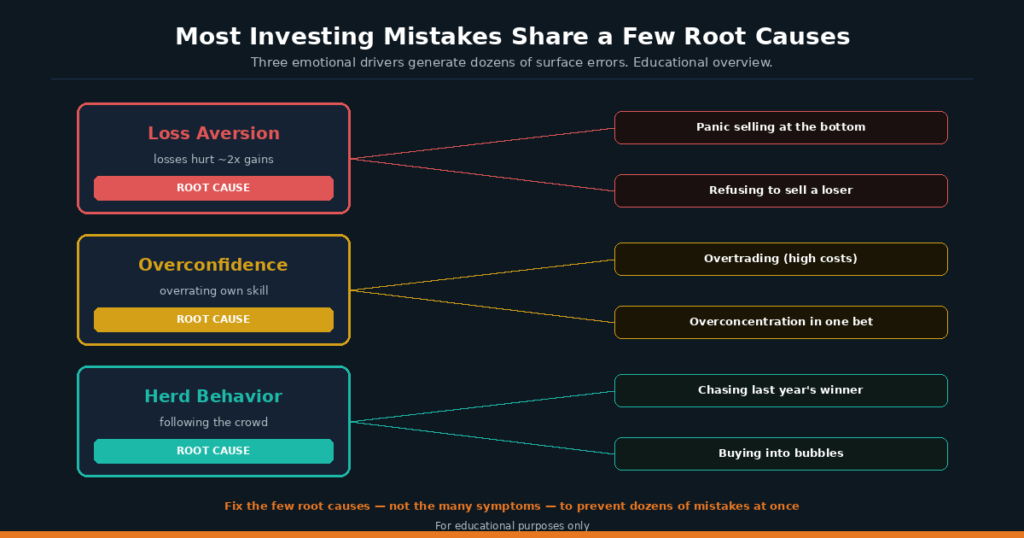
Caption: Most beginner errors trace back to a few emotional root causes — fear, overconfidence, and herd behavior — rather than being unrelated mistakes.
An investing mistake is any decision that predictably reduces long-term returns, whether or not it feels reasonable at the time. The crucial word is predictably. Random bad luck — buying before an unforeseeable event — is not a mistake. A mistake is a decision that the evidence shows tends to hurt returns, repeated by beginners because it feels right in the moment.
The reason a checklist fails is that it addresses surface behaviors instead of their source. Panic selling, performance chasing, overtrading, and refusing to sell a loser look like four separate errors. In reality, they are surface expressions of a few underlying emotional drivers. Treating each as a standalone rule means fighting the same root cause four times, badly. Understanding the root cause lets a beginner recognize the pattern before it produces yet another specific mistake.
The Behavioral Roots Beneath the Surface
Most beginner guides list mistakes without explaining what generates them. This is the gap. Behavioral finance — the study of how psychology affects financial decisions — has identified a handful of biases that produce the majority of investing errors. Loss aversion, the tendency to feel losses about twice as intensely as equivalent gains, drives panic selling and the refusal to sell losers. Overconfidence drives overtrading and overconcentration. Herd behavior drives performance chasing and buying into bubbles. Therefore, the efficient approach is to learn the few drivers, not the many symptoms.
| Surface Mistake | Behavioral Root Cause | What It Looks Like |
|---|---|---|
| Panic selling in a downturn | Loss aversion | Selling at the bottom to stop the pain |
| Chasing last year’s winner | Herd behavior + recency bias | Buying after a big run-up |
| Overtrading | Overconfidence | Frequent buying and selling, high costs |
| Refusing to sell a loser | Loss aversion (disposition effect) | Holding a falling stock hoping to break even |
| Overconcentration | Overconfidence | Too much in one stock or sector |
The Mistakes That Cost Beginners the Most
Among the surface errors, a few do disproportionate damage, and each traces to a root cause. Panic selling is the most expensive. When markets fall, loss aversion makes the pain feel unbearable, and the beginner sells to make it stop — locking in a loss and usually missing the recovery. The decision feels like protection. It is actually the single most reliable way to convert a temporary decline into a permanent loss.
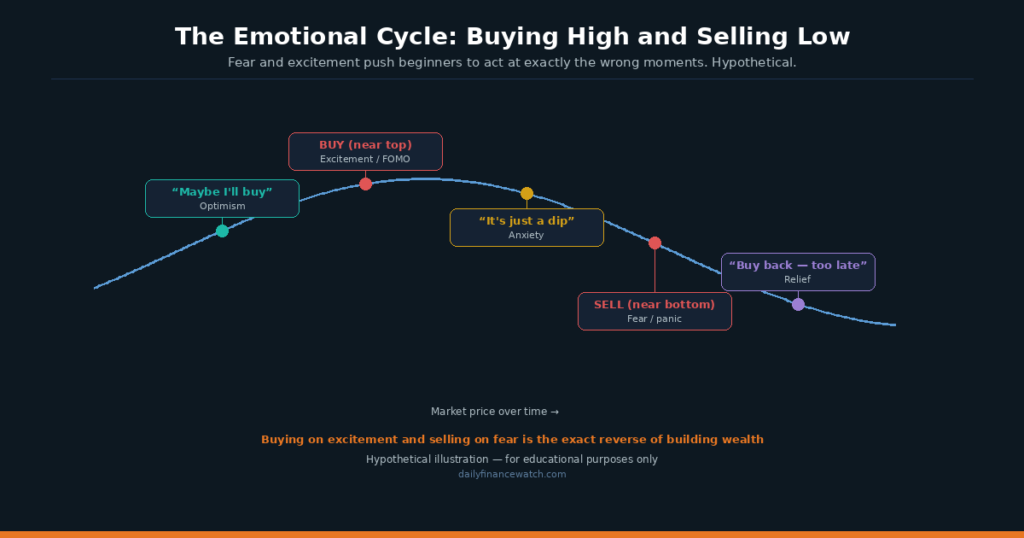
Caption: Emotional reactions push beginners to buy near peaks out of excitement and sell near bottoms out of fear — the opposite of building wealth.
Performance chasing is the mirror image. After an asset rises sharply, herd behavior and recency bias — the tendency to assume recent trends will continue — pull beginners in near the top, just as the easy gains end. The result is a cycle of buying high and selling low, driven entirely by emotion. This pattern is so common that it explains much of why average investor returns historically trail the funds those investors own.
Why Doing Nothing Is Often the Hardest Skill
The counterintuitive truth is that many investing mistakes are errors of action, not inaction. A beginner feels that good investing requires constant decisions — buying, selling, adjusting. In reality, the most damaging mistakes come from acting on emotion, while the most effective behavior is often disciplined inaction: staying invested, not reacting to headlines, not tinkering. Doing nothing feels passive and uncomfortable, which is precisely why so few beginners manage it when it matters most.
How Beginners Can Prevent These Mistakes
Because the mistakes share roots, the prevention does too. The single most effective defense is removing emotion from the moment of decision through automation and rules set in advance. An investor who automates contributions does not face the monthly choice that fear or greed would distort. An investor who decides in advance to hold through declines removes the panic-selling decision before the panic arrives. The SEC’s investor education resources at Investor.gov emphasize long-term investing over reacting to short-term market movements.
Most guides advise beginners to “control your emotions.” This advice is well-meant but nearly useless, because emotions are hardest to control precisely when they matter most — in a crash or a mania. The accurate approach is not to control emotions in the moment but to remove the in-the-moment decision entirely. Institutional investors build rules and automation specifically so that fewer decisions depend on how they feel that day. You cannot reliably out-discipline fear; you can design a system that does not ask you to.
For investors deepening this foundation, investor psychology: loss aversion and FOMO examines the two most powerful biases in detail, and why most investors underperform the market shows the measurable cost of these patterns.
A Realistic Example of the Cycle
Consider a hypothetical beginner during a market decline. Their portfolio falls 25%, loss aversion makes the loss feel intolerable, and they sell to stop further pain. The market recovers over the following year, but they wait for “clarity” and re-enter only after prices have risen — buying back higher than they sold. They then see a different stock surging, chase it near its peak out of FOMO, and watch it cool. Two mistakes, two root causes — loss aversion and herd behavior — and a portfolio worse off than if they had done nothing at all. The specific errors differ, but the drivers repeat.
What Disciplined Investors Do Instead
Smart money behavior is defined less by clever moves than by the consistent avoidance of these predictable errors. Disciplined investors automate participation, set allocation in advance, and rebalance on a schedule rather than on emotion. They expect declines as a normal feature of markets, which strips fear of its power to trigger selling. They avoid frequent trading, understanding that activity usually adds costs and taxes without adding returns.
A disciplined investor also recognizes the emotional pattern in real time. When they feel the urge to sell in fear or buy in excitement, they treat that feeling itself as a warning sign rather than a signal to act. This does not guarantee better returns, but it neutralizes the behavioral drivers that produce the most common and most costly mistakes. The edge is not prediction — it is the refusal to self-inflict the standard errors.
What you should now understand differently is how to think about investing mistakes at all. They are not a list of thirty unrelated traps to memorize. They are a handful of emotional patterns — fear, overconfidence, herd-following — wearing different costumes. Learn to recognize the few root causes, build automation and rules that remove the in-the-moment decision, and you prevent dozens of specific mistakes at once. The checklist treats symptoms; understanding the roots cures the cause.
FAQ
What is the most common investing mistake beginners make?
Panic selling during market declines is among the most common and most costly. When prices fall, loss aversion makes the loss feel unbearable, so beginners sell to stop the pain — locking in the loss and usually missing the recovery. This converts a temporary paper decline into a permanent realized loss. The mistake feels like protecting your money, but it is the opposite, because markets have historically recovered from declines over time for diversified long-term investors.
Why do beginners keep making mistakes even after reading about them?
Because most guides list surface mistakes without addressing their behavioral root causes. Knowing that panic selling is unwise does not prevent it, since the same loss aversion that causes it overrides the knowledge in the moment. The effective fix is not memorizing more rules but removing the in-the-moment decision through automation and pre-set rules. Recognizing the few emotional drivers — fear, overconfidence, herd behavior — prevents many specific mistakes more reliably than any checklist.
How can I stop my emotions from hurting my investing?
The most reliable method is not trying to control emotions in the moment but designing them out of the decision. Automate your contributions so buying happens on schedule regardless of mood. Decide in advance to hold through declines, removing the panic-selling choice before fear arrives. Rebalance on a fixed schedule rather than reacting to markets. These systems work because they reduce how many decisions depend on how you feel, which is when mistakes happen.
This content is for educational purposes only and does not constitute personalized financial advice. All investing involves risk, including the possible loss of principal.