Last updated: July 4, 2026
Two accounts can advertise “daily compounding” as if that alone makes one meaningfully better than a competitor compounding monthly. In practice, the compounding frequency contributes far less to your APY rate than most people assume — the nominal interest rate does almost all of the work.
What APY Actually Measures
Annual percentage yield (APY) is a standardized rate that reflects the total interest an account would earn over one year, accounting for compounding. Unlike a simple stated interest rate, APY already factors in how often interest is added back into the balance and begins earning its own interest. The Truth in Savings Act of 1991, implemented through the Federal Reserve’s Regulation DD, requires depository institutions to disclose the APY on virtually all deposit accounts.
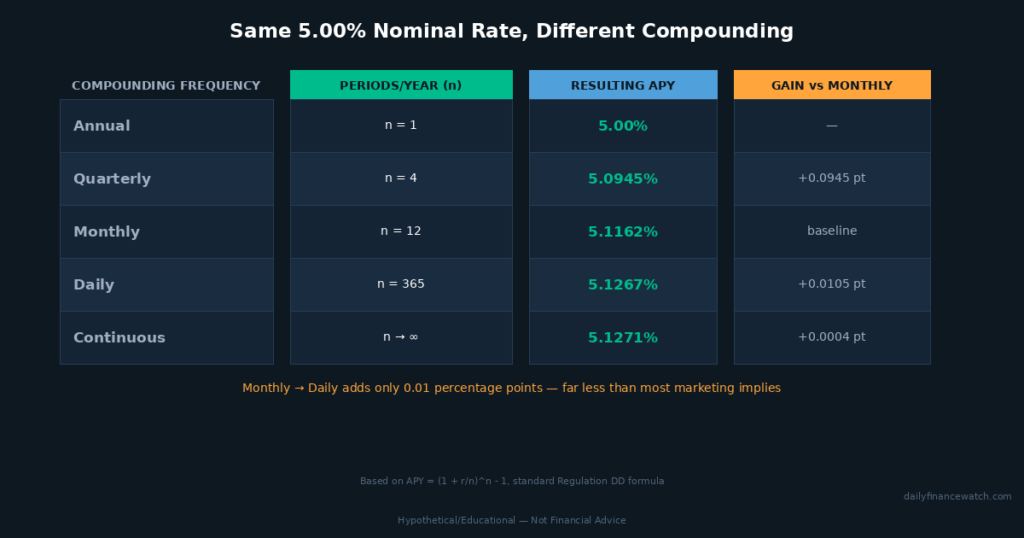
A comparison chart showing how the same nominal interest rate produces different APY rates at monthly, daily, and continuous compounding frequencies.
The regulation defines annual percentage yield as a percentage rate reflecting the total amount of interest paid on an account, based on the interest rate and the frequency of compounding for a 365-day period. You can review the full text at the Federal Reserve’s Regulation DD compliance guide.
The APY Formula
The standard formula converts a nominal interest rate into an annualized yield: APY = (1 + r/n)^n − 1, where r is the nominal annual rate and n is the number of compounding periods per year. When n equals 1 — annual compounding — APY and the nominal rate are identical. As n increases, APY rises above the nominal rate, though the size of that increase shrinks with each additional compounding period.
Why More Frequent Compounding Adds Less Than Expected
Here is the mechanism behind the thesis. A 5.00% nominal rate compounded monthly produces an APY of approximately 5.12%. The same 5.00% rate compounded daily produces an APY of approximately 5.13%. The jump from monthly to daily compounding adds only about one-hundredth of a percentage point. Moving from daily to continuous compounding adds even less. This is why most banks settle on daily compounding for savings products — the computational cost of finer compounding intervals delivers a diminishing, and eventually negligible, return.
The Experience Anchor: A Real Regulatory Calculation
Regulation DD’s official text includes worked examples that show exactly how this plays out. Under 12 CFR Part 1030, Appendix A, one example describes a $1,000 six-month certificate of deposit paying a 5% interest rate, compounded daily, for the first three months (91 days), followed by a 5.5% interest rate, compounded daily, for the next three months (92 days). The total interest earned over the six months comes to $26.68. Applying the annualization formula, the resulting annual percentage yield is 5.39%. This calculation appears verbatim in the eCFR’s Truth in Savings text as the regulatory standard every institution must follow.
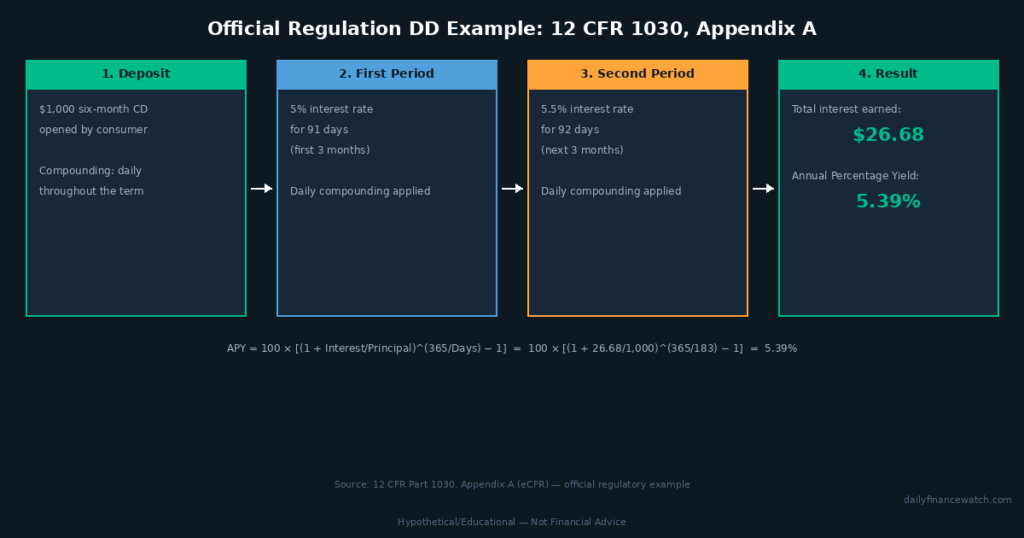
A step-by-step visual breakdown of the official Regulation DD example: a stepped-rate CD calculation resulting in a 5.39% annual percentage yield.
Notice what drives this result. The compounding frequency stayed constant — daily — throughout the example. What determined the final yield was the change in nominal rate from 5% to 5.5%, not any change in how often interest compounded. This is a clean illustration of the thesis: rate changes move the yield far more than compounding-frequency changes do.
How to Actually Compare Two Accounts
Because APY already incorporates compounding, it is the only number that matters when comparing deposit accounts head to head. A 12-month CD advertising 5.10% APY will pay more than one advertising 5.05% APY, regardless of whether either institution compounds daily, monthly, or some other way. The underlying compounding schedule has already been folded into that single percentage. Comparing raw nominal rates instead of APY figures risks favoring an account that only appears more generous.
APY vs. APR: Not Interchangeable
APY and APR measure different things and apply to different products. Annual percentage rate (APR) typically describes the cost of borrowing — loans and credit cards — while APY describes what a deposit earns. APR generally does not incorporate intra-year compounding the way APY does, which is one reason a 5.00% APR loan and a 5.00% APY savings account do not represent the same effective rate. Mixing the two terms when comparing products produces a distorted picture of the actual cost or return involved.
Where APY Applies
APY governs disclosure for savings accounts, money market accounts, and certificates of deposit. Our guides on high-yield savings accounts, certificates of deposit, and money market accounts each reference the APY figure as the standard comparison metric, since Regulation DD requires all three product types to display it consistently. Variable-rate accounts must also disclose that the rate and APY may change, along with how the rate is determined.
What APY Assumes — and What It Does Not Guarantee
The published APY assumes that principal and all accrued interest remain on deposit for the full term, with no withdrawals during that period. A withdrawal before the assumed term ends can reduce actual earnings below what the advertised APY implies. APY also does not account for fees, which can reduce the effective return regardless of how attractive the advertised figure looks. Reading the account disclosure alongside the APY figure clarifies whether any conditions apply to earning the full advertised rate.
The Anti-Advice Reminder
A high APY rate is only one factor in choosing where to hold cash. Minimum balance requirements, monthly fees, withdrawal limits, and the safety of deposit insurance all affect the real value of an account beyond the headline percentage. An account with a slightly lower APY but no fees and full liquidity may outperform a higher-APY account with restrictive terms, depending on your specific situation. Before opening any deposit account based on its advertised rate, review the full disclosure for minimum balance rules, fee structures, and any conditions attached to earning the stated yield.
Comparing accounts by their APY figure, rather than a bank’s marketing language about compounding frequency, is the more reliable way to evaluate a deposit offer. The nominal rate is doing nearly all the work behind that percentage — compounding frequency is a much smaller factor than the marketing usually implies.
This article is for educational purposes only and does not constitute financial advice. APY rates and account terms are variable and subject to change.
© 2026 Daily Finance Watch. All rights reserved.