Last updated: July 3, 2026
The term blue chip sounds like an official rating. It is not. No exchange, regulator, or rating agency certifies a company as blue chip. Instead, the label describes shares of large, established firms with long records of stable earnings. Investors borrowed the phrase from poker, where blue chips traditionally carry the highest value.
This article explains what the blue chip label means in practice. It also covers the traits investors usually attach to it. More importantly, it shows why the label can disappear without notice. Intel wore it for 25 years, until an index committee decided otherwise in November 2024.
What Does Blue Chip Mean?
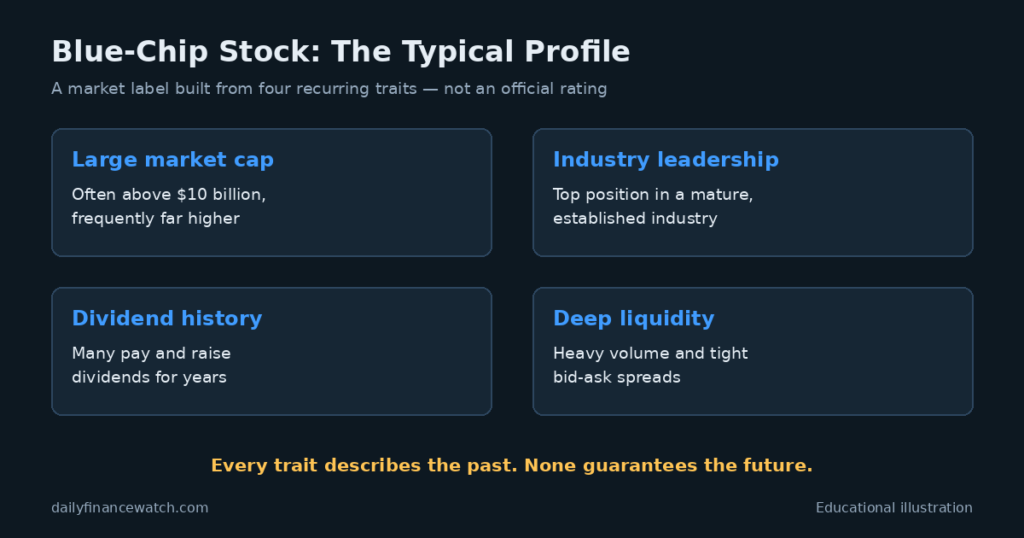
Common blue chip traits, shown as descriptions of the past, not guarantees.
A blue-chip stock is a share in a large, well-known company with a long record of dependable performance. The SEC’s Investor.gov education pages describe blue-chip stocks as shares in large, well-known companies with a solid history of growth. Notably, that description mentions reputation and history, not any formal test. The market applies the label by consensus, and consensus can shift.
The name itself comes from the poker table. Blue chips historically carried the highest value in a standard chip set. Dow Jones company lore credits employee Oliver Gingold with attaching the phrase to high-priced stocks in the 1920s. Over time, the meaning drifted from high price toward high quality. That informal origin explains why no precise definition ever followed the label.
In the United States, the Dow Jones Industrial Average serves as the best-known shorthand for the group. The index holds 30 large companies chosen by a committee at S&P Dow Jones Indices. However, Dow membership is a curated list, not a certification. Companies join and leave whenever the committee votes, which matters for the story below.
Common Traits Investors Look For
No single rule defines the group, but most candidates share a familiar profile. First, they carry large market capitalizations, often above $10 billion and frequently far higher. Second, they hold leading positions in mature industries. Third, many pay dividends and have raised them for years. Finally, their shares trade with heavy volume and tight bid-ask spreads.
Beginners sometimes treat this profile as a safety checklist. That reading goes too far. The traits describe a company’s past, and the past is the only thing they can describe. A firm can satisfy every item on the list while its core business quietly erodes. Size and reputation slow decline; they do not prevent it.
Why Blue Chip Status Can Disappear
Blue chip status is a revocable market label, not a protected title. Nobody grants it officially, so nobody has to withdraw it formally. In practice, the market signals the change through falling prices, reduced dividends, or index removals. Each signal tends to arrive without warning or appeal. A reputation that took decades to build can also fade slowly and invisibly. Investors who anchor on the label may hold a declining business far too long. For that reason, seasoned analysts track the underlying numbers each quarter instead of the nickname.
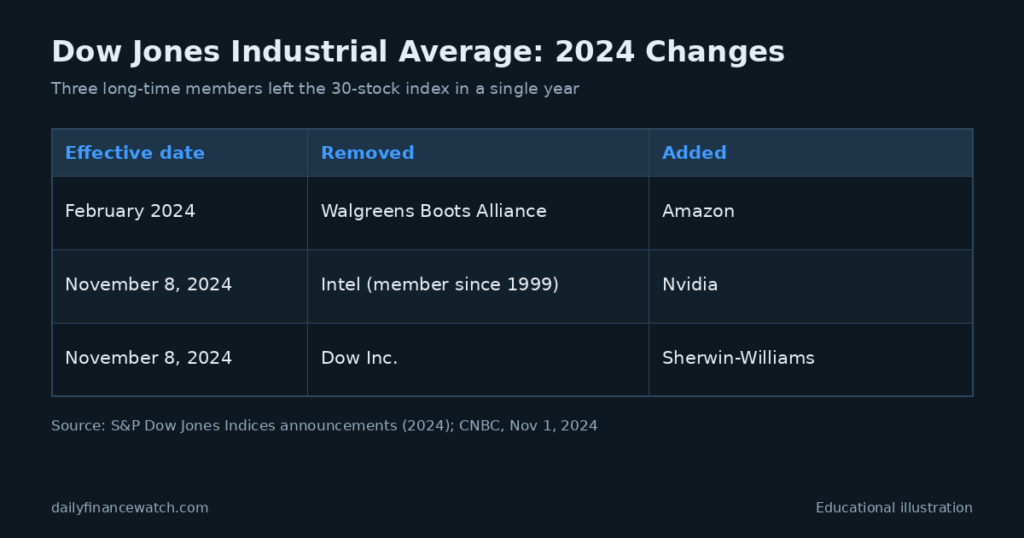
Three long-time Dow members left the index during 2024 alone.
Index committees make the clearest version of that call. During 2024, the Dow’s committee swapped out three long-time members. In February 2024, Amazon replaced Walgreens Boots Alliance. Then, in November 2024, the committee removed Intel and the chemical firm Dow Inc. in a single announcement. Each departing firm had matched the classic blue-chip profile for decades.
Removal from a headline index also carries mechanical consequences. Index funds tracking the Dow must sell the departing stock and buy the replacement. Consequently, the label’s loss shows up directly in trading volume on the effective date. For long-term shareholders, though, the deeper issue is what the removal says about the business itself.
Case Study: Intel Leaves the Dow in 2024
On November 1, 2024, S&P Dow Jones Indices announced that Nvidia would replace Intel in the Dow. The change took effect on November 8, 2024. Intel had held its seat since 1999, a run of 25 years. According to the committee, the swap gave the index more representative exposure to the semiconductor industry.
The numbers behind the swap tell the story. According to CNBC’s November 1, 2024 report, Intel shares had fallen more than 50% during 2024. Nvidia shares, by contrast, had climbed over 170% that year. That surge lifted Nvidia’s market value to roughly $3.3 trillion. Meanwhile, Intel had announced plans to cut about 16,500 jobs. The label followed the fundamentals, not the seniority.
One detail deserves a closer look. Nvidia only became a practical candidate after its 10-for-1 stock split in May 2024. The Dow weights members by share price, so a four-digit stock would have distorted the index. In other words, even entry into the club depends partly on mechanics, not merit alone.
How to Evaluate a Large, Established Company
Treat the label as a starting point for research, not a conclusion. Check whether revenue and profit margins still grow, or merely persist. Read the dividend history alongside the payout’s share of earnings. Additionally, compare the firm against the competitor most likely to displace it. Intel’s case shows how fast that comparison can flip. Public companies file audited financial statements with the SEC every quarter and year. Those filings, not headlines, hold the numbers this comparison requires.
Nothing in this article recommends buying, selling, or avoiding any company or index. Blue-chip labels, Dow membership, and dividend streaks are descriptive facts, not signals to act. Every investor faces different taxes, time horizons, and risk limits, and this site cannot know yours. Before making decisions, verify current data through official filings. Consider speaking with a licensed financial professional as well. Treat every example here, including Intel and Nvidia, as history used strictly for education.
The takeaway mirrors the opening point. Blue chip describes a reputation the market has granted and can quietly take back. Intel’s 25-year Dow run ended with a press release, not a ceremony. Judge companies by their current numbers, because the label always trails the facts.
Related Articles
Frequently Asked Questions
Is there an official list of blue-chip stocks?
No. No regulator or exchange maintains an official blue-chip list. Investors often use the 30 members of the Dow Jones Industrial Average as an informal proxy. However, an index committee chooses those members, and the lineup changes. During 2024, the committee replaced Walgreens, Intel, and Dow Inc., showing how quickly the informal list moves.
Do blue-chip stocks always pay dividends?
Many do, but a dividend is not required. The label reflects size, reputation, and earnings history rather than any payout rule. Some large, established companies retain profits to fund growth instead. Others pay dividends for decades and still lose the label when their business weakens. Always check a company’s current dividend policy in its filings.
Can a blue-chip company still fail?
Yes. Size and reputation reduce risk, yet they cannot remove it. Well-known companies have suffered severe declines, dividend cuts, and even bankruptcy. Intel kept its strong reputation for years while its shares fell more than 50% in 2024. Diversification remains the standard way investors limit exposure to any single company.
This article is for educational purposes only and does not constitute financial advice.
© 2026 Daily Finance Watch. All rights reserved.